
Why Repetition Alone Does Not Build Transferable Golf Skill
Overview
Repetition helps golfers become more familiar with a movement, but repetition alone does not guarantee transfer to the course.
Indoor golf practice transfers better when repetition includes slope, target context, decision-making, and meaningful feedback.
This is why indoor golf needs to evolve from practice volume into training design. A player who repeats shots from a flat mat can build a stable indoor pattern, yet still struggle when the course asks for adaptation.
The article explores the key concepts behind why traditional practice may be failing to translate learning to the course. It then identifies steps players and coaches can take to create more representative learning environments to develop adaptable skills.
Written by: Will Stubbs, Head of Education, Zen Golf
Last Updated: 18/05/2026
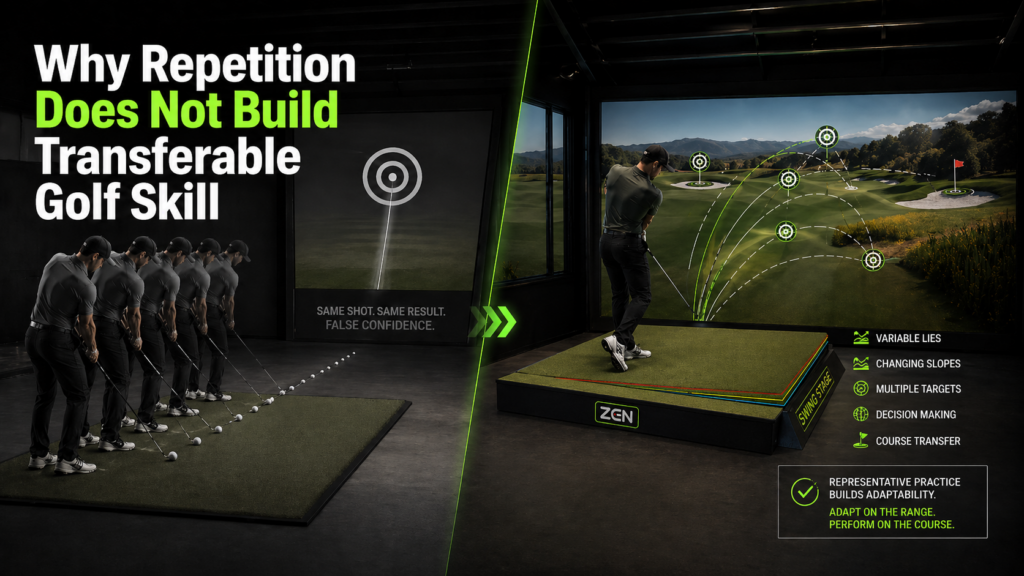
Why Flat Repetition Creates False Confidence
Flat repetition gives the player a stable problem. The stance does not change, the ground does not change, the target often stays similar, and the feedback appears quickly.
That structure helps calibration. It also risks overfitting the player to a narrow task.
As golfers we need to adapt to the variety of the course and find solutions that work for how we see the game. That comes through experience solving those problems. Therefore we need our practice to recreate that experience for us to learn properly.
Indoor practice often removes many of the factors that are crucial for performance on the course. The player receives clean lies, stable footing, repeated targets, and instant enriched feedback. This makes practice easier to organize, but it can reduce the representativeness of the task.
Zen’s Trackman × Zen integration addresses this problem by connecting Trackman simulator course data with Zen’s active slope platforms. The physical ground beneath the player changes to match the lie shown in the simulator, while Trackman captures the ball and club data from that representative condition.
This helps prepare the player for the course, not just for the simulator bay.
Transfer Needs Representative Constraints
A representative practice task preserves the information the player needs in performance. The player needs to perceive the lie, manage the ground, choose the shot, and read the outcome.
Research on slopes in golf supports this practical concern. Blenkinsop and colleagues connected uphill and downhill slopes to weight transfer, alignment, and shot outcome.
Li and colleagues reported that slope restricted body center-of-gravity movement in amateur golfers, which may affect weight movement and performance parameters.
These studies do not mean every session must be difficult. They show why the ground belongs in the learning design when the goal is learning transfer.
Repetition Still Has a Role
Repetition helps the player stabilize a useful response. The key is choosing what the player repeats.
- A player repeating 40 7-irons from a flat mat to the same target repeats one problem.
- A player repeating 40 approach shots across flat, uphill, downhill, and sidehill lies repeats the skill of adapting.
That distinction matters for on-course performance. The goal is not random variation for its own sake, but useful variation that teaches the player to organize behavior around golf-like information.
Data Needs Context
Launch monitor data becomes more meaningful when the environment is representative.
A player’s angle of attack, face-to-path, launch, spin, and carry distance may look different from a flat lie compared with an uphill or downhill lie.
If coaches only measure the flat version, they risk overestimating how stable the player’s movement is.
The articles in the wider Trackman × Zen series showcase how that ecosystem support skill development, covering topics like: slope-based combine testing, GIR testing on slopes, key Trackman metrics on slopes, swing tendencies on slopes, and data misinterpretation in golf.
Together, they support a simple point: data needs context before it can guide transfer.
Coach Application
A coach can redesign a repetition-based session by adding one representative constraint.
|
Old Session |
Transfer-Based Version |
|
50 7-irons from flat |
5 sets of 8 balls from varied side slopes |
|
Same target every shot |
3 target zones |
|
Full feedback after every ball |
Feedback after each set |
|
Outcome judged by best shots |
Outcome judged by pattern |
This keeps structure while adding the variability and nurturing the self-awareness needed for adaptation.
Player Application
Players should ask a simple question after practice.
“Did this session prepare me for a shot I actually face on the course?”
If the answer is no, the session may still have value, but it should not be mistaken for transfer training.
Zen Relevance
The Trackman x Zen Golf Integration Explained article shows how visual simulation, physical slope, and performance data can relate to the same shot. This allows the coach to interpret launch monitor data within a representative environment.
Zen Swing Stage introduces environmental load for full-swing coaching. Zen Green Stage introduces environmental load for putting and green reading. Zen Golf Stage connects full-swing and putting tasks when the session needs whole-game realism.
Key Takeaways
Repetition helps skill when the repeated task contains the information the player needs in performance.
Flat repetition can improve calibration, yet it may not prepare the player for slope, lie, stance, and decision-making demands.
Transfer improves when the practice environment includes representative constraints.
Zen’s moving floors help coaches repeat the right problem, not only the same swing.
Read Flat vs Sloped Practice: What Really Transfers and Closing the Practice Gap with Trackman and Zen Swing Stage to connect this article with Zen’s wider transfer-focused education pathway.
