
Indoor Golf Practice as Training: Designing Skill Adaptation Like a Gym Program
Overview
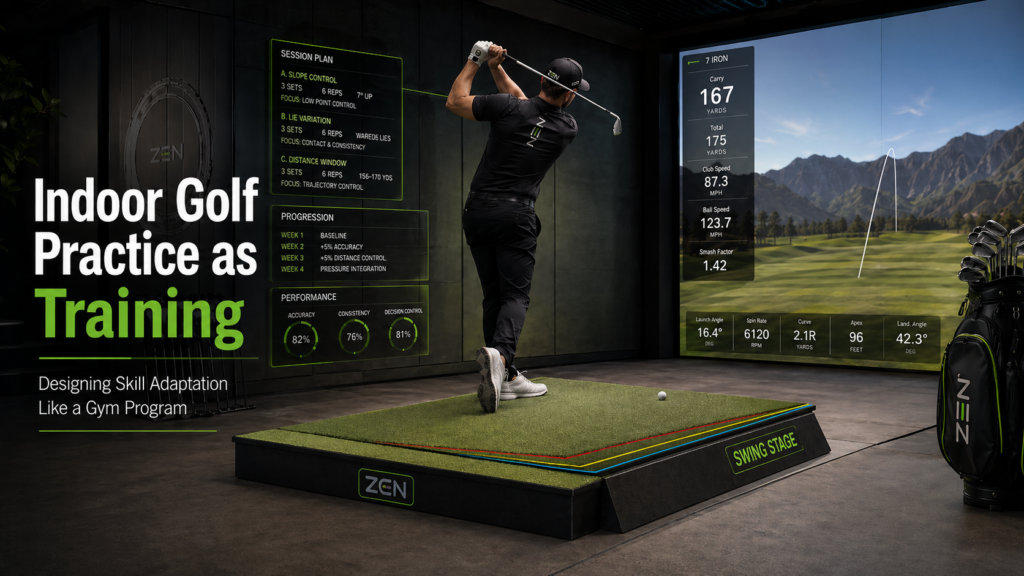
Indoor golf practice becomes more valuable when coaches and players structure it as training for skill adaptation. The session needs a goal, a planned level of challenge, a way to measure response, and a clear reason to increase or reduce difficulty.
A gym program uses load, reps, sets, recovery, and progression to create physiological adaptation. A golf training program uses slope, lie, club, target, scoring pressure, launch monitor feedback, heart rate variability (HRV), and strokes gained priorities to create skill adaptation.
The Indoor Golf Practice Series gives the wider context for this approach. Zen Green Stage, Zen Swing Stage, and Zen Golf Stage support indoor sessions where the ground, the data, and the training goal relate to the realism of the on-course shot.
Written by: Will Stubbs, Head of Education, Zen Golf
Last Updated: 11/05/2026
Confidence Vs Context in Indoor Golf Practice
Indoor practice often gives players confidence from conditions that do not match the golf course. A player hits good shots from a flat mat, sees strong launch monitor numbers, then struggles when the ball sits above the feet, the lie is downhill, or the shot requires a different trajectory.
The issue is usually the practice environment rather than the player’s effort. Flat, repeated, low-variability practice builds solutions for flat, repeated, low-variability tasks.
Zen’s Flat vs Sloped Practice: What Really Transfers article explains why transfer depends on more than repetition. When the ground changes balance, aim, posture, delivery, and start line, the player faces a different task.
From Practice to Training
Most golfers understand physical training more clearly than skill training.
A personal trainer does not usually tell a client to “do some exercise.” They prescribe a session that has an objective, a warm-up, working sets, rest periods, progression, and a way to measure response.
Golf practice often lacks that structure. A player hits balls, changes clubs, reacts to good and bad shots, then leaves with a vague impression of whether the session went well.
Training changes the question.
From:
“Did I hit good shots today?”
To:
“What adaptation was this session designed to create?”
Repetition matters, but repetition without changing constraints risks building a skill that only works in one narrow environment.
The Zen Swing Stage Coaching Tips guide shows how coaches use uphill, downhill, sidehill, and compound lies to challenge balance, sequencing, strike, shot selection, and data interpretation in a more representative setting.
Skill Adapts Through Constraints
Karl Newell’s constraints model gives coaches a useful way to design indoor practice. Skill emerges from the interaction between the individual, the task, and the environment, rather than from one isolated movement pattern. Newell’s original constraints chapter remains a foundational reference for this way of understanding coordination and motor learning.
In golf, those constraints include:
| Constraint Type | Golf Example | Indoor Training Application |
| Individual | Strength, mobility, confidence, fatigue, skill level | HRV, readiness, player profile |
| Task | Club, target, shot shape, distance, score, consequence | Launch monitor test, wedge ladder, combine |
| Environment | Slope, lie, stance, surface, visual context | Zen Green Stage, Zen Swing Stage, Zen Golf Stage, Trackman |
When one constraint changes, the movement solution changes.
A flat 7-iron to a target does not ask the same question as a 7-iron from a ball-below-feet lie. The club, target, and player remain similar, yet the ground changes how the player balances, orients, aims, swings, and interprets feedback.
Golf-specific research supports this point. Li and colleagues examined amateur golfers swinging from different slopes and reported that slope restricted body center-of-gravity movement and influenced performance parameters compared with flat ground.
Blenkinsop and colleagues also studied uphill and downhill golf shots and connected slope to changes in weight transfer, alignment, and shot outcome.
The Three Phases of Skill Adaptation
Otte, Millar, and Klatt’s PoST framework builds from this ecological view of skill development. Their work presents skill training periodization as a practical way to plan learning over time, rather than treating skill practice as isolated drills. The framework draws on Newell’s three stages of motor learning: skill coordination, skill control, and skill optimization.
For indoor golf, those stages translate into how we can periodize sessions for adaption and transfer to on-course performance.
Coordination
The player explores movement solutions, and variability is expected. The goal is to help the player perceive the constraints and begin organizing movement around it.
A coordination session might expose a player to uphill, downhill, sidehill, and compound lies with low scoring pressure. The coach watches how the player searches, balances, and adjusts.
Control
The player begins to stabilize a solution under a defined constraint. Variability still exists, yet the pattern becomes more organized.
A control session might keep the player on one slope category, such as ball above feet, while changing target direction or club. The goal is to maintain a functional shot pattern while the task remains demanding.
Skill Optimization
The player adapts the solution to changing performance contexts. The environment becomes more representative. Scoring, decision-making, club selection, and consequence become part of the task.
A skill session might use simulator course play, one-ball scoring, random lies, and post-shot reflection. This is where indoor practice begins to look more like golf.
The Trackman x Zen Golf Integration Explained page shows how this applies indoors. The integration links Trackman simulator course data with Zen’s active slope platforms, so the physical ground beneath the player matches the lie shown in the simulator before the shot is played.
Skill Load: The Golf Version of Training Load
In gym training, load drives adaptation. Load might be weight, tempo, range of motion, volume, or density.
In golf training, skill load comes from the constraints placed on perception, balance, coordination, decision-making, and execution.
| Skill Load Variable | Low Load | Medium Load | High Load |
| Ground | Flat lie | Single slope | Compound slope |
| Shot order | Blocked | Serial | Random |
| Target | One target | Target zones | Course scenarios |
| Feedback | Immediate full data | Selected data | Delayed review |
| Pressure | No score | Target score | One-ball consequence |
| Readiness | High recovery | Normal | Fatigue or stress present |
Zen Swing Stage creates full swing skill load through slope, stance variability, and ground interaction. Zen Green Stage creates putting skill load through real gradients, green reading, pace, entry speed, and stroke adaptation. Zen Golf Stage connects full swing and putting into a whole-game indoor environment.
This changes the learning problem. The player is not learning only about slope. They are standing on it, reading it, balancing against it, and striking from it.
Embracing this concept moves the learner and coach away from a Knowledge About to a Knowledge Of, whereby learning and hence our knowledge is developed in context of the on-course experience, rather than theoretically.
Challenge Point: Matching Difficulty to the Player
The Challenge Point Framework states that learning depends on the relationship between task difficulty and the player’s current skill level. A task that is too easy creates limited learning. A task that is too difficult creates noise that makes useful organization harder.
A 5-handicap player and a 20-handicap player should not receive the same slope, target, club, scoring rule, and feedback demand. A player with high readiness and stable strike patterns should not receive the same session as a fatigued player with chaotic dispersion.
The Zen article on The 70 Percent Rule in Golf Practice with Zen Golf gives coaches a practical way to think about this learning zone. The target is a task difficult enough to demand adaptation, yet clear enough for the player to keep solving.
This is where data supports lesson design, structure and planning.
HRV, Launch Monitor Data, and Strokes Gained
A training system needs task design and regulation. Heart rate variability (HRV), launch monitor data, and strokes gained help the coach decide whether the current challenge is appropriate.
Three data sources help regulate the challenge point.
HRV Shows Readiness
Heart rate variability provides insight into training status, recovery, and readiness.
Strength and conditioning literature uses HRV as one monitoring input for training status, adaptability, and recovery. It should not dictate the session alone.
Athlete-monitoring literature often uses root mean square of successive differences (RMSSD) as a field-based HRV metric, with interpretation based on trends and context rather than single readings.
For golf, HRV should not dictate the session. It should inform the starting load.
| HRV Trend | Session Implication |
| Above Baseline | Progress complexity, add randomization, increase slope challenge |
| Normal Baseline | Train planned session |
| Below Baseline | Reduce volume, lower slope severity, focus on calibration or control |
A player with low readiness might still train well, but the coach should avoid treating that session like a maximum-load adaptation day.
Launch Monitor Data Shows Behavior
Launch monitor data becomes representative when it is interpreted in relation to the on-course constraints.
Trackman data from a flat mat tells one story, while the same metrics data from an uphill lie, downhill lie, or sidehill lie tells a different story because the player’s balance, delivery, launch, spin, and strike pattern are shaped by the ground.
The Trackman × Zen Integration Explained articles make this relationship clear: performance data becomes more meaningful when visual simulation, physical slope, and launch monitor feedback are synchronized to the same shot.
Relevant measures include:
| Measure | What It Helps Regulate |
| Start Line | Face control and aim response |
| Carry Distance | Distance control under constraint |
| Lateral Dispersion | Shot pattern width |
| Front-To-Back Dispersion | Distance control and strike |
| Face-To-Path | Delivery response |
| Attack Angle | Slope-specific delivery adaptation |
| Strike Quality | Contact under changing balance |
Trackman’s official definitions provide useful reference points for terms such as attack angle, face-to-path, carry, and launch direction. Zen’s article on Key Trackman Metrics On Slopes then shows how those metrics change meaning when the player trains from real gradients.
Strokes Gained Highlights Practice Priorities
Strokes gained helps decide where adaptation should be targeted. Broadie’s original strokes gained work reframed golf performance by comparing each shot against expected scoring outcomes, rather than judging every shot in isolation.
If a player is losing strokes on approach shots, the training plan should not be dominated by driver speed. If a player loses strokes around the green, wedge play, slope interaction, landing zone control, and putting start line might deserve more training time.
Arccos data gives useful GIR x distance per handicap expectation anchors. Its 2024 article reported that different handicap levels reach a 50 percent green-hit rate from different approach distances: 20-handicap players from 92 yards, 15-handicap players from 110 yards, 10-handicap players from 129 yards, 5-handicap players from 147 yards, and scratch players from 165 yards.
That type of benchmark helps players set practice tasks that match their current scoring reality.
Benchmarks For Challenge Point
Benchmarks help players avoid two common mistakes. The first is expecting tour-level precision from amateur patterns. The second is accepting poor patterns because the player lacks a reference point.
The following tables should be used as training anchors, not fixed standards.
The GIR data has stronger external support than the lateral dispersion bands. Public, club-specific lateral dispersion by handicap is still limited, so the dispersion bands below should be treated as coach-calibrated starting points and refined using each player’s own launch monitor baseline.
GIR Benchmarks by Handicap
Shot Scope data reported by Golf Monthly showed scratch golfers hitting 59 percent of greens in regulation, 10-handicap golfers hitting 32 percent, and 20-handicap golfers hitting 14 percent.
| Handicap | GIR Benchmark | Training Meaning |
| Scratch | 62% | Strong approach control |
| 5 | 46% | Strong amateur pattern control |
| 10 | 35% | Train playable shot patterns |
| 15 | 23% | Prioritize target size and club choice |
| 20 | 16% | Prioritize contact and decision quality |
| 25 | 9% | Simplify task and build strike pattern |
These numbers help regulate player and coach performance expectations. A 10-handicap player does not need to judge every 7-iron by whether it finishes close to the pin. The task should train a playable pattern that improves GIR, proximity, and decision-making from realistic lies.
Official PGA TOUR GIR rankings provide a tour reference, although tour benchmarks should not be used as normal amateur expectations.
Coach-Calibrated Dispersion Bands
Public, club-specific lateral dispersion by handicap is limited. The following bands should be treated as coach-calibrated starting points, then refined using each player’s own launch monitor baseline.
7-Iron Dispersion Bands
| Handicap | Suggested Dispersion Band | Challenge Point Interpretation |
| Scratch | ~15 yards | Increase load when pattern stays inside this band |
| 5 | ~18 yards | Maintain or progress with slope |
| 10 | ~22 yards | Train pattern control before pin seeking |
| 15 | ~27 yards | Simplify target and build strike pattern |
| 20+ | ~35+ yards | Lower complexity until pattern emerges |
A 10-handicap challenge point might be a 7-iron pattern that stays inside 18 to 30 yards laterally while the player works from a mild side slope. If the same player produces a 45-yard spread with no predictable bias, the task is likely too difficult.
Driver Dispersion Bands
| Handicap | Suggested Lateral Dispersion Band | Challenge Point Interpretation |
| Scratch | 20 to 30 yards | Progress with narrower fairways or slope |
| 5 | 30 to 40 yards | Maintain pattern and test pressure on different hole shapes |
| 10 | 40 to 55 yards | Train playable start line and curvature |
| 15 | 55 to 70 yards | Reduce pressure, identify dominant miss |
| 20+ | 70+ yards | Simplify task and build contact first |
These bands are not performance claims, but should be used as planning tools. The coach compares the player’s pattern with their own baseline, then decides whether to increase, hold, or reduce difficulty.
The Challenge Point Decision Rule
Using these data points we can now create some principles as heuristics that support decision making and guide the manipulation of constraints to optimize learning within the session.
| Data Response | Training Interpretation | Session Adjustment |
| Dispersion tighter than benchmark with stable strike | Task too easy | Increase slope, randomize target, add scoring |
| Dispersion within benchmark with visible pattern | Useful challenge | Maintain load or progress slightly |
| Dispersion outside benchmark with a pattern | Challenging but informative | Hold task and coach decision-making |
| Dispersion outside benchmark with no pattern | Task too difficult | Reduce slope, simplify club or target |
| HRV below baseline and pattern unstable | Low readiness plus high complexity | Reduce volume and focus on calibration |
This makes challenge point visible. The coach observes the player’s behavior, compares it with realistic expectations, then changes the task.
Session Design: The Indoor Golf Training Template
Every session follows four phases.
| Phase | Purpose | Golf Equivalent |
| Calibration | Establish readiness and baseline | Warm-up, flat and mild slope shots |
| Working sets | Target the adaptation | Constraints, reps, rest, data |
| Transfer block | Connect to play | Random lies, scoring, simulator holes |
| Reflection | Guide next session | Notes, benchmark comparison, load decision |
This structure mirrors gym programming. The difference is the load source. Instead of adding weight to a bar, the coach changes slope, lie, target, scoring rule, club, and feedback.
Session Template 1: Coordination Session
Primary adaptation: Exploration
Best for: New slope exposure, movement discovery, early off-season work
Total time: 60 minutes
Products: Zen Swing Stage, Trackman integration
Data focus: Strike, carry, start line, pattern notes
HRV adjustment: Reduce total volume by 20 percent if HRV is below baseline
| Block | Time | Sets And Reps | Constraint | Coach Focus |
| Calibration | 10 min | 20 balls | Flat to mild random slopes | Notice balance and strike |
| Exploration set 1 | 8 min | 2 x 6 balls | Uphill lie | Allow searching |
| Exploration set 2 | 8 min | 2 x 6 balls | Downhill lie | Observe trajectory response |
| Exploration set 3 | 8 min | 2 x 6 balls | Ball above feet | Observe start direction, posture and strike |
| Exploration set 4 | 8 min | 2 x 6 balls | Ball below feet | Observe start direction, posture and strike |
| Random block | 13 min | 18 balls | Random slopes | Identify emerging pattern |
| Reflection | 5 min | Notes | Player report | Record easiest and hardest lies |
Progression rule: Progress to control training when the player identifies the constraint and produces a repeatable pattern on at least two slope types. This section connects naturally with Zen’s article on Understanding Swing Tendencies on Slopes.
Session Template 2: Control Session
Primary adaptation: Stabilization
Best for: Building repeatable performance under one constraint
Total time: 60 minutes
Products: Zen Swing Stage, Trackman integration
Data focus: Lateral dispersion, carry dispersion, face-to-path, strike
HRV adjustment: Keep slope constant and reduce target switching if HRV is below baseline
| Block | Time | Sets And Reps | Constraint | Target |
| Calibration | 8 min | 12 balls | Mild side slope | Baseline dispersion |
| Working set 1 | 7 min | 8 balls | Ball above feet | Centre target |
| Working set 2 | 7 min | 8 balls | Ball above feet | Left target zone |
| Working set 3 | 7 min | 8 balls | Ball above feet | Right target zone |
| Working set 4 | 7 min | 8 balls | Ball above feet | Random target zones |
| Transfer block | 16 min | 12 balls | Ball above feet varied severity, one-ball scoring | GIR handicap zone |
| Reflection | 8 min | Review | Compare to benchmark | Decide next load |
Progression rule: If dispersion sits tighter than the player’s benchmark for two sets, increase target complexity or slope. If dispersion exceeds the benchmark with no clear pattern, reduce target complexity before reducing slope. The Key Trackman Metrics on Slopes article supports this data-led control theme.
Session Template 3: Skill Session
Primary adaptation: Adaptability
Best for: Translating movement solutions into realistic play
Total time: 60 minutes
Products: Zen Swing Stage, Trackman integration
Data focus: GIR, strokes gained, scoring, club decision, pattern stability
| Block | Time | Sets And Reps | Constraint | Score |
| Calibration | 5 min | 8 balls | Mixed mild slopes | No score |
| Scenario set 1 | 8 min | 6 balls | Par-3 | GIR handicap zone |
| Scenario set 2 | 8 min | 6 balls | Uneven fairway lies | Strokes Gained proximity band |
| Scenario set 3 | 8 min | 6 balls | Recovery approach lies | Playable miss |
| Scenario set 4 | 8 min | 6 balls | Wedge play on random slopes | Distance window |
| Pressure block | 15 min | 18 balls | Random lies on Performance Center approach play | Strokes Gained score vs handicap |
| Reflection | 8 min | Review | Strokes gained priority | Choose next session |
Progression rule: Progress when the player keeps decision quality stable while the lie changes. Good outcomes matter, yet decision stability is the stronger transfer marker. Zen’s article on GIR Testing on Slopes for Real Golf Performance connects this type of session design to scoring outcomes.
Session Template 4: Transfer Test Session
Primary adaptation: Performance evaluation
Best for: Testing whether training holds under realistic constraints
Total time: 60 minutes
Products: Zen Golf Stage, Zen Swing Stage, Trackman integration
Data focus: GIR, dispersion, strokes gained, decision notes
| Block | Time | Sets And Reps | Constraint | Output |
| Warm-up | 8 min | 12 balls | Self-selected | Readiness |
| 9-hole test | 30 min | One ball per shot | Simulated on-course lies | Score and Stokes Gained |
| Constraint injection | 12 min | 10 balls | Hardest recurring lie | Pattern and dispersion check |
| Retest | 5 min | 8 balls | Random slope test | Adaptation signal |
| Review | 5 min | Notes | Coach and player | Next plan |
Pass marker:
The player does not need perfect performance. They need a pattern that remains functional under realistic shot order, slope, club changes, and scoring consequence. The Trackman x Zen Integration Explained hub provides the wider context for slope-based indoor testing.
Putting and Short Game: Complete the Training System
A full indoor golf training system should include putting and short game. Players often separate full swing practice from putting practice, yet the same adaptation principles apply.
Zen Green Stage is designed around real slope interaction. Zen Green Stage Coaching Tips explains how the platform supports green reading, pace control, stroke adaptation, and decision-making across uphill, downhill, and sidehill putts.
The Quintic × Zen Green Stage integration adds a data layer for putting. Pace, line, launch, skid, roll, and entry speed all change when the green has real slope.
| Phase | Putting Example |
| Coordination | Explore left-to-right, right-to-left, uphill, downhill reads |
| Control | Repeat one slope category with varied distances |
| Skill | Random putts with score and consequence |
| Transfer | Simulated putting course with one-ball rules |
A 3-Day Weekly Indoor Training Plan
| Day | Session | Goal | Product Fit | Data Focus |
| Day 1 | Coordination | Explore slope responses | Zen Swing Stage + Trackman | Strike and start line |
| Day 2 | Control | Stabilize one constraint | Zen Swing Stage + Trackman | Dispersion and carry |
| Day 3 | Skill and transfer | Perform under realistic conditions | Zen Swing Stage + Trackman | GIR, combine score, Strokes Gained |
| Optional | Putting | Train read, pace, and start line | Zen Green Stage + Quintic | Roll and entry speed |
The plan should adjust based on readiness. If HRV is suppressed, the coach lowers load. If dispersion becomes too tight and predictable, the coach raises challenge. If the player’s pattern breaks down, the coach simplifies the task.
A 6-Week Indoor Golf Training Block
| Week | Adaptation Focus | Skill Load | Session Priority |
| 1 | Coordination | Low to medium | Slope awareness and exploration |
| 2 | Coordination | Medium | Varied lies and basic targets |
| 3 | Control | Medium | One slope category per session |
| 4 | Control | Medium to high | Data-led dispersion control |
| 5 | Skill | High | Random lies, scoring, decision-making |
| 6 | Transfer | High and representative | Simulated play, GIR tests, combine |
This structure links directly to the PoST framework, because training shifts from coordination work toward skill adaptability and performance testing across a block. This allows coaches and players to plan skill development across macro-cycles, micro-cycles, and individual sessions.
Coach Application
Use this model when planning sessions:
| Step | Coaching Action |
| 1 | Choose the performance priority from strokes gained or player goals |
| 2 | Select the skill adaptation phase: coordination, control, or skill optimization |
| 3 | Set the skill load through slope, target, club, and scoring |
| 4 | Check readiness through HRV or player report |
| 5 | Monitor launch data and dispersion |
| 6 | Adjust difficulty during the session |
| 7 | Record the next progression |
This keeps the coach in the role of designer. The coach shapes the environment so the player learns how to adapt. Readers who want to see how this appears in applied coaching settings should also explore Zen Master coaches and For Coaches resources.
Player Application
Use this model when training alone:
| Question | Player Action |
| What am I training today? | Choose one adaptation goal |
| How ready am I? | Check HRV trend or energy level |
| What is my benchmark? | Use GIR and dispersion expectations |
| What is my load? | Choose slope, club, target, and score |
| What did the pattern show? | Review dispersion and strike |
| What changes next time? | Increase, maintain, or reduce challenge |
This helps players avoid random indoor practice, as each session becomes part of a training block with clear intents supported by data-informed decisions.
Key Takeaways
Indoor golf practice improves when it is planned like training. The session needs a goal, a load, a benchmark, a feedback loop, and a progression.
Skill adapts through constraints. Zen’s moving floors make slope, lie, gravity, and ground interaction part of the indoor task.
Launch monitor data, HRV, and strokes gained help regulate the challenge point, so practice remains useful for the player in front of the coach.
The strongest indoor training environments bring the course, the ground, the player, and the data into the same session.
Explore the wider Indoor Golf Practice Series, then use the Trackman x Zen Golf Integration Explained, Zen Swing Stage Coaching Tips, and Zen Green Stage Coaching Tips resources to build a connected indoor training pathway for full swing, putting, testing, and transfer.
