
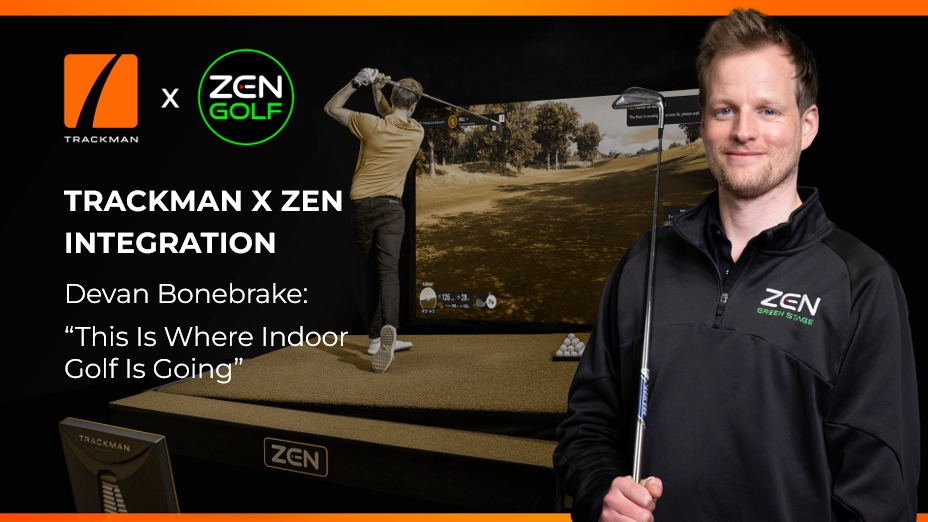
Trackman x Zen Integration: Devan Bonebrake “This Is Where Indoor Golf Is Going”
Overview
Indoor golf has become excellent at brining the reality of the shot alive.
Trackman gives players trusted ball data, club data, beautiful visuals, world-class courses, and meaningful practice modes. The missing piece has usually been the ground beneath the golfer.
Golf is not played from flat lies.
That is what made this walkthrough with Devan Bonebrake, host of Golf Channel’s The Golf Fix, so revealing. As he played through the Trackman x Zen experience with Will Stubbs, the conversation quickly moved beyond novelty.
The reaction was immediate: “This changes everything.”
That is because the system does more than move the floor. It changes what the player has to notice, what decisions become relevant, what movement solutions emerge, and what the data means.
With the Trackman × Zen integration overview, indoor golf starts looking less like a simulator experience and more like golf.
This is the next step in indoor golf experience for:
- Players who want practice that transfers
- Coaches who want to teach in context
- Indoor facilities that want a premium differentiated product
- Universities and colleges that want more representative player development
This is not just more immersion, but a more golf-like experience.
Written by: Will Stubbs, Head of Education, Zen Golf
Last Updated: 20/04/2026
What was the First Thing Devan Noticed?
One of the strongest moments in the walkthrough happened almost instantly.
As soon as the shot finished, the next lie appeared. The Swing Stage moved seamlessly into place and Devan’s response was immediate. He noticed how natural it felt, how little interruption there was, and how quickly the environment kept asking the next question.
If indoor golf is going to feel like golf, the player cannot keep dropping out of the experience between shots. Too much friction breaks the rhythm of the hole. It turns play into a sequence of disconnected reps rather than one connected golf problem.
That is why Trackman × Zen Integration: Virtual Golf with Real-World Slopes matters so much. The value is not only in the slope itself. The value is in how naturally the player moves from one decision to the next.
That flow is what allows the player to stay in:
- The hole
- The strategy
- The emotional rhythm
- The consequence of the previous shot
That is a very different experience from simply hitting another ball from a flat bay.
How do Slope Shape the Decision?
The second shot revealed the real value of the system.
Devan now had 266 yards with the ball below his feet. Straight away, the shot changed. It was no longer a simple “pull a fairway wood and hit it down there” problem.
The slope forced thought. He had to consider how the ball would react, how the face and path might interact, and how his setup would influence the shape.
That is the key point.
Slope does not only influence mechanics, but it also changes the decision.
This is exactly why How Slopes Change Your Golf Swing Mechanics and Trackman x Zen Integration: Key Trackman Metrics on Slopes are such important companion pieces to this demo. The same Trackman numbers are still there. The golfer now must produce them from a more representative situation.
Devan also pointed out something very useful for coaches and advanced players.
The slope was not uniform.
His feet were feeling one thing while the ball sat on something slightly different. That is real golf. The ground often twists and becomes a compound slope. It changes the routine, from just build a stance to reorganizing around strike point.
Zen Swing Stage’s ability to recreate compound and twisted lies is a major step forward because that is what players face outside.
How did the Slopes Affect his Strategy?
Later in the demo, Devan highlighted one of the most useful things about the system.
The slope did not just alter shape. It altered his strategy.
On a five-wood from an uphill right-to-left lie, he and I started talking not just about the shot shape but about the safe space on the hole.
The draw slope suggested one thing, but the map suggested something else.
The left side looked risky at first glance, but once the slope and the space were understood together, it became clear that left was not actually the end of the world.
That is a very important insight.
Course management is not only about knowing your stock yardage. It is about understanding what the lie and the hole are offering together.
This is the difference between being a club golfer and being a great golfer.
Great players do not just hit shots. They understand what the slope does to the strategy of the hole.
This links directly to Trackman x Zen Integration: Map My Bag on Slopes and Trackman x Zen Integration: Fixing Data Misinterpretation in Golf. A flat number can tell you how far a club goes in one condition. A slope-driven environment helps you understand what the shot means in context of the course.
How Does this Change the Coaching Conversation?
One of the most useful parts of the transcript was when Devan started speaking like a coach rather than just a player.
He immediately saw the value for lessons.
Players often say they want coaches to go on the course with them because they ‘hit it different’ on the course. We know that’s because the course presents different situations and experiences than the range or sim-bay.
The problem is that real playing lessons are slow, expensive, hard to repeat, and not always easy to deliver well.
Coaches must manage time, pacing, course access, and the reality that players are paying for every minute.
Thie Trackman x Zen integration changes that.
Now a coach can run playing-lesson style sessions indoors, with speed between shots, with repeated access to different lies, and with the ability to go back and revisit where the player struggled and where the player succeeded.
That is a huge shift in what the coach can now offer.
It means a coach can identify:
- Where the player made poor decisions
- Where the lie exposed a technical weakness
- Where a mental error crept in
- Where the player’s attack angle or strike pattern broke down
- Where confidence was high and why
This aligns closely with Trackman x Zen: Playing Lessons on Slopes with Karl Morris, Trackman x Zen Integration: Training the Mental Game with Slopes, and Trackman x Zen Integration: AI Motion Capture on Slopes.
Once the environment becomes richer, coaching becomes more player-centered and more co-adaptive.
The Integration Exposes the Skill Side of Golf
A particularly important theme in the demo was adaptability.
Devan repeatedly came back to the same idea:
The golfer must adapt to what the slope is doing.
That sounds obvious, but it is often missing from indoor training.
A lot of practice still asks golfers to solve one stable task repeatedly. That may improve consistency in that exact environment, but it does not always build adaptability we need on the course.
Golf requires a player to repeatedly answer new questions.
- The lie changes
- The launch changes
- The strike changes
- The tactical picture changes
This is especially powerful in wedge play and distance control.
One of the standout coaching ideas in the walkthrough was using the same target distance, while changing the slope every shot:
- Uphill
- Flat
- Downhill
Same task goal, but different environmental demands.
That is excellent golf practice.
It turns distance control into a real skill rather than a fixed number.
That is why Trackman × Zen Integration: Map My Bag on Slopes becomes so valuable. Yardages are not fixed truths. They are relationships shaped by lie, gravity, and delivery.
The same club can become a different club depending on the slope.
That matters for:
- Wedge play
- Approach play
- Course management
- Player trust and confidence
When players start understanding how slope changes their carry windows and strike patterns, the game begins to make more sense.
That is how practice becomes transferable.
Why Is This a Better Version of Indoor Golf for Players?
For players, the biggest benefit is simple:
The golf starts feeling more realistic and believable.
That means indoor golf becomes better at preparing them for the real thing.
Instead of only seeing numbers and ball flight, they now must:
- Feel the lie
- Organize around gravity’s pull
- Make more realistic decisions
- Understand how slopes unbalance their swing and ability to create power
- Learn how slopes influence ball flight
- Develop comfort on awkward shots
That matters for developing confidence.
A player who has repeatedly practiced uneven lies indoors is far more likely to step onto the course and feel, “I’ve felt this before.”
That is a much better psychological state than surprise.
This also makes the session more engaging.
Devan’s reaction captured that clearly. The system is fun. It is entertaining, and it keeps you in the hole. It makes you want to keep coming back like a round on the course does.
That matters because engagement is not a side benefit, but one of the key ingredients of better learning.
That same principle is explored in Gamify Your Golf Practice: Turning Trackman Data Into Learning Fuel, where challenge, feedback, and environmental variability make practice more meaningful.
This is indoor golf that can entertain and educate at the same time.
Why This Is a Better Tool for Coaches?
For coaches, the value is even deeper.
The Trackman x Zen integration gives coaches a place to teach golf in context rather than just mechanics in isolation.
That means coaching can move more fluidly between:
- Movement
- Strategy
- Shot selection
- Decision-making
- Emotional response
- Data interpretation
That is a more complete lesson.
Instead of saying, “Your path was too far left,” the coach can ask:
- What did the shot invite?
- What did the player perceive?
- Did the player choose the right shot for the slope?
- Did the movement solution fit the environment?
That changes the coaching conversation from fault-finding to problem-solving.
It also helps coaches identify what is really going on in the player’s mind.
A player might appear to have a technical issue on flat ground. Though the issue may be that they struggle to adapt movement and decision-making once the environment becomes more realistic.
For coaches building premium lesson experiences, Zen Swing Stage becomes a powerful tool because it supports instruction that is more believable, more engaging, and more likely to transfer.
This Gives Indoor Facilities a Stronger Experience to Sell
For indoor golf facilities, this is a major commercial opportunity.
A lot of venues can now offer launch monitor data and virtual golf.
Far fewer can offer virtual golf with real slopes and real shot problems.
That is a meaningful difference as it changes how a facility can position itself in the market.
Instead of offering only simulator access, the venue can offer:
- A more realistic version of golf
- Premium coaching sessions like Bag Mapping on Slopes
- More memorable member experiences
- More engaging events and challenges
- Stronger performance storytelling
That matters because indoor golf is becoming more competitive. Facilities need clearer reasons for golfers to choose them, return to them, and talk about them.
The Trackman x Zen experience is not just visually impressive. It creates a more distinctive product.
That gives operators a stronger narrative for:
- Serious players
- Coaching clients
- Memberships
- Leagues
- College partnerships
- Academy programming
This is also why Zen Golf Stage and Zen Green Stage matter in the wider product ecosystem.
Different environments serve different needs, but the principle is the same: bring the ground into the learning experience so practice looks more like the game.
Why this Has Huge Value for Universities and Colleges
For universities and colleges, the opportunity is especially strong.
Competitive players do not just need access to golf technology. They need access to practice environments that resemble the game they play.
They need environments that help them prepare for:
- Uneven lies
- Awkward trajectories
- Decision-heavy shot selection
- Pressure-based execution
- Course-specific demands
This is where the Trackman x Zen integration becomes such a valuable development tool.
Programs can use it to:
- Build more representative training sessions
- Create better testing environments
- Improve player understanding of yardages and slope effects
- Connect indoor work more directly to tournament golf
This is especially useful when paired with structured performance testing, wedge control work, and on-course strategy training.
A college coach does not just want players who can produce good indoor numbers.
They want players whose skills hold up when the environment gets messy in the heat of competition.
That is exactly what this environment helps reveal.
Key Takeaway: “This Is Where Indoor Golf Is Going”
The walkthrough with Devan Bonebrake showed why the Trackman x Zen integration matters.
Once the ground starts changing, the conversation changes.
Now the player must:
- Read the lie
- Respond to slope
- Adapt movement
- Choose a strategy
- Manage consequence
That is what real golf asks, and what indoor golf has often been missing.
- For players, this creates more believable practice.
- For coaches, it creates richer diagnosis and better lesson design.
- For indoor facilities, it creates a stronger premium product.
- For universities and colleges, it creates a better bridge between training and competition.
That is why this is not just another simulator feature.
It is a meaningful step forward in what indoor golf can become.
Explore What the Next Evolution of Sim Golf Could Mean for You
For Players
Practice the kinds of shots you face on the course and build confidence that transfers.
For Coaches
Offer lessons that combine data, strategy, slope interaction, and real golf decisions in one environment.
For Indoor Facilities
Differentiate your venue with a premium experience that goes beyond flat simulator golf.
For Universities and Colleges
Prepare players for real competition demands with more representative indoor practice.
Explore the Trackman x Zen Integration Overview.
Explore Zen Swing Stage, Zen Green Stage, and Zen Golf Stage.
Book a call to discuss how the next evolution of sim golf could support your players, program, or facility.
