
Trackman x Zen Integration: Brian Manzella Plays the Next Evolution of Sim Golf
Overview
Indoor golf has become very good at showing the shot.
Trackman gives players great visuals, trusted ball data, club data, and the ability to play world-class courses indoors. The missing piece has usually been the ground beneath the player.
Golf is not played from level lies.
That is why this walkthrough with Top 13 US coach, Brian Manzella matters. The demo shows what happens when Trackman Virtual Golf is paired with Zen Swing Stage.
The player does not just see the hole. The player feels the lie, responds to the slope, and has to solve the shot in a way that looks much closer to real golf.
That is the next evolution of sim golf.
It is not just more immersion, it is more reality.
That means players can practice shots that resemble the ones they face on the course.
This gives coaches a more meaningful way to study how golfers think, decide, and adapt.
It gives indoor facilities a differentiated experience that goes beyond flat-bay simulator golf.
This means universities and colleges a chance to prepare players for the courses and lies they will face in competition.
This is where the practice-performance gap starts to close.
Written by: Will Stubbs, Head of Education, Zen Golf
Last Updated: 15/04/2026
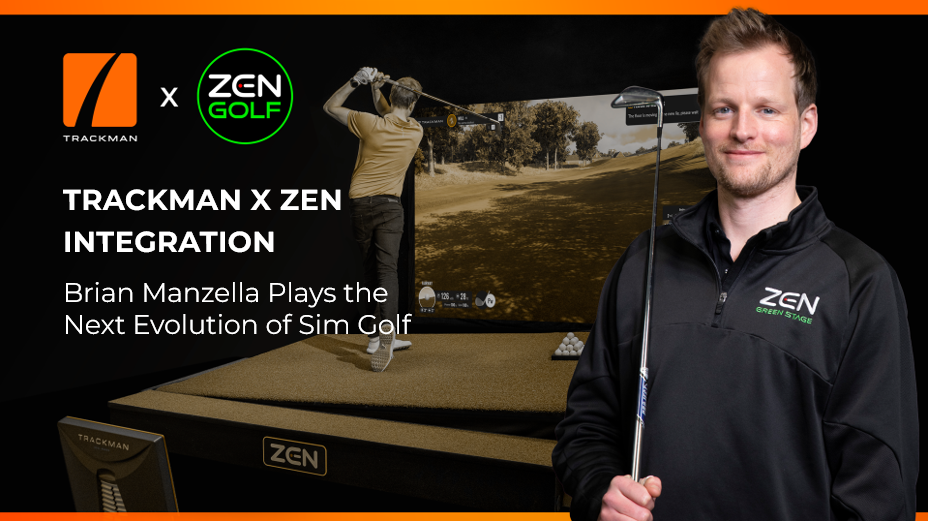
What Made the Session So Powerful?
The power of the demo was not just that Brian hit a few shots.
It was the way he narrated the golf problem in front of him.
That is what good players and good coaches do. They read the hole, identify what the course is offering, then match a shot to the lie, the wind, the trouble, and the safest scoring option.
Straight away, on the par five, Brian looked at the bunker on the left and described what the hole was asking for. He did not begin with a mechanical thought. He began with strategy.
The bunker told him where the ball wanted to go.
That is an important point.
The best indoor golf experiences do not just let you hit balls. They let you play golf.
This is the same shift explored in Trackman x Zen Integration: Par 5 Testing on Slopes, where the task becomes less about isolated execution and more about managing a sequence of shots with consequence.
Brian saw a hard cut up the left as the right play. That took the left side out of play and used the width of the fairway properly.
That is golf thinking.
That is also what flat simulator golf often misses. Flat lies can still show a good shot. They do not always ask the player to solve the full puzzle.
Real Slopes Change the Shot Problem
One of the best moments in the demo came immediately after the tee shot.
As soon as Trackman knew where the ball was, Zen Swing Stage moved to the next lie.
Brian’s first reaction was how smooth the movement felt. There was no awkward delay. No sense that the technology was interrupting the flow of play.
That matters.
If you want indoor golf to feel like golf, the transition between shots must be smooth enough that the player stays in the hole, stays in the decision, and stays in the rhythm of play.
The second shot then exposed the real value of the integration.
Brian had 227 yards with fairway wood from a downslope. He immediately began talking about what that would do to the strike, why fairway wood becomes harder from that lie, and how he needed to adjust the delivery.
This is where How Slopes Change Your Golf Swing Mechanics and Trackman x Zen Integration: Key Trackman Metrics on Slopes become important.
Slope changes posture, pressure, low point, face-to-path relationships, strike tendencies, launch, and spin.
The shot may still be measured with the same Trackman parameters. The meaning of those numbers changes once the golfer is standing on a real lie.
Brian also highlighted something more subtle and very important.
The slope was not uniform.
His feet could be feeling one thing while the ball sat on another tilt. That is real golf. Courses do not usually give you one neat planar lie. They give you twists, compound slopes, awkward hangs, and uneven relationships between the player and the ball.
That is exactly why the ability to recreate compound and twisted slopes matters. It moves indoor golf away from simple tilt and much closer to the conditions players face.
There Were Almost No Basic Shots
Brian made a brilliant point later in the demo.
Other than perhaps the tee shot, there was not one basic shot in the sequence.
That line captures the whole value proposition.
Most golfers struggle to “take it to the course” not because they are incapable of hitting good shots, but because most of their practice is built on basic shots. Flat lie. Repeated target. No real consequence. No need to adapt to what the ground is doing.
Then they get on the course and almost every shot is different, as the:
- Lie changes
- Footing changes
- Wind changes
- Required shot height changes
- Shape of the green changes
- Safe miss changes
This is exactly the issue explored in Trackman x Zen Integration: Common Data Misinterpretations Without Ground Context. Golf data gathered in simplified environments can be useful. It becomes much more valuable once the environment starts to resemble the game.
Brian’s praise was strong because he immediately recognized that this system makes players adjust their swing to different lies for their feet and different lies for the ball. That is the complexity of golf. That is also the reason many players say simulator performance does not always transfer.
They are not practicing enough of the shots they get on the golf course.
Why the Integration Changes the Coaching Opportunity
A standard simulator can show the hole, and a flat bay can show the number.
The Trackman × Zen integration can bring the real-world experience into the sim.
That is the difference.
When slopes are introduced, the player is no longer just hitting into a picture of a hole. They are physically responding to the lie under their feet. That changes:
- Setup
- Balance
- Tension
- Perception of difficulty
- Club choice
- Start line
- Shot shape
- Commitment
- Strike
That makes the data more meaningful.
This is where the other Trackman × Zen blogs connect naturally:
- Trackman × Zen Integration: Key Trackman Metrics on Slopes helps explain why ball and club data change meaning once slopes enter the task.
- Trackman × Zen Integration: Map My Bag on Slopes shows how distance calibration changes when the lie changes.
- Trackman × Zen Integration: Using Optimizer on Slopes shows why optimization without terrain can mislead.
- Trackman × Zen Integration: Common Data Misinterpretations Without Ground Context explains why flat data often overstates transfer.
- Trackman × Zen Integration: Understanding Swing Tendencies on Slopes helps coaches study the individual rather than compare the player to one idealized pattern.
- Trackman × Zen Integration: Training the Mental Game with Slopes shows why intention, opportunity, and pressure belong inside the same coaching conversation.
This is what makes the integration player-centered.
It studies the golfer as they are when the course asks real questions.
Short Game Is Where the Realism Really Shows Up
The short-game section of the demo was especially revealing.
Brian faced a ball-below-feet hanging lie for a lob shot and immediately explained the danger. Shots like that can be bladed across the world if the player does not make a real effort to manage strike and trajectory properly.
That is a very different conversation from chipping on flat ground.
This is where Trackman x Zen Integration: Wedge Play on Real-World Slopes becomes such a useful companion to this demo. Wedge play and short game are incredibly sensitive to lie, slope, spin, low point, and how the golfer organizes around balance.
The most exciting coaching insight from this part of the walkthrough was simple.
If a student hit that shot poorly, the coach could recreate the exact lie and practice from it again.
That changes everything.
Traditional on-course coaching is powerful, but hard to repeat. Once the shot is gone, it is gone. This integration makes it possible to recreate the shot, revisit the lie, study the decision, and help the player develop a better answer.
That is a major step forward for indoor coaching.
The Integration Turns Sim Golf into a Playing Environment
This walkthrough was not really about technology for technology’s sake.
It was about what the technology allows the player to do.
Brian was effectively playing and teaching at the same time. He was explaining how the hole shaped the strategy, how the slope shaped the movement, and how each shot needed a different solution.
That is what a real playing lesson looks like.
This aligns closely with Trackman x Zen: Playing Lessons on Slopes with Karl Morris. Playing lessons matter because they show the golfer in situ. They show how technique, decision-making, shot picture, and emotional control hold up when the environment starts asking questions.
This integration makes that kind of learning easier to deliver indoors.
Now coaches can:
- Recreate the shot
- Revisit good and bad decisions
- Study how slope changed the movement
- Compare what the player intended with what they did
- Link that to Trackman’s ball and club data
That is a much richer coaching loop than simply saying, “You pulled that one,” or “You lifted up.”
Why Is This a Better Use of Data?
Trackman has always been strong because it gives players trusted data and clear visuals.
The integration adds context.
That is the key shift.
Data becomes more meaningful when the shot resembles the real-world problem it is supposed to represent. This is why Trackman x Zen Integration: Using Optimizer on Slopes, Trackman x Zen Integration: Map My Bag on Slopes, and Trackman x Zen Integration: GIR Testing on Slopes are all part of the same story.
The metrics do not disappear, but the environment becomes more representative.
That means the data tells you more about how the player is likely to perform on the course.
For players, that creates more trust.
For coaches, it creates better diagnosis.
For facilities, it creates a premium experience with a stronger performance narrative.
What Does This Mean for Players?
For players, this is a better version of sim golf.
You still get the fun, the visuals, the courses, and the competition. You now get the complexity of real golf as well.
That means you can:
- Practice the kinds of shots you face
- Learn how slopes affect club choice and movement
- Build confidence on uneven lies
- Develop competence that transfers more cleanly to the course
This is not just entertainment.
It is rehearsal for real golf.
What Does This Mean for Coaches?
For coaches, this is a very different kind of lesson environment.
You can now teach:
- Strategy
- Shot selection
- Slope response
- Technique in context
- Mental game under realistic visual and physical demands
This makes it easier to provide a differentiated coaching experience and stronger lesson retention. Players are more likely to come back when they feel the session helped them solve golf, not just rehearse mechanics.
This also pairs naturally with Trackman x Zen: AI Motion Capture on Slopes, where player movement, club delivery, and ball data can all be studied together in a more representative environment.
What This Means for Indoor Facilities?
For indoor facilities, this is a major differentiator.
Plenty of venues can offer virtual golf.
Far fewer can offer virtual golf with real slopes, real consequences, and a much more believable version of the game.
That opens:
- Premium coaching packages
- Weekly nearest-the-pin and hole-recreation challenges
- More engaging member formats
- Better retention for serious golfers
- A clearer performance story for marketing
This is also why Zen Swing Stage, Zen Golf Stage and Zen Green Stage matter in the wider product ecosystem.
Different environments have different use cases, but the core principle is the same: bring the ground into the learning environment so the practice looks more like the game.
What This Means for Universities and Colleges?
For universities and colleges, this is especially valuable.
Players can prepare for courses they will face in competition with much more realistic indoor practice.
Coaches can build more meaningful practice loops by pairing Trackman data with real lies and, where available, on-course tracking statistics.
That means better feedback, better planning, and a stronger link between what the player sees indoors and what the player experiences in competition.
This is the same broader opportunity discussed in Trackman x Zen Integration: Slope-Based Combine Testing, and Trackman x Zen Integration: Virtual Golf with Real-World Slopes.
Key Takeaways
Brian Manzella’s walkthrough showed why this integration matters.
The value was not just that the floor moved, but that every shot started to look more like golf.
Now every player stepping into a Trackman x Zen powered sim they have to:
- Read the hole
- Respond to slope
- Adjust the swing
- Manage the consequences
- Solve a new problem on nearly every shot
That is what the next evolution of sim golf should be.
Trackman provides the visuals, trusted data, and virtual golf environment.
Zen Swing Stage adds the real slopes, compound lies, and physical demands that shape the shot.
Together, they create a far richer indoor golf experience for players, coaches, facilities, and universities.
That is why this demo stood out.
It did not just show a better simulator.
It showed a better version of golf indoors.
Explore What the Next Evolution of Sim Golf Could Mean for You
For Players
Practice real golf shots, not just flat-bay repetitions, and build confidence that transfers to the course.
For Coaches
Offer lessons that combine strategy, technique, and real-world lie interaction in one environment.
For Indoor Facilities
Differentiate your venue with a premium experience that goes beyond flat simulator golf.
For Universities and Colleges
Prepare players for real competition demands with more realistic indoor practice.
Explore the Trackman x Zen Integration Overview.
Explore Zen Swing Stage, Zen Green Stage, and Zen Golf Stage.
Book a call to discuss how the next evolution of sim golf could fit your players, program, or facility.
