
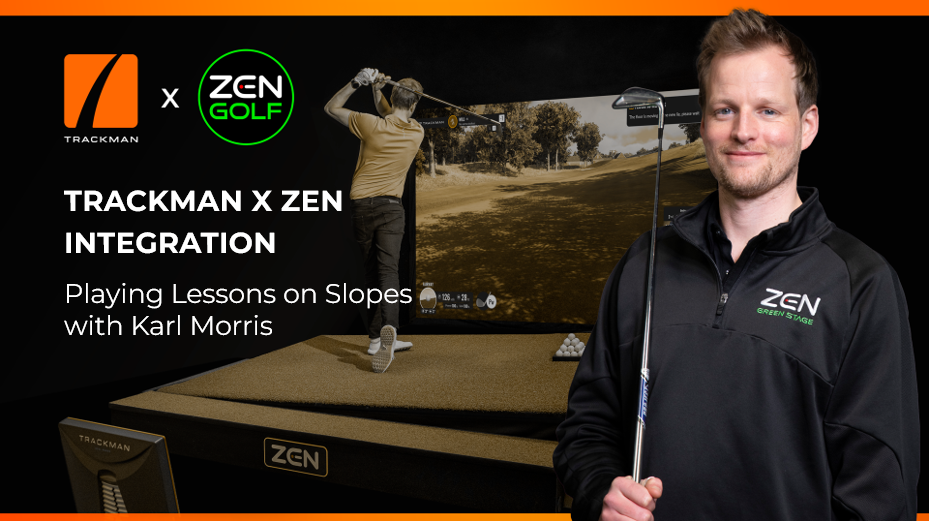
Trackman × Zen Integration: Playing Lessons on Slopes with PGA TOUR Coach Karl Morris
Overview
Playing lessons are one of the most valuable things a coach can do.
They place the player in context to show how technique, decision-making, attention, emotion, and shot selection hold up when the course starts asking questions.
That is also why they are hard to deliver.
It take times, depends on availability, and are shaped by weather, access, pace of play, and the presence of other groups on the course.
They are often hard to repeat in a structured way, and are even harder to revisit shot by shot once the round is over.
The Trackman × Zen integration starts to solve that problem.
When Karl Morris worked with Josh Gudgeon, known to many as Breaking Golf, the lesson showed exactly why context matters.
The slopes changed the shot.
The shot changed the decision.
The decision changed the swing.
These integrations brought those layers together inside an indoor environment that looked and felt far closer to golf than a flat practice bay ever could.
This is where the value sits.
Trackman provides the visuals, the hole context, the ball and club data, and the ability to revisit shots. Zen Swing Stage recreates the slope and lie demands that shape what the player feels and how the player responds.
Together, they create a form of playing lesson that is repeatable, measurable, and much closer to the real game.
That is what makes the data more meaningful and the practice more transferable.
For a full system overview, see: Trackman × Zen Integration Explained
Written by: Will Stubbs, Head of Education, Zen Golf
Last Updated: 10/04/2026
Why Playing Lessons Matter So Much
A range session can show how a player swings, but a playing lesson shows how a player reacts to the course.
That difference matters.
On the course, the player must:
- See the shot
- Read the environment
- Manage attention
- Choose a target
- Select a club
- Regulate tension
- Commit under pressure
Those are playing skills, not simply swing skills.
Karl’s conversation with Josh made this point repeatedly.
Josh arrived with clear swing ideas from his work with Zen Master Ambassador, Marcus Bell. He spoke about weight shift, delivery, face control, and how he was trying to organize the club.
Karl did not dismiss that work. He reframed it.
Training and playing require different hats.
That was one of the clearest themes from the session.
In training, the player can work on movement pieces.
In play, the player needs to reduce, reduce, reduce, so that attention moves toward the shot and the environment rather than remaining stuck in technical analysis.
This sits closely with the principles explored in Trackman × Zen Integration: Make Swing Changes That Transfer to the Course and Trackman × Zen Integration: Training the Mental Game with Slopes. The player needs a bridge between mechanics and performance. The playing lesson is often that bridge.
Why Traditional Playing Lessons Are Hard to Scale
Everyone knows the value of on-course coaching.
Few environments make it easy.
Traditional playing lessons are limited by:
- Tee time access
- Coach availability
- Travel time
- Weather
- Disruption from other groups
- Difficulty repeating the same shot or hole
- Limited access to ball, club, and player data
- Poor ability to revisit good and bad shots in a controlled way
That creates a bottleneck.
The coach may see a brilliant example of the player tightening up, misreading the lie, choosing the wrong club, or rushing the pre-shot routine.
The problem is that once the shot is gone, it is often gone. There is no clean way to reset it, replay it, and study it with the same structure.
This is where the Trackman × Zen integration becomes far more than a simulator.
It becomes a playing lesson system.
What the Karl Morris and Josh Gudgeon Session Revealed
The session was rich because it showed the player in situ.
Not in theory, or in standard practice. In context.
Several themes stood out.
Playing mindset is different from training mindset
Karl’s central message was clear. Josh needed a training hat and a playing hat.
Training can be detailed. Playing needs one clear intention and a felt sense of the shot.
That shift was visible straight away on the opening hole.
Josh described how much swing information was active in his mind when he played. Karl reduced the task to something more useful. See the draw. Feel the swing that produces the draw. Reduce the internal noise.
This links strongly with Trackman × Zen Integration: Common Data Misinterpretations Without Ground Context. Data gathered in simplified environments often misses the mental clutter, target fixation, and threat response that appear when golf becomes golf.
The course changes the question
On the first hole, Josh initially saw danger everywhere. Trees, trouble, narrow visuals, pressure. Karl reframed the hole by asking what the course was offering rather than what it was threatening.
That changed the shot.
A draw was no longer something theoretical. It became a playable opportunity tied to a specific target picture.
Josh created an image, felt the movement, and hit a poor strike that still produced a functional outcome.
That matters.
The shot was not perfect, but the decision process was better.
This is one of the clearest values of a playing lesson. It reveals whether the player can still organize around an intention when the environment creates stress.
Slope changes decisions, not only mechanics
This was one of the strongest themes in the lesson.
On the second shot of the first hole, the ball sat below Josh’s feet. Karl immediately linked that lie to what the shot would likely do.
The lie would encourage the ball to leak right. The target and club choice were then chosen in response to that reality. Josh himself said he would never have considered that on a standard range bay.
That point is crucial.
Flat practice strips away one of the most meaningful pieces of information the golfer needs. The slope tells the player something about the shot. It shapes start line, curve, strike, and club choice. Without it, the player is often practicing numbers without context.
This connects directly to How Slopes Change Your Golf Swing Mechanics and Trackman × Zen Integration: Key Trackman Metrics on Slopes. The numbers do not change. Their meaning does. The player reorganizes posture, balance, pressure, and delivery to solve the task. The resulting ball and club data become more honest when the ground asks a more realistic question.
The golf course is offering shots, not only threats
Karl repeatedly moved Josh away from a threat-based view of the hole and toward an opportunity-based one.
That is important language.
On the fourth hole, Karl challenged Josh’s phrase, “I need to hit a draw.” He replaced it with a more useful frame: there is an opportunity for a draw here.
One creates pass-fail pressure. The other keeps options open.
That shift in language changed Josh’s state almost immediately.
This is highly relevant for coaches. The player’s mental game is not separate from the shot. It is embedded in the language, the target picture, the lie, and the way the course is being interpreted.
This is exactly why Trackman × Zen Integration: Training the Mental Game with Slopes matters as part of the wider cluster. The environment shapes intention. The intention shapes the swing.
Good playing lessons reveal where doubles and triples come from
Karl made another important point. Breaking 80 is less about making more birdies and more about reducing doubles and triples.
That showed up clearly on the fourth hole.
After a poor tee shot, Josh’s first instinct was to take 3-wood from a severe downhill lie. Karl slowed the situation down. The question changed from “How far can I hit this?” to “What is the course offering from this lie?”
The answer was not hero golf.
The answer was medicine.
That is a hugely valuable coaching moment. Josh did not need better technique in that moment, he needed a better decision.
The slope, lie, and hole context all pushed toward a safer option. Without a realistic environment, this lesson would be hard to recreate.
This is where the integration becomes so powerful, as you can:
- Revisit the shot.
- Test the aggressive option.
- Test the conservative option.
- Compare the outcomes with meaningful trackman data.
You can see whether the issue was:
- Decision-making
- Pre-shot routine
- Tension
- Club selection
- Slope response
- Shot picture
- Strike quality
- Mental speed
That is a far richer loop than “you hit that badly.”
Warm-up quality affects playing quality
The warm-up session added another important layer.
Karl did not start by fixing technique. He started by shifting Josh into observation mode:
- What have you got today?
- What is the body doing?
- Where is the tension?
- What happens to grip pressure when the club goes from chest height to the ball?
This led to one of the most useful practical insights in the session.
Josh’s tension changed dramatically when the club moved down to address. Karl reframed warm-up as awareness rather than fixing.
That is hugely relevant to playing lessons because the course amplifies tension. A player who is stable in the bay may tighten significantly on the first tee.
Trackman × Zen Integration: AI Motion Capture on Slopes and Trackman × Zen: Training the Mental Game on Slopes belong together here.
Ball and club data tell us part of the story. Player data, slope context, and observation of pre-shot changes tell us more about why performance varies.
Why the Integration Changes the Coaching Opportunity
A standard simulator can show the hole, and a flat bay can show the number.
The Trackman × Zen integration can bring the real-world experience into the sim.
That is the difference.
When slopes are introduced, the player is no longer just hitting into a picture of a hole. They are physically responding to the lie under their feet. That changes:
- Setup
- Balance
- Tension
- Perception of difficulty
- Club choice
- Start line
- Shot shape
- Commitment
- Strike
That makes the data more meaningful.
This is where the other Trackman × Zen blogs connect naturally:
- Trackman × Zen Integration: Key Trackman Metrics on Slopes helps explain why ball and club data change meaning once slopes enter the task.
- Trackman × Zen Integration: Map My Bag on Slopes shows how distance calibration changes when the lie changes.
- Trackman × Zen Integration: Using Optimizer on Slopes shows why optimization without terrain can mislead.
- Trackman × Zen Integration: Common Data Misinterpretations Without Ground Context explains why flat data often overstates transfer.
- Trackman × Zen Integration: Understanding Swing Tendencies on Slopes helps coaches study the individual rather than compare the player to one idealized pattern.
- Trackman × Zen Integration: Training the Mental Game with Slopes shows why intention, opportunity, and pressure belong inside the same coaching conversation.
This is what makes the integration player-centered.
It studies the golfer as they are when the course asks real questions.
From Good Shot vs Bad Shot to a Deeper Investigation
One of the strongest commercial and coaching advantages here is the ability to revisit shots.
This matters because golfers often leave playing lessons or rounds with simplistic conclusions:
- I swung that badly
- I got quick
- I lost my posture
- I hit a poor club
- I rushed
Sometimes that is true, but mostly, it is incomplete.
The integration allows the player and coach to revisit the environment and ask:
- Was the club choice wrong?
- Was the slope misread?
- Was the target too narrow?
- Was the shot picture poor?
- Did tension spike?
- Did the pre-shot routine break down?
- Did the lie demand a different ball flight?
- Did the player ignore what the course was offering?
This is exactly the kind of richer diagnostic loop that traditional playing lessons struggle to provide consistently.
Meaningful Data from Real-World Experiences
This is where the Trackman × Zen integration becomes uniquely valuable.
It allows players to get meaningful, accurate data from experiences that are much closer to real golf. That matters far more than simply collecting more numbers.
A 7-iron from flat turf into a static screen may tell you something.
A 7-iron from a ball-below-feet lie, into a shaped hole, with visual trouble, a specific target, a tension response, and a clear intended shot tells you more.
That is what creates confidence and competence together.
Confidence grows when the player sees that a good decision and a clear intention can produce a reliable pattern in an environment that feels like golf.
Competence grows when the player learns how to solve the task repeatedly, with context, feedback, and reflection.
What Does This Mean for Coaches?
For coaches, this changes the lesson model.
You can offer:
- Playing lessons without needing the golf course
- More repeatable decision-making work
- Better integration of technical and mental coaching
- Greater retention through richer insight
- Clearer ROI for the player
A differentiated experience matters.
Players remember lessons that feel relevant to their scores, not just their positions.
When they can see how a decision, a lie, a slope, and a target picture changed the shot, the lesson becomes more useful and more memorable.
What Does This Mean for Facilities
For facilities, this opens several opportunities.
First, it creates a genuine differentiator. This is not just simulator golf. It is contextual coaching and recreation.
Second, it opens the door to weekly recreations and challenges. Members can replay famous holes, difficult approaches, or score-based scenarios using realistic slopes.
That turns engagement into something more meaningful than hitting balls at the same flat target every week.
Third, it supports coach-led premium services, which can improve lesson retention and commercial return.
What Does This Mean for Universities and Colleges
For universities and colleges, the value is especially strong.
Teams can prepare for the kinds of courses they will face in future events.
Coaches can pair indoor playing-lesson environments with on-course tracking and performance stats, then harmonize feedback and practice loops more effectively.
This allows for:
- Better tournament preparation
- Better player profiling
- Better linking of stats to real decisions
- Better transfer from analysis to action
That is a far more complete development ecosystem.
Key Takeaways
Playing lessons matter because they show the player in situ.
They reveal how swing, decision-making, pre-shot routine, and mental game hold up when the course starts asking questions.
Traditional playing lessons are valuable but difficult to scale.
They are constrained by time, access, weather, pace of play, and the challenge of repeating the same shot in a controlled way.
The Trackman × Zen integration changes that.
It brings realistic slopes into the Trackman simulator environment, which means players and coaches can recreate the on-course experience indoors and study how the golfer solves problems.
The Karl Morris and Josh Gudgeon session showed this clearly:
- Slope changed shot choice
- Language changed pressure
- Better decisions reduced damage
- Warm-up awareness influenced playing performance
- The course offered solutions when the player learned how to look
Trackman gives the visuals, hole context, ball data, and replayability.
Zen Swing Stage gives the terrain, the lie, and the physical demands that shape the shot.
Together, they create a more meaningful playing lesson environment and a more transferable form of practice.
Explore What Playing Lessons on Slopes Could Mean for You
For Players
Build confidence by practicing real golf problems in an environment that shows how your swing, decisions, and routine hold up under pressure.
For Coaches
Offer a differentiated lesson experience that links mental game, decision-making, and technique to the actual problems the course presents.
For Facilities
Create premium coaching, member challenges, and recreation formats that go beyond flat simulator play.
For Universities and Colleges
Prepare players for future competitive environments while linking indoor practice to on-course tracking and performance feedback.
Explore the Trackman × Zen Integration Overview.
Explore Zen Swing Stage, Zen Green Stage, and Zen Golf Stage to find which moving floor supports your use case.
Book a call to discuss how playing lessons on slopes could support your players or facility.
