
Why Green Reading Starts With The Zero Break Line: Mind Caddie Podcast with Karl Morris
Overview
Green reading improves when golfers understand how gravity, slope, pace, and entry point work together before the stroke begins. In a recent Mind Caddie podcast, Karl Morris and I explored why the Zero Break Line gives players and coaches a clearer way to read putts, design practice, and transfer putting skill from training to performance.
Listen to the full conversation on Apple Podcasts or Spotify.
The Zero Break Line is the straight uphill and downhill reference line passing through the hole. Once a player finds this line, every breaking putt gains context because the player has a stable reference for where gravity is moving the ball.
Karl Morris, performance coach and now a Zen Master, also discusses these ideas through his wider Mind Caddie work. His new book, The Mind Caddie: Become Mentally Strong, When It Counts, is available on Amazon and focuses on becoming mentally strong when performance matters.
Written by: Will Stubbs, Head of Education, Zen Golf
Last Updated: 10/07/2026

Why Most Putting Practice Misses The Real Problem
Many golfers treat putting as a stroke problem first. They work on face angle, path, setup, and tempo, then expect the same movement to transfer across different greens.
The difficulty appears when the green asks a different question. A flat 8-foot putt, an uphill 8-foot putt, a downhill 8-foot putt, and a sidehill 8-foot putt share a distance. They do not share the same read, pace, entry point, or emotional demand.
Zen has explored this transfer problem in Why Flat Putting Practice Often Fails To Transfer and Why You Should Train On Slopes: The Science Of Transfer In Golf Practice. Both articles support the same coaching principle: practice becomes more meaningful when the environment carries more of the information the player must use on the course.
External research points in the same direction. Pinder and colleagues introduced representative learning design to describe practice tasks that preserve the informational relationship between learning and performance environments. Renshaw and colleagues also describe ecological dynamics in motor learning, where learning and performance are treated as connected through the athlete-environment relationship.
This is why repetitive flat practice has limits. Flat practice gives the player a useful reference, especially for start line, contact, and simple rhythm. Slope changes the task. It changes how the ball breaks, how much speed the player needs, where the ball enters the hole, and how the player reorganizes the stroke.
When the practice surface removes slope, it also removes much of the information the player needs on the course.
The Zero Break Line Gives The Read A Starting Point
The Zero Break Line gives the player a way to start with gravity rather than guesswork. In the podcast, I explained the process through a clock face around the hole.
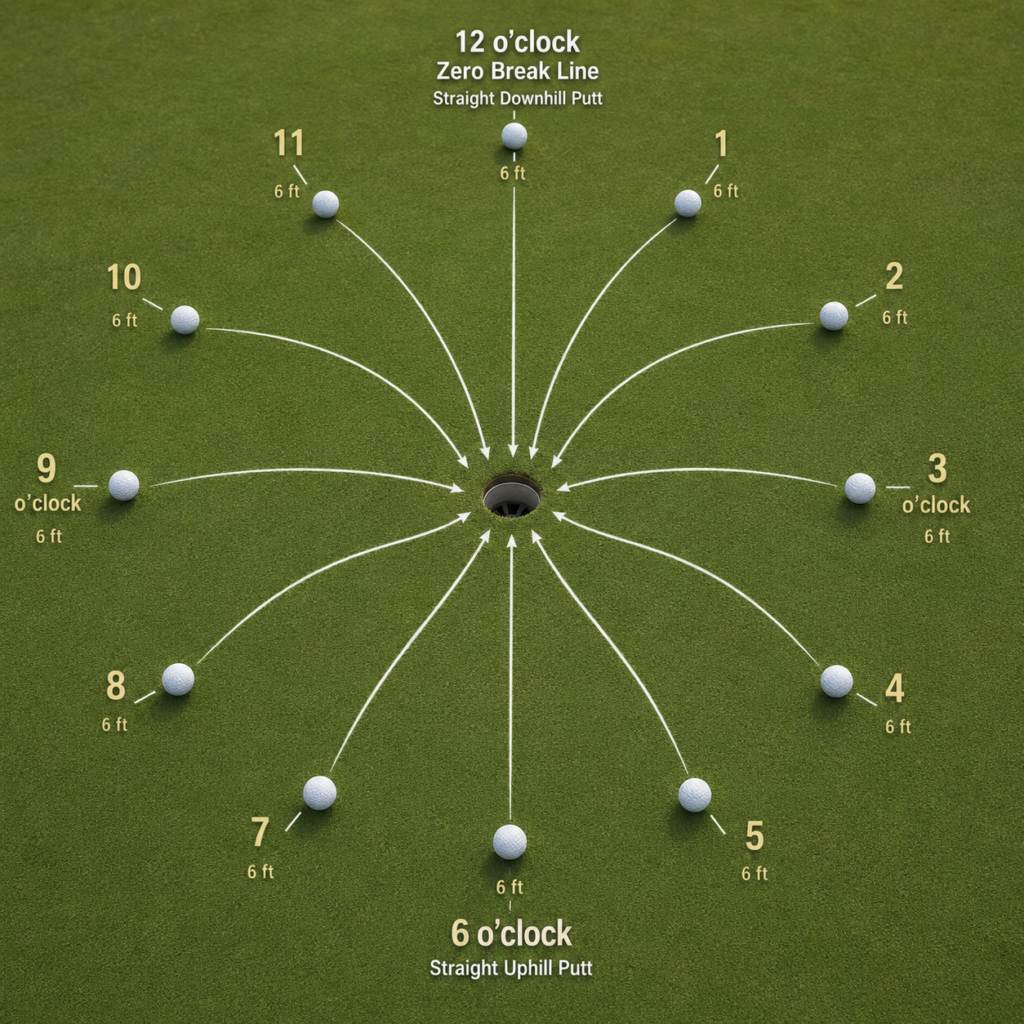
The hole sits at the center of the clock. The 12 o’clock position is the straight downhill putt. The 6 o’clock position is the straight uphill putt. Putts from the right-hand side of the clock move right to left. Putts from the other side move left to right.
This does not give the golfer one fixed line. It gives them a quick reference system.
A single breaking putt has more than one possible route into the hole because pace changes the amount of break. Therefore, a firmer putt enters through a different part of the clock face than a softer putt. The read only becomes useful when the player matches line and pace as one decision.
This principle aligns with Zen’s putting education article, Change The Slope, Change The Stroke: Using The Zen Green Stage To Develop The Three Principles Of Putting, which frames putting around slope perception, speed control, and start direction.
Pace Changes The Entry Point
A golfer often misses a breaking putt because the line and pace disagree.
The player might choose a high line and hit the putt firmly. The ball then holds its line longer and misses high. Another player might choose a lower line and hit the putt softly. The ball then loses speed earlier, takes more break, and misses low.
Both misses start before the stroke. The decision was incomplete.
This can be developed into a simple a practical process. First, find the Zero Break Line. Next, locate the ball on the clock face. Then decide whether the putt is uphill, downhill, right to left, or left to right. From there, the player starts to choose a pace and entry point rather than aiming at a single fixed line.
Zen’s article on Trackman × Zen Integration: Putting Training On Real-World Slopes explains how slope-based putting practice links green reading, stroke delivery, and ball behavior into one feedback loop.
Academic putting research also supports a broader view of putting performance. Couceiro and colleagues studied skilled golfers under different putting constraints and reported how perception-action coupling reflects the relationship between the performance environment and each golfer’s abilities. Their paper, The Re-Organization Of Action In Golf Putting Under Different Task Constraints, gives coaches a useful research reference for why the putting task changes when constraints change.
The Funnel Between Gravity And Pace
Once the player knows where straight is, a pace window starts to appear. This is where attention constraints intention and allows perception-action coupling to emerge.
One boundary comes from the Zero Break Line. The other boundary comes from the lower, faster route that still allows the ball to enter the hole. The space between those boundaries gives the player a functional putting funnel.
Within that funnel, different entry points create different putting solutions.
A soft entry asks the ball to arrive with less speed and use more break. A medium entry balances pace and break, and a firm entry reduces break and increases the consequence if the ball misses.
This gives the golfer options. The best option depends on the putt, green speed, confidence, and the situation. A player with two putts to win a hole might choose a slower, safer entry. While a player needing to hole the putt might choose a more assertive pace.
The environment stays the same, but the intention changes the solution.
Zen’s article on Indoor Putting Practice: Build Confidence Inside 10 Feet gives this concept a practical training context by connecting short-range putting, slope, speed, and confidence inside a structured indoor environment.
Green Reading Is A Perceptual Skill
Green reading is often discussed as information gathering. The player looks from behind the ball, reads the slope, chooses a line, and then tries to execute.
That process becomes stronger when the player treats green reading as perception linked to action.
A golfer is not only looking at the green, they are preparing the body to roll the ball through a chosen speed, start line, curve, and entry point. The read affects the movement because the task becomes constrained by our intention.
This is why the player should build a read whilst rehearsing the stroke. A stroke without a clear task often becomes a search for technical comfort. A stroke with a clear task gives the body a problem to solve.
A practical routine might include:
- Find the Zero Break Line
- Locate the ball on the clock face
- Choose the entry point
- Match the pace to the entry point
- Trace the curve back from the hole to the ball
- Hit the putt and compare outcome with intention
The missed putt then becomes information. The player starts to ask whether the miss came from the read, the pace, or the start line.
This reflects the wider motor learning idea behind Bernstein’s “repetition without repetition.” Ranganathan and colleagues discuss this principle in Challenges In Understanding Behavioral Flexibility In Motor Skill, where skilled movement is understood through flexible solutions rather than identical repetition.
A Simple Scoring System For Better Feedback
A player needs a way to review putting without turning every miss into a stroke fault.
After each putt, the player scores the read, pace, and start line. If the ball misses low, the player asks whether the read was too low, the speed was too soft, or the ball started away from the intended line.
A simple scorecard note works well:
- R means read
- P means pace
- S means start line
Over a round, patterns become visible. A player might discover that most misses come from pace on downhill putts. Another player might learn that right-to-left putts create a start-line bias. A third player might realize that the read is strong, but pace and entry point do not match.
This protects the player from changing technique too quickly, and the coach gains contextual evidence before intervening.
Zen’s article on Zen Green Stage Coaching Tips For Coaches And Facilities explains how coaches can use slope-based putting practice to develop green reading, pace control, stroke adaptability, and performance under variable conditions.
How Zen Stages Supports Green Reading
Zen Golf Stage combines putting and full-swing training on one slope-controlled surface. This broadens the same educational idea. Golfers learn more effectively when the practice environment contains the information the game requires.
Putting needs slope, pace, entry point, and ball-roll feedback. Full swing needs lie, balance, ground interaction, trajectory, and decision-making. Zen Golf Stage supports both forms of practice by keeping the player connected to realistic terrain.
Zen’s article on Trackman × Zen Integration: Playing Lessons On Slopes With PGA TOUR Coach Karl Morris develops this idea in a playing lesson context. The article explains how slope, shot choice, decision-making, and mental game combine when practice starts to resemble the problems players face on the course.
The product does not replace coaching judgment. It gives coaches a more representative environment where better questions become easier to ask.
Karl Morris, Mind Caddie, And The Zen App Roadmap
Karl Morris has since become a Zen Master, and Zen Golf is working on bringing his Mind Caddie content into the Zen Golf app for Stage users. This should help connect mental performance, practice design, and realistic slope environments in one learning pathway.
The Mind Caddie platform presents Karl’s framework through structured mental game content for golfers who want to improve how they access their skills under pressure.
Zen App gives Stage users 3D control of their Stage, including any lie, any slope, and structured practice sessions. Zen’s Playlists for moving floors is a great way for users to preset gradients and build repeatable training environments.
The next step is educational alignment. Mind Caddie content in the Zen Golf app should help Stage users practice mental skill alongside the physical task. The goal is to develop slope playlists driven through Mind Caddie themes, so users learn green reading, pace control, commitment, attention, and pressure response through gamified practice.
What This Means For Coaches
For coaches, the Zero Break Line gives a clear starting point for putting lessons.
Instead of moving straight to stroke correction, the coach first checks whether the player understands the task. The coach observes how the player reads gravity, chooses pace, predicts entry point, and responds to the outcome.
This creates better diagnosis.
If the player reads the putt correctly and starts the ball online, pace might be the issue. If the pace is suitable but the ball never starts on the chosen line, start direction might be the issue. If the player launches the ball well but repeatedly misses low, slope perception might be the issue.
Each answer changes the lesson.
For applied examples, Zen’s Zen Masters network provides a useful reference point for coaches who want to see how realistic practice environments, data, and expert coaching combine in performance settings.
Coaches can also deepen the training design through How Coaches Use Slope In Golf Lessons and Indoor Golf Practice: Why Slopes Change Learning And Performance.
What This Means For Players
Players gain a clearer way to practice.
A putting session does not need to be long to be useful. It needs enough structure to make feedback meaningful.
Try this 20-minute green reading session:
- Choose one breaking putt
- Find the Zero Break Line
- Mark the clock face around the hole
- Hit three putts with three entry points
- Score each putt for read, pace, and start line
- Change the slope or move to a new putt
- Repeat the process without trying to copy the same stroke
The aim is to improve how the player predicts, rolls, watches, and adapts.
Players who want a broader practice framework can use Zen’s Indoor Putting Practice: Build Confidence Inside 10 Feet and The Consistency Myth: Why Most Golfers Practice The Wrong Things as supporting reads.
A player who repeats this process starts to see putting as an interaction with the green. The stroke becomes the result of a clearer decision.
Key Takeaways
- The Zero Break Line gives golfers a reference point for understanding gravity.
- A breaking putt has several possible routes because pace changes the entry point.
- Green reading, pace control, and start line should be reviewed separately before changing technique.
- Zen Green Stage supports green reading development by making slope repeatable, measurable, and coachable indoors.
- Zen Golf Stage extends the same representative learning principle into putting and full-swing training.
- External research in representative learning design, ecological dynamics, and task constraints in golf putting supports the article’s core claim: practice should preserve the information players need in performance.
- Karl Morris becoming a Zen Master creates a natural link between Mind Caddie mental performance content and Zen’s slope-based practice environments.
- Zen Golf is working on bringing Mind Caddie content into the Zen Golf app so Stage users can access gamified slope playlists linked to practice and performance.
Explore More
Explore how Zen Green Stage helps coaches and players train green reading, pace control, and start line on controlled slopes.
For full tee-to-green practice, review how Zen Golf Stage brings putting and full-swing training into one slope-aware environment.
Listen to the full Mind Caddie episode with Karl Morris and Will Stubbs on Apple Podcasts or Spotify, then use the Zero Break Line process in your next putting session.
