
Trackman × Zen Integration: Training the Mental Game with Slopes
Overview
Golf performance is not only physical. Our mind and how it’s connected to the game is a major factor in success.
Every shot requires a decision:
- What shot is possible?
- What trajectory is required?
- How will the slope influence the strike?
- What is the safest strategy?
Most practice environments remove these decisions.
Flat ground reduces the complexity of the game to a sterile environment. The golfer only practices execution, not decision-making.
Golf is not played on flat ground.
As explored earlier in Using Optimizer on Slopes, slope changes how the golfer delivers the club and how the ball launches. When terrain changes, so does the player.
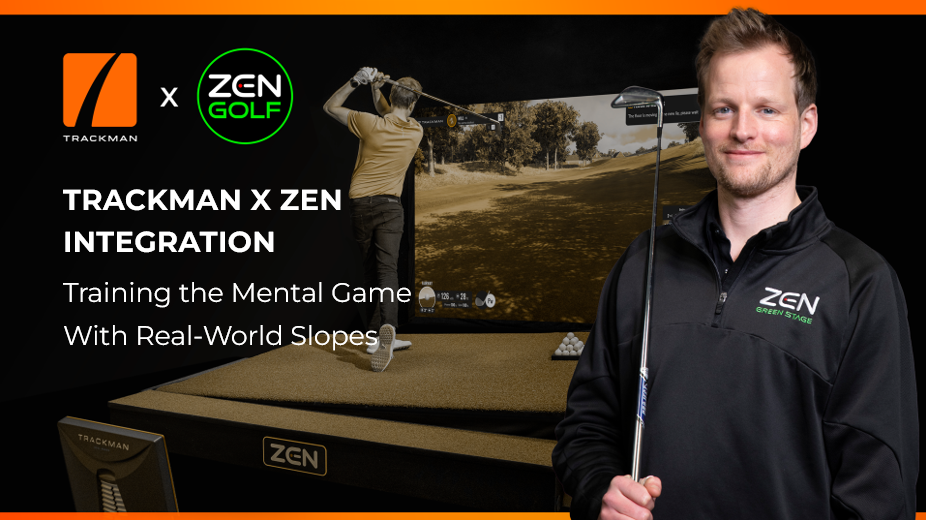
When Trackman is combined with the Zen Swing Stage, the environment begins to resemble the real course.
The golfer must read the lie, evaluate the slope, and choose a shot.
Practice becomes decision-making rather than repetition.
This is where the mental game begins to develop.
Written by: Will Stubbs, Head of Education, Zen Golf
Last Updated: 23/03/2025
The Mental Game Begins With Perception
Every golf shot starts with perception.
The player observes:
- The lie
- The slope
- The distance
- The landing area
- The risk
The shot selection happens through exploring the environment and becoming aware of both themselves and the opportunities they can exploit.
Flat practice removes most of this process. The player stands on a level surface and repeatedly hits the same shot.
Virtual Golf with Zen Golf slopes introduces the environment again.
The player must decide:
- Can I launch this shot low enough off this uphill?
- Will this ball release more because of the downhill?
- How will the side slope affect my start line?
The golfer is not just executing a swing.
They are solving a problem.
Slopes Change What Is Possible
Slope alters the golfer’s action capabilities.
Action capability describes what a player can do in each situation.
For example:
- Uphill lies often increase effective loft and launch.
- Downhill lies reduce launch and shift low point forward.
- Sidehill lies influence balance, power and path.
These changes influence which shots are realistic.
A shot that works on flat ground may not work on a side slope.
Training on slopes teaches players to recognize these limits.
They begin to understand what the environment and their body allows.
This develops what we call ‘swing awareness’ and is explored deeper in our blog Understanding Swing Tendencies on Slopes.
Virtual Golf Creates Decision-Making Opportunities
On the course, players make hundreds of small decisions, but they only experience each shot once.
Trackman’s Virtual Golf creates an opportunity to repeat those decisions.
With On-Course Practice, a player can play the same shot and hole multiple times.
Each time they face:
- Different slopes
- Different distances
- Different strategic options
With the Trackman × Zen integration, those decisions now include the physical slope under their feet.
Instead of guessing how the lie will influence the shot, the player feels it.
The decision becomes grounded in experience.
Within research realms, this is known as embodied decision making.
Connecting Decision-Making With Performance Data
Trackman provides measurement for every shot.
It captures:
- Launch conditions
- Carry distance
- Spin
- Dispersion
- And many more
When this data is paired with slope-based practice, coaches gain a deeper understanding of player behavior.
They can observe patterns such as:
- Players who choose overly aggressive lines
- Players who avoid certain shot shapes
- Players whose performance drops under uneven lies
- Players who consistently misjudge slope influence
These insights support better coaching conversations.
Instead of discussing only swing mechanics, coaches can explore decision patterns and tendencies.
Linking the Mental Game to Physical Skills
The mental game is often described as focus or confidence.
In reality, it is strongly connected to perception and decision-making.
When a player has experienced similar situations before, confidence increases.
Slope-based training links the mental and physical parts of the game.
The same integration discussed across the Trackman × Zen series applies here.
For example:
- Optimizer on Slopes demonstrates how launch efficiency adapts to terrain.
- Map My Bag on Slopes shows how distance control changes across lies.
- Speed Training on Slopes reveals how ground reaction forces influence club speed.
- Slope-Based Putting Training exposes how pace control changes on gradients.
Virtual Golf with Zen Swing Stage combines all these elements into a single environment.
The player must make decisions about the shot while experiencing the physical slope.
Amplifying Learning Through Slopes
Coaches can design practice environments that amplify learning.
Using slope and course simulation together allows them to highlight specific challenges.
For example:
- Uphill shots may encourage players to understand how launch conditions change.
- Downhill approach shots develop distance judgement.
- Sidehill lies reveal balance and path tendencies.
When these situations appear during course play on Trackman, players begin to connect the lesson environment with the course environment.
This improves learning transfer.
Lessons no longer stay in the bay.
They appear in the player’s next round.
What This Reveals for Coaches
Slope-based Virtual Golf practice exposes patterns that flat practice hides.
Coaches can observe:
- Decision speed
- Shot selection tendencies
- Risk tolerance
- Performance changes across slopes
This information helps coaches guide both technical and strategic improvement.
Players also feel the relevance of the lesson.
They see how the work relates directly to the course.
This strengthens engagement and retention.
Bringing the Course Indoors
The Zen philosophy behind our technology is simple:
- Connect the learning environment with the performance environment.
Trackman measures performance.
Zen recreates terrain.
Virtual Golf connects those measurements with real decision-making.
Players are no longer just hitting balls.
They are playing golf.
Key Takeaways
The mental game develops through decision-making.
Flat practice reduces decision complexity.
Slope-based training restores the environmental challenges of golf.
Virtual Golf allows players to repeat those decisions in realistic conditions.
Trackman provides measurement.
Zen provides golf course at their feet.
Together they create a practice environment where the golfer learns not only how to swing, but how to play.
Explore What Slope-Based Mental Game Training Could Mean for You
For Players
Develop better on-course decision-making by practicing real golf situations. Experience how slopes influence club delivery, shot shape, distance control, and putting pace so your choices on the course become faster and more confident.
For Coaches
Use slope-training to observe how players make decisions under realistic constraints. Identify tendencies in shot selection, risk management, and performance across uneven lies, then connect lesson insights directly to on-course play.
For Colleges and Academies
Create structured on-course training environments indoors. Use Trackman and Zen slope technology to develop strategy, decision-making, and performance consistency across the full game.
For Indoor Golf Centers
Deliver premium course-play experiences that go beyond simulator golf. Real slopes combined with Trackman course simulation create immersive environments where players practice real golf decisions, not just swing mechanics.
Explore the Trackman × Zen Integration Overview
Discover how real slopes and real data combine to bring the golf course indoors.
Book a Call
Discuss how slope-based Virtual Golf sessions could strengthen your coaching program, academy curriculum, or indoor facility experience.
