
Trackman × Zen Integration: 3D Motion Analysis on Slopes for Better Golf Coaching
Overview
Modern golf technology has transformed how we measure performance.
Trackman allows us to capture:
- Ball data
- Club delivery
- Launch conditions
- Spin and carry
- Dispersion patterns
This has elevated coaching from opinion to measurement.
The next evolution is understanding the golfer.
Trackman’s 3D Motion Analysis and AI motion capture add a critical layer by capturing how the golfer’s body moves during the swing. When combined with the Trackman × Zen integration, this movement data becomes far more meaningful.
Golfers do not swing in isolation, they adapt to the ground beneath them.
As slope changes, the golfer reorganizes:
- Posture
- Balance
- Pressure
- Segment coordination
- Timing
This changes the swing.
Trackman captures the ball, the club, and now the player. Zen Swing Stage recreates the slope conditions that shape how that movement emerges.
The result is a more complete system.
Not:
“What should the swing look like?”
Instead:
“How does this golfer adapt their movement to the task?”
For a full system overview, see: Trackman × Zen Integration Explained
Written by: Will Stubbs, Head of Education, Zen Golf
Last Updated: 10/04/2025
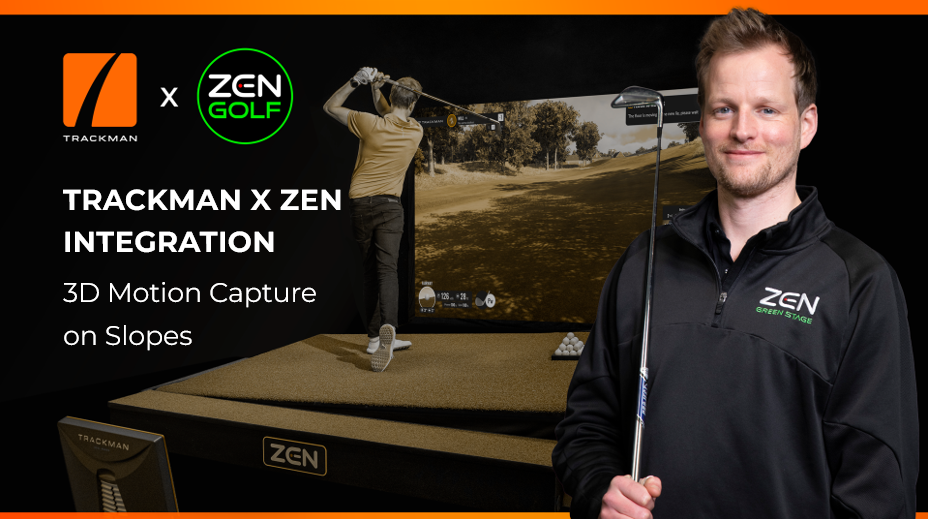
Why 3D Motion Capture Matters in Golf Coaching
Trackman 3D motion capture allows coaches to move beyond outcome and into process.
Ball data shows what happened.
Club data shows how it happened.
Motion capture begins to show why it happened.
Trackman’s 3D Motion Analysis allows coaches to study:
- Pelvis and thorax rotation
- Posture and inclination
- Sequencing and timing
- Segment coordination
- Movement variability and tendencies across swings
Two golfers can produce a similar launch window or carry distance through very different movement solutions.
One may be robust and adaptable.
The other may depend on flat, idealized conditions.
This matters even more once slopes enter the task.
A golfer standing on a 4% uphill lie is not solving the same movement problem as a golfer standing on flat ground.
The body must adapt and that adaptation is not noise.
It is information.
This is one of the same arguments made in How Slopes Change Your Golf Swing Mechanics.
Slopes do not simply alter the outcome of the shot. They reorganize how the golfer produces the shot in the first place.
That is where 3D motion capture becomes powerful.
It helps us see the player’s adaptation, and tie this to the shot result.
Movement Changes on Slopes: What Trackman Can Now Show
When Trackman 3D Motion Analysis is used on slopes, coaches can begin to observe how the player reorganizes movement under changing terrain.
That may include changes in:
Posture and Inclination
Players often adjust spine angle, pelvic orientation, and overall setup shape to match the slope.
Balance and Segment Control
Slope changes how the golfer manages center of mass, especially in transition and through impact.
Rotation and Tilt
Uphill and downhill lies may change how thorax and pelvis rotate, tilt, and sequence.
Pressure-Driven Movement Tendencies
Even without a force plate, visible movement adaptations can help coaches infer how the golfer is organizing around balance and ground interaction.
Strike-Related Adaptations
Changes in body organization often show up in:
- Low-point control
- Dynamic loft
- Attack angle
- Strike quality
This is where 3D motion capture becomes far more useful when paired with the wider Trackman data set.
You are no longer only asking “What happened?”
You can now ask:
- How did the golfer move?
- How did slope influence that movement?
- Did the player adapt functionally or break down under constraint?
That is a much richer coaching conversation.
For more on how these movement changes show up in launch and delivery, see Trackman × Zen Integration: Key Trackman Metrics on Slopes.
From Technical Models to Player-Centered Coaching
Traditional golf coaching has often used movement capture to compare players against an ideal technical model.
That can be useful in some cases, but it can also become limiting.
A player-centered approach asks a better question:
What movement solution is this golfer using, and how functional is it for the task they are trying to solve?
This is where ecological dynamics become useful reference to support the coach and technology they use.
From that perspective, skill is not repeating one perfect movement pattern. Skill is the ability to produce functional outcomes under changing constraints.
That means movement should not be judged only by whether it matches a textbook.
It should be judged by whether it helps the player solve the problem in front of them.
Slope makes that recognizable.
The same player may:
- Stand differently
- Sequence differently
- Load differently
- Rotate differently
- Strike differently
…depending on whether the lie is uphill, downhill, sidehill, or compound.
That is not a flaw, but what happens on the course.
This is one of the core themes in Trackman × Zen: Make Swing Changes That Transfer to the Course.
Real improvement does not come from making a swing look better in one indoor condition. It comes from helping the player organize movement that still works when the course changes the problem from shot to shot.
What 3D Motion Capture on Slopes Reveals About the Golfer
When 3D motion capture is used within a slope-based environment, coaches can identify:
- Where movement patterns remain stable
- Where they begin to break down
- How players adapt under constraint
- How different players solve the same problem differently
Trackman 3D Motion Analysis helps separate:
- The visible outcome
- The movement strategy that produced it
- The adaptation pattern behind it
That is what makes this such a powerful coaching tool.
It supports a more player-centered approach because it helps coaches stop treating every golfer as if they should solve the same problem in the same way.
Instead, it allows us to ask:
- What is this player’s preferred solution?
- Where does it hold up?
- Where does it become fragile?
- What should practice expose next?
This links closely with the argument in Trackman × Zen Integration: Common Data Misinterpretations Without Ground Context. Data only becomes meaningful when it is interpreted within the environment that produced it.
Motion capture is no different.
A flat-ground swing trace may look “clean.”
That does not mean it tells the whole story.
Why Flat Motion Capture Is Incomplete
Flat-ground motion capture can be useful for baseline observation.
It can help identify tendencies in a stable environment.
What it often misses is whether those tendencies survive when golf becomes golf again.
Without slope, we miss:
- How movement adapts under balance demands
- How sequencing changes under constraint
- How strike patterns reorganize
- How decision-making influences movement
This is where Zen adds something genuinely important.
By recreating uphill, downhill, sidehill, and compound lies, Zen Swing Stage changes the movement problem.
That means 3D motion capture can begin to answer more relevant questions:
- Does this player lose balance on downhill lies?
- Does thorax rotation change on uphill slopes?
- Does side bend or inclination reorganize on sidehill lies?
- Does movement sequencing remain functional under terrain constraint?
- Does the player’s “best swing” only exist on flat ground?
Those are better questions for performance and transfer.
At the heart of this we need to consider the functional problem solving the player is completing. Each golfer swings in their own way, based on their own biology, hence we need to consider their own tendencies and how slopes work with or potentially against them.
We explore further in our article Trackman x Zen Integration: Understanding Swing tendencies on Slopes.
It is also the same reason Trackman × Zen Integration: Using Optimizer on Slopes becomes more useful than flat-ground optimization alone. Once the environment changes, the interpretation of “good” changes too.
From Movement Capture to Better Practice Design
This technology is only useful if it changes what we do next.
That is where it becomes exciting.
3D Motion Capture on slopes allows coaches to design practice around:
- How the player currently adapts
- Where their solution is robust
- Where it becomes fragile
- What environmental changes expose useful learning
This creates better coaching interventions.
Instead of giving a golfer a generic technical fix, a coach might:
- Expose them to repeated downhill lies to improve low-point stability
- Use uphill lies to challenge posture and launch management
- Use sidehill lies to study how balance changes club delivery
- Compare flat vs slope movement to identify where transfer breaks down
That creates a more representative practice environment.
It also creates a better learning environment.
This connects strongly with Trackman × Zen Skills Testing and Practice with Zen & Trackman. The real goal is not simply to gather more data. It is to use data to design better practice.
Closing the Practice–Performance Gap
One of the biggest challenges in indoor golf is the gap between what looks good in the bay and what transfers to the course.
Motion capture can either widen that gap or help close it.
When it is used only to chase idealized movement positions in a flat environment, it can become disconnected from real performance.
If it is used to study how golfers adapt under realistic constraints, it becomes much more useful.
That is where the Trackman × Zen system becomes different.
Trackman captures:
- Ball data
- Club data
- Player movement
Zen recreates:
- The slope
- The terrain demands
Together, that gives coaches a much richer window into:
- How the player moves
- How the environment shapes movement
- What is likely to transfer to the course
This creates a system that reflects golf more accurately.
For a broader view of how this helps bridge indoor and on-course performance, see Closing the Practice Gap with Trackman and Zen Swing Stage.
Key Takeaways
Trackman’s AI Motion Capture and 3D Motion Analysis give coaches a more complete picture of the golfer.
Zen Swing Stage gives that movement data a more realistic environment.
That combination matters as golf swings are not static.
They adapt to the lie, the slope, and the task.
This means movement should not be judged only by what it looks like on flat ground.
It should be understood in relation to the problem the golfer is trying to solve.
This is where Trackman × Zen becomes so valuable.
Trackman helps us measure:
- What the golfer did
- What the club did
- What the ball did
Zen helps ensure the environment asks a more realistic question.
Together, they support a more player-centered, transfer-focused approach to golf coaching.
Explore What 3D Motion Capture on Slopes Could Mean for You
See how your swing adapts when the environment changes and understand which tendencies transfer to the course.
Use player, club, and ball data together to study how each golfer solves movement problems under realistic terrain demands.
Build player development environments that reflect the adaptive demands of real golf.
Offer a more advanced coaching and performance experience grounded in real movement and real context.
Explore the Trackman × Zen Integration Overview
Explore Zen Swing Stage, Zen Green Stage, and Zen Golf Stage
Book a call to discuss how motion capture on slopes could support your players or facility.
