
Liam Mucklow and the Golf Lab Model: A Guide for Coaches
Overview
The Golf Lab model is a player development system built around diagnosis before prescription. Liam Mucklow uses that model with the Zen Swing Stage to connect biomechanics, force measurement, club delivery, equipment, and realistic slope training.
Liam founded The Golf Lab to bring a data-led development environment to golfers. The Golf Lab’s own history describes its work across research, coach education, club optimization, and academy development.
Liam is as a leader in biomechanics, club fitting, and skill acquisition, with work that has shaped the development of certified professionals across multiple continents.
The first article in the series, How Zen Master Coach Liam Mucklow Uses the Zen Swing Stage to Improve GRF, shows an applied example of Golf Lab’s diagnostic model in action. This article explains the system behind that example, by diving into the key measurement metrics and the process.
Written by: Will Stubbs, Head of Education, Zen Golf
Last Updated: 04/06/2026
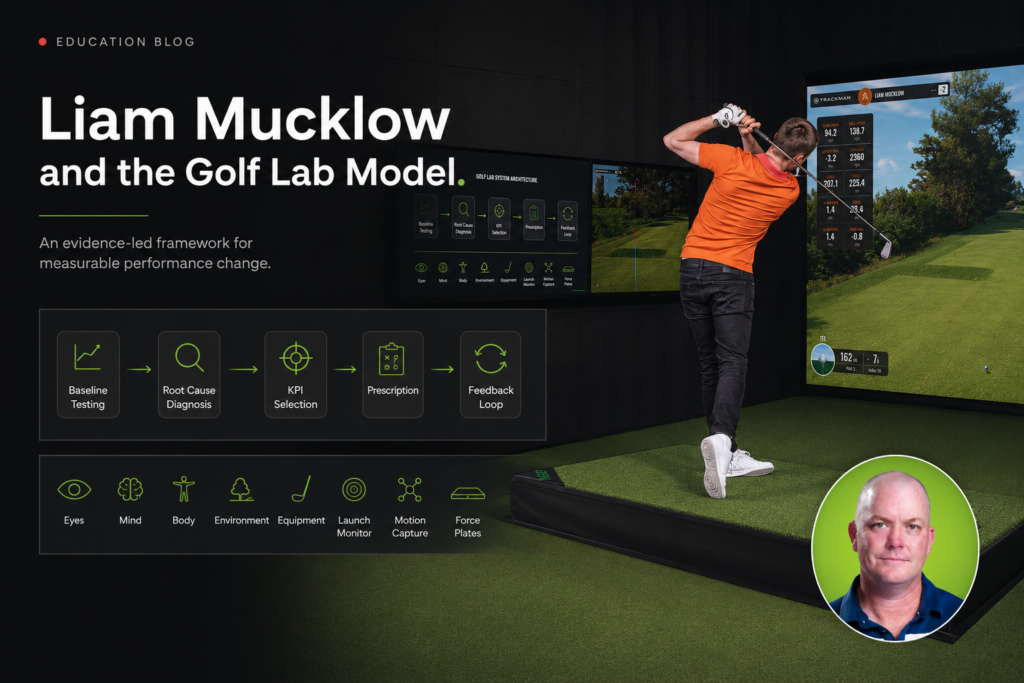
The Core Principle: Root Cause Before Prescription
The Golf Lab System Architecture places Root Cause Diagnosis at the center of the entire system. Everything before it is data collection. The intervention after it depends on how accurately the coach identifies the root cause.
That principle changes coaching behavior.
A coach does not begin by prescribing a drill because the player hit a poor shot. The coach first identifies whether the issue comes from the player’s visual system, cognitive profile, physical capacity, equipment, environment, movement pattern, force pattern, or club delivery.
Only then does the coach select a Key Performance Indicator, or KPI.
These KPI’s fit as a single measurable metric with the highest cascade potential for the individual player development at that moment.
This gives the coaching process discipline. It prevents a player from chasing five swing thoughts when one higher-leverage change would affect the rest of the system.
The Golf Lab Human System
The Golf Lab System Architecture places Root Cause Diagnosis at the center of the entire system. Everything before it is data collection. The intervention after it depends on how accurately the coach identifies the root cause.
That principle changes coaching behavior.
A coach does not begin by prescribing a drill because the player hit a poor shot. The coach first identifies whether the issue comes from the player’s visual system, cognitive profile, physical capacity, equipment, environment, movement pattern, force pattern, or club delivery.
Only then does the coach select a Key Performance Indicator, or KPI.
These KPI’s fit as a single measurable metric with the highest cascade potential for the individual player development at that moment.
This gives the coaching process discipline. It prevents a player from chasing five swing thoughts when one higher-leverage change would affect the rest of the system.
Phase 1: Baseline Testing
The Golf Lab architecture captures 10 baseline domains before diagnosis.
These include Eyes, Mind, Body Stability and Mobility, Body Strength and Power, Environmental Conditions, Lifestyle and Constraints, Current Equipment, Launch Monitors, 3D Motion Capture, and Force Plates and Pressure.
This broad baseline is important because golfers are not identical data sets.
Two players can produce similar ball flights for different reasons. One may have a mobility restriction. Another may have poor target perception. Another may be using equipment that changes delivery. Another may be reacting to a surface or tee height variable.
The baseline phase protects against shallow interpretation.
Phase 2: Root Cause Diagnosis
Root Cause Diagnosis is the hub where all baseline data converges.
The architecture asks whether the root cause is visual, cognitive, physical, equipment-related, environmental, or constraint-based.
This is where Liam’s coaching model becomes more precise.
A launch monitor might show excessive path from the inside. Motion capture might show late pelvis rotation. Force plates might show trail-foot pressure dropping early. The coach still needs to determine why that pattern exists.
The answer may be physical. It may be equipment. It may be visual. It may be psychological. It may be environmental.
The coach’s job is to find the highest-leverage cause.
Phase 3: KPI Selection and Prescription
The first output of The Golf Lab model is not a drill. It is KPI selection.
Once the root cause is identified, the system selects one KPI, two prescribed options, and a feedback loop. The KPI then directs drill recommendation, club optimization, and launch condition targets where relevant.
This matters because not every player needs the same solution.
A player may need a biofeedback drill. Another may need equipment optimization. Another may need club delivery targets. Another may need a change in practice environment.
Liam’s model does not force every golfer through the same intervention. The KPI determines the branch.
Phase 4: Feedback Loop
The Golf Lab model includes a feedback loop.
The golfer trials two options, reports back, remeasures, and recalibrates. The KPI may shift as the player improves.
This is a strong fit for modern coaching.
Players change over time. A useful KPI in January may not remain the highest-leverage KPI in April. As stability improves, the next issue may become equipment. As club delivery improves, the next issue may become shot selection or environment.
The system becomes more individualized with each cycle.
Where Zen Swing Stage Fits the Model
The Zen Swing Stage coaches a controllable environmental and task variable.
The coach can assess the player on flat ground, then observe how the movement pattern changes on slope. That gives more information for Root Cause Diagnosis.
If the player’s issue only appears when the surface changes, the environment is part of the problem. If the player’s force pattern remains stable across slopes, the coach may look elsewhere. If equipment behaves differently on slope because posture and delivery change, fitting may enter the prescription.
The Trackman × Zen Integration Guide shows how Zen’s physical slopes and Trackman data support this type of integrated assessment.
Why This Model Builds Authority
The Golf Lab model starts with diagnosis before prescription.
Many golfers arrive at coaching sessions with visible symptoms. Ball flight may be inconsistent. Strike location may move across the face. Club path may shift under pressure. The first response is often to change the visible swing pattern.
Liam’s model slows that process down.
The Golf Lab System places Root Cause Diagnosis at the center of the system. Baseline data is collected first, then the coach determines why the pattern exists before selecting one KPI with the highest cascade potential.
That creates a more reliable coaching pathway.
A player’s issue may come from visual perception, physical capacity, cognitive bias, equipment, environment, force timing, or club delivery. Two players can produce the same ball flight for different reasons. A system that diagnoses the cause protects both the coach and player from generic intervention.
This is where the Zen Swing Stage adds value. It gives the coach a controllable way to test how movement changes when the ground changes. The Stage does not replace diagnosis. It adds a realistic environmental variable that helps the coach ask better questions.
The same principle appears in Representative Learning Design and Functionality of Research and Practice in Sport. The research argues that practice should preserve the information and actions that matter in performance.
For Liam, the coaching authority comes from the relationship between system and setting. The Golf Lab model identifies the cause, and the Zen Swing Stage helps expose how that cause behaves under course-like conditions.
Key Takeaways
The Golf Lab model starts with baseline testing across human, environment, equipment, movement, force, and performance data.
Root Cause Diagnosis determines why the issue exists before a prescription is selected.
KPI Selection identifies the single metric with the highest cascade potential.
The Zen Swing Stage adds slope as a controlled task and environmental input.
Liam’s coaching model combines data with applied learning design rather than treating technology as the solution by itself.
What’s The Next Step?
For a deeper education pathway, continue with related Zen Golf articles on representative practice, slope-aware learning, putting performance, and transfer from training to the course. These themes help explain why players often perform well in controlled practice, then struggle when the ground, target, and consequence change.
Start with the Liam Mucklow pillar article, How Zen Master Coach Liam Mucklow Uses the Zen Swing Stage to Improve GRF, then explore the wider Zen Golf Resource Hub for more education on:
- Representative practice
- Slope-aware learning
- Putting performance
- Transfer from training to the course
- Practice design for adaptability
Coaches who want to see these principles in applied settings should explore Zen’s Master Coaches. Their work shows how elite coaching environments use realistic conditions, clear feedback, and structured task design to help players adapt more effectively.
For facilities, academies, and coaches building this type of environment, the relevant product pathways are Zen Green Stage for putting, green reading, pace control, and short-game training on realistic gradients, Zen Swing Stage for full-swing training from uneven lies and slope interaction, and Zen Golf Stage for integrated putting and hitting environments.
