
Jason Day vs Akshay Bhatia: What A Truist Championship Practice Round Reveals About Adaptability
Overview
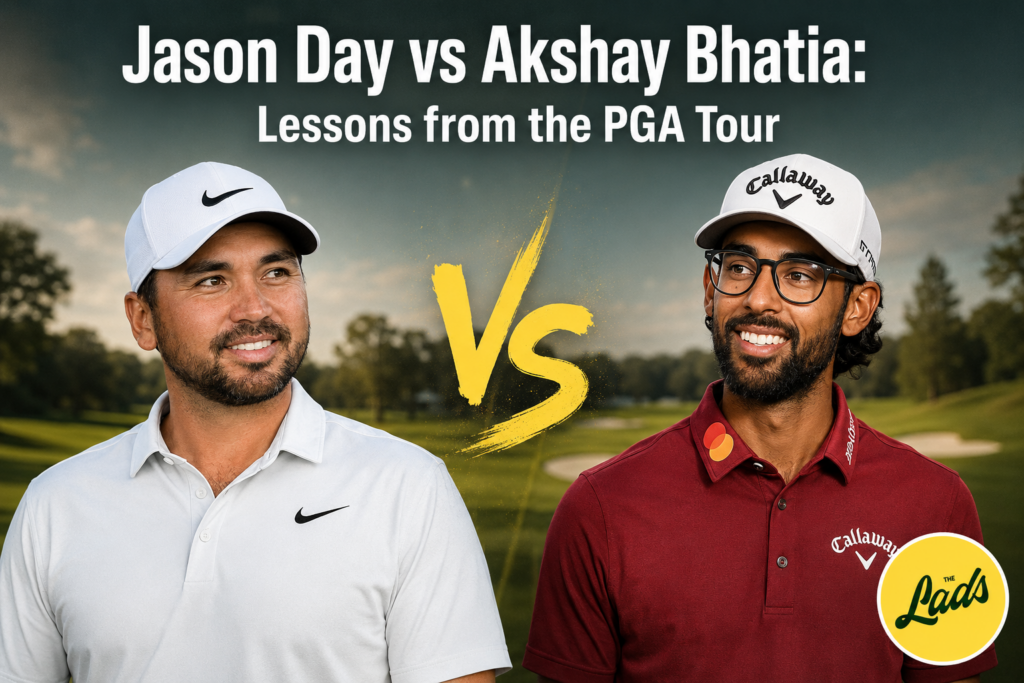
Jason Day and Akshay Bhatia’s match play practice round before the Truist Championship gives coaches and players a clear view of how elite golfers adapt to real course conditions. The video, published on The Lads YouTube channel in collaboration with the PGA TOUR, follows both players at Quail Hollow as they work through wind, slope, lie, green speed, club choice, and shot shape.
Elite golf performance depends on choosing the right solution for the shot in front of you, then executing that solution with enough commitment to match the conditions.
The event context matters. The Truist Championship is a PGA TOUR event that returns to Quail Hollow Club in Charlotte, North Carolina, and the players are using it as a warm-up for the PGA Championship at Aronimink the following week.
This article provides coaches, players, and golf facilities with an applied framework for understanding elite shot adaptation, then shows how representative practice and slope-aware learning can help bridge the gap between controlled training and on-course performance.
Written by: Will Stubbs, Head of Education, Zen Golf
Last Updated: 12/05/2026
Reframing Consistency In Golf
Many players describe consistency as repeating the same movement. Jason Day and Akshay Bhatia show that PGA Tour golf has a more applied version of consistency.
A player becomes more reliable when they develop several usable solutions. A straight shot, a cut, a draw, a lower flight, a higher launch, a softer landing, and a controlled miss each solve a different problem.
This view is consistent with representative learning design, a concept proposed in sport science to help coaches design practice tasks that preserve the key information and action demands of performance. Pinder, Davids, Renshaw, and Araújo describe representative learning design to maintain functionality and action fidelity between practice and performance environments.
Akshay’s caddie gives one of the clearest examples in the video. He describes Akshay playing the 18th at Bay Hill with the same yardage in regulation and in the playoff, yet choosing two different shots.
In regulation, Akshay hit a draw 9-iron.
In the playoff, he hit a cut 7-iron.
The number stayed similar, but the wind changed the shot.
That example matters because distance alone did not decide the shot. Wind, start line, curve, trajectory, landing angle, and consequence shaped the decision.
What Jason And Akshay Reveal About Shot Adaptation
Wind Changes The Task
Throughout the match, Jason and Akshay talk through wind direction before almost every full shot. They discuss wind off the right, wind helping, wind hurting, and how elevation increases the effect of the wind.
That process changes the player’s intention. A 177-yard shot into wind from elevation does not behave like a 177-yard shot from a flat lie in calm air. The ball spends more time exposed to the wind, so trajectory and launch become part of the decision.
For coaches, this is where practice design becomes important. A player who only trains from flat, stable surfaces receives less exposure to the information that shapes on-course decisions. Representative learning design research supports the idea that practice tasks should preserve the perception-action relationship of the performance environment.
Slope Changes The Player
Akshay’s comments about Augusta are insightful because he talks about subtle tee-box slopes and stance conditions. Those details are easy to miss, yet they affect balance, setup, pressure, face control, and start direction.
Everyone says tee boxes are flat, but even at the most prestigious and premium major venue, they’re not flat. This highlights a key issue with our practice environments, we practice hitting drivers on a flat mat, but even on the PGA Tour they have slopes and this affects shot shaping and decision making.
Research into golf shots from different lies has examined how uneven terrain changes weight transfer during the swing, which supports the practical coaching view that slope affects movement organization rather than only ball flight.
A 2024 biomechanical study on slope perception and body control also concluded that golfers need improved slope perception in toe-down, toe-up, and right-direction slope conditions through proprioceptive training. This aligns with the coaching need to expose players to the ground conditions they face on the course.
This is why Zen Golf developed the Zen Swing Stage, as a moving floor that replicates on-course gradients. The purpose is to help players learn how their movement, aim, speed, and ball behavior respond when the ground changes beneath them.
Green Speed Changes The Short Game
Jason and Akshay repeatedly comment on the speed of the greens. Downhill putts, chips landing on slopes, and recovery shots from collection areas all demand specific pace control.
Putting research supports this emphasis. Campbell and Moran’s study on green reading found that professional golfers used more economical gaze behavior than elite amateurs and club players when reading virtual sloped putts, and professionals predicted 76.5% of putts accurately compared with 57.1% for the elite and club groups.
More recent putting research in PLOS ONE examined how golfers perform on steep slopes. The study found that amateurs underestimated slope steepness compared with professionals, and that this under-recognition influenced aim and launch direction.
Those findings support the point Jason demonstrates in the video. When greens are fast and sloped, performance depends on reading the surface, matching speed to line, and choosing leave positions that reduce the cost of a miss.
Attention, Focus and Akshay’s Short Game
Akshay’s short game discussion is one of the strongest coaching moments in the video. He explains that his chipping improved when he stopped thinking about every technical detail and focused more on the hole, the ball, and the shot required.
That change in attention affects behavior.
When a player becomes too aware of how the motion looks, they often lose connection with the task. The landing spot, pace, trajectory, and roll-out become secondary. When attention returns to the task, technique still matters, but it has a clearer purpose.
Jason also talks about trust. He explains that different methods, grips, and styles work when the player believes in them and produces a repeatable result. That point appears during the discussion around putting styles and cross-handed chipping.
The coaching implication is practical. A player does not need every motion to look conventional. They need a motion that produces a predictable ball response under pressure. This highlights why adopting a human-first approach to coaching is so important.
The Value Of One Clear Option
Akshay makes an interesting point about preferring some bunker shots to simple chips. A difficult shot often gives him one clear option. A simple chip creates several options, such as putting, pitching wedge, 60-degree wedge, lower flight, higher flight, more spin, or more release.
The easier shot becomes harder when the player has too many choices. We call this ‘drowning in freedom’. Sometimes constraints create creativity and allows the player to attune attention to intentionality.
That is an important detail for practice design. Some players do not need more technique. They need clearer decision rules.
A coach might help by defining:
- The default chip shot for neutral lies
- The preferred landing window
- The release pattern
- The club selection hierarchy
- The miss pattern that still leaves a manageable putt
Once those rules exist, the player has less decision noise. They make cleaner choices and players can commit with confidence earlier.
Why Representative Practice Matters
Representative practice means training in conditions that preserve the key information a player uses on the course. The slope, lie, target, green speed, distance, wind, visual aim, and consequence all influence how the player organizes movement.
The Jason Day vs Akshay Bhatia video shows why this matters. The players and caddies constantly match the shot to the environment. They build the shot around the task.
This is where Zen Golf’s technology has a specific role in learning design. Zen Green Stage supports putting and short-game environments where slope and ball roll become part of the feedback. Zen Swing Stage supports full-swing training from varied lies. Zen Golf Stage brings putting and hitting applications together for facilities that want a broader performance environment.
Zen products support richer practice conditions and clearer performance testing. They do not replace coaching judgment. They give coaches and players a more representative environment for asking better questions.
What Coaches Can Take From The Match
Build Practice Around Decisions
A productive practice session should include decision-making, not only repetition.
This means a coach might ask the player to choose:
- The safest miss
- The intended start line
- The curve required
- The landing area
- The trajectory window
- The club that best matches the shot
This turns practice into a performance rehearsal. The player learns how to select and execute, rather than hit the same shot until the movement feels familiar.
Train The Same Yardage In Different Ways
Akshay’s 9-iron draw and 7-iron cut example is a useful practice template.
It also connects directly to Challenge Point Theory, which explains how learning improves when task difficulty is matched to the player’s current skill level. Guadagnoli and Lee’s Challenge Point Framework suggests that practice should create enough uncertainty to generate useful learning information, without making the task so difficult that the player cannot interpret the feedback.
As explored in Zen Golf’s education blog on Challenge Point Theory and golf practice, the coach’s role is to adjust the task so the player receives meaningful feedback. Too little variation can make practice comfortable but low in learning value. Too much variation can overwhelm the player and reduce transfer.
A coach might set one distance and ask the player to solve it through different flights:
- Standard stock shot
- Lower flight into wind
- Higher landing shot
- Draw pattern
- Cut pattern
- Conservative miss to the wide side
- Aggressive shot to a tucked pin
The yardage stays constant, but the task changes. That variation helps the player understand how ball flight responds to intention, club selection, and environment.
For a developing player, the coach might begin with two options, such as a stock shot and a lower flight. For an advanced player, the same yardage can become a higher-challenge task with multiple shot shapes, different targets, and changing slope types on the Zen Swing Stage. This keeps the challenge close enough to the player’s current ability to support learning, while still preparing them for the variability they face on the course.
Use Slope To Expose Transfer Gaps
Flat practice often hides problems that appear on the course. A player might strike the ball well from level ground, then lose start line, low-point control, or speed control when the ball sits above or below the feet.
Slope gives the coach more information.
On Zen Swing Stage, a coach can ask how the player adapts pressure, alignment, ball position, and face awareness on uneven lies. On Zen Green Stage, a putting coach can test how the player reads break, pace, and aim on realistic gradients.
These ideas also connect with the work of Zen’s Master Coaches, whose coaching environments show how realistic practice design supports transfer from training to performance.
What Players Can Take From The Match
Jason and Akshay show that elite players spend much of their time clarifying the shot before they hit it.
Players at every level can apply a simpler version of the same process:
- Read the lie
- Read the slope
- Read the wind
- Choose the intended ball flight
- Choose the safest miss
- Commit to one clear shot
This does not require a tour-level skill set, but a more specific pre-shot process.
When the player has a clear task, the swing has more context. When the task is vague, technical thoughts often fill the space.
Zen Golf: Bringing Course Variability Into The Learning Environment
Zen Golf’s mission is built around connecting the learning environment with the performance environment. The brand manual describes realism as recreating the shapes, slopes, and experience of the course, and positions Zen to help players own their learning journey.
The Jason Day vs Akshay Bhatia match shows why that connection matters.
Golfers do not play from one stance, one lie, one speed, or one visual picture. They play from changing ground, changing slopes, and changing consequences. Practice becomes more transferable when those variables appear in training with enough structure for the player to learn from them.
Zen Green Stage, Zen Swing Stage, and Zen Golf Stage support that process by making slope and ground interaction part of the coaching conversation.
The result is a more complete learning environment. Players receive feedback from the ball, the ground, the target, and the coach in the same task.
Key Takeaways
- Jason Day and Akshay Bhatia’s match shows how elite players adapt shot choice to wind, slope, lie, and consequence
- Akshay’s same-yardage example at Bay Hill shows why one number can require two different shots
- Research on representative learning design supports practice tasks that preserve the key information and action demands of performance
- Green-reading research shows that professional golfers use visual attention differently when reading sloped putts
- Putting research on steep slopes shows that amateurs often underestimate slope and aim too low
Zen Green Stage, Zen Swing Stage, and Zen Golf Stage support practice environments where slope and task design become part of learning
What’s The Next Step?
For a deeper education pathway, continue with related Zen Golf articles on representative practice, slope-aware learning, putting performance, and transfer from training to the course. These themes help explain why players often perform well in controlled practice, yet struggle when the ground, target, and consequence change.
Coaches who want to see these principles in applied settings should also explore Zen’s Master Coaches. Their work shows how elite coaching environments use realistic conditions, clear feedback, and structured task design to help players adapt more effectively.
For facilities, academies, and coaches building this type of environment, the relevant product pathways are:
- Zen Green Stage for putting, green reading, pace control, and short-game training on realistic gradients
- Zen Swing Stage for full-swing training from uneven lies, slope interaction, and variable ground conditions
- Zen Golf Stage for integrated putting and hitting environments where players can train across a wider range of course-like tasks
Explore the wider Zen Golf education library, learn from the Zen Master Coaches most relevant to your coaching or facility goals. The aim is to create practice that reflects the game more closely, so players learn how to adapt before the course asks them to.
