
The 70 Percent Rule In Indoor Golf Practice
Overview
If you’re succeeding more than 9 times out of 10 in practice, you’re not learning fast enough.
When practice becomes too easy, progress slows because the brain is no longer solving meaningful problems.
The Challenge Point learning zone often appears when success is high enough to sustain confidence and low enough to require adaptation.
True improvement lives in the 70% success zone, in that delicate balance between challenge, confidence and competence.
Written by: Will Stubbs, Head of Education, Zen Golf
Last Updated: 27/04/2026
Why Does Comfortable Practice Limit Learning?
Most golfers associate improvement with consistency. They chase “perfect reps,” hit balls from flat mats, and celebrate the comfort of a grooved swing, but golf isn’t played in comfort.
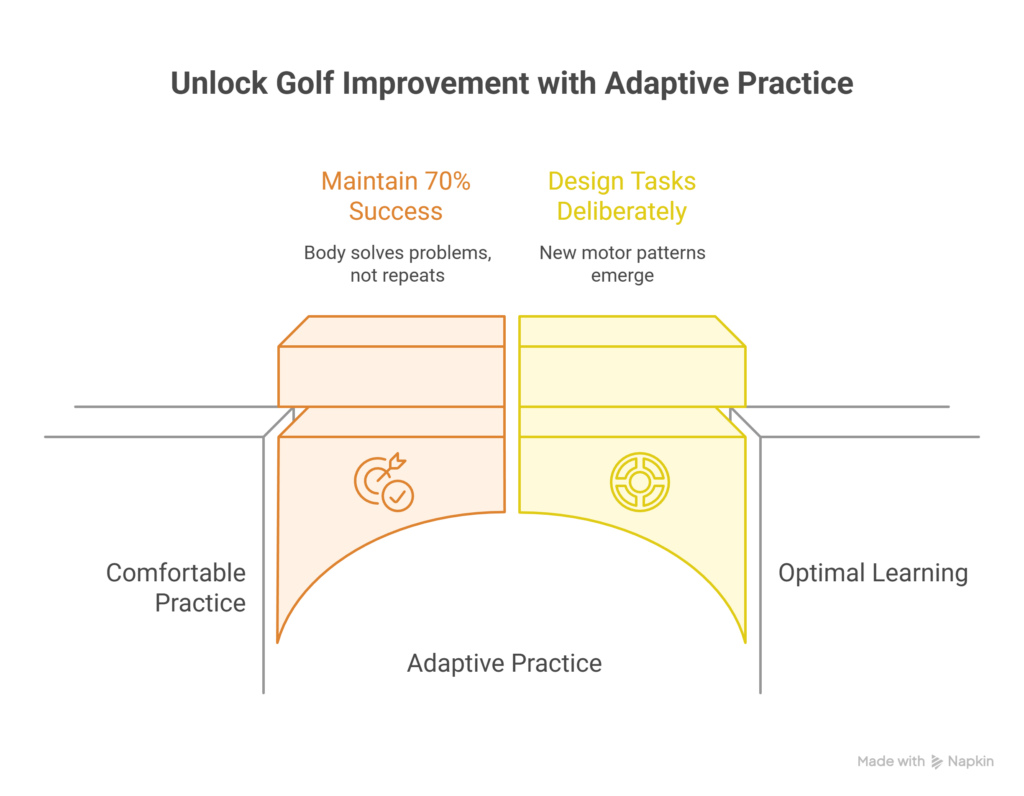
Motor-learning research, from Guadagnoli & Lee’s Challenge Point Theory, shows that the optimal learning window is around 70% success. When difficulty is too low, feedback starts to become meaningless. When it’s too high, the nervous system shuts down. At roughly 70% success, your body is solving problems and not repeating patterns.
Zen Golf practice environments use this principle by adjusting slope, target size, distance, and scoring rules.
Using Trackman to Measure your Learning Zone
Trackman’s Performance Center gives players objective ways to measure this “challenge point.” Each session produces Strokes Gained (SG) vs Handicap data for each shot, club, and target distance.
How to interpret SG bands:
| Result | Meaning | Action |
| SG within ±0.10 vs Handicap | Ideal difficulty (≈70% success) | Stay here — optimal learning. |
| SG > +0.10 (too easy) | Task too simple; plateau risk | Increase slope angle or tighten target dispersion. |
| SG < –0.20 (too hard) | Task too challenging | Reduce slope severity or widen scoring zones. |
Example:
Your 9-iron to 130 yds from a flat lie averages SG = +0.25 (too easy). Move onto varied 2–6% downslopes on the Zen Swing Stage, re-run the same block, and aim to keep SG within –0.10 to +0.10. That is your learning zone.
The key isn’t maximizing SG during practice, but stabilizing performance within that band under increasingly harder constraints. This develops the adaptability that the course will ask of you.
How the 70% Rule Fits into the PoST Framework
The 70% challenge zone is the heartbeat of the PoST Framework.
- Coordination Phase: Movements stabilize at ~70 percent success on representative slopes.
- Adaptability Phase: Variability increases while maintaining 60–70 percent success.
- Performance Phase: Players hold that 70 percent window under competitive constraints., the goal is to hold that 70% zone under pressure and unpredictability.
PoST gives the 70% rule a time-based structure, ensuring each week of training builds on the last.
How to Use Slopes to Control Challenge
The Zen Swing Stage acts as a precise difficulty dial. By adjusting slope gradient and direction, you manipulate the environmental constraint that drives adaptation.
| Slope Type | Learning Focus | Challenge Adjustment |
| 2% Uphill | Tempo, sequencing | Moderate challenge |
| 4% Sidehill (ball above feet) | Path control, draw bias | High challenge |
| 6% Diagonal Downhill | Pressure transfer, stability | Peak challenge |
Progress through these as your Trackman SG stabilizes around ±0.10. When your data shows >85% of shots beating handicap, increase the slope, shrink the target zone, or add variability, like a bandwidth of distances rather than just one. When success drops below 60%, ease constraints until performance returns to the 70% zone.
Example: The 130-Yard Ladder
- Week 1: Flat lie, 130 yd, SG = +0.05 → Too easy.
- Week 2: 2% random Slope, SG = –0.08 → Optimal.
- Week 3: 4% random Slope, SG = –0.25 → Too hard.
- Week 4: Reduce slope to 3%, SG = –0.12 → Back in zone.
That fluctuation is non-linear learning in action. Your nervous system explores, adjusts, and stabilizes, which is the hallmark of genuine skill growth.
Coach Applications
- Design practice around SG bands: Each task should aim for ±0.10 vs Handicap.
- Modify environment before mechanics: Use slope, distance, or feedback delay to shift difficulty before offering verbal cues.
- Track weekly SG trendlines: Improvement is not linear. Track the journey, not just averages.
Player Applications
- Welcome variability: Three bad shots per 10 means your brain is working.
- Monitor SG drift: If it creeps above +0.10, you’re rehearsing, not learning.
- Own the Adjustments: Change slope or target yourself, autonomy accelerates adaptation.
Zen Practice Tip
- Use Trackman Performance Center’s Custom Practice mode:
- Set 3×10 shots at variable distances (100–150 yds).
- Randomize slope every shots on your Zen Swing Stage (2–6%).
- After each set, export SG vs Handicap report.
- Highlight any block where SG ≈ –0.10 and mark as “optimal challenge.”
These blocks form the baseline for the next week’s plan, helping players calibrate challenge rather than chase perfection.
Closing Thoughts
Real learning is messy, and that’s exactly how it should be.
Holding practice within the 70 percent zone — supported by Trackman SG data and slope control on a Zen Swing Stage or Zen Green Stage — turns every swing into a dialogue with gravity and the environment.
Progress comes from embracing the seven shots that work and learning from the three that do not. Real slopes, real data, and real environments create lasting improvement.
Real Slopes. Real Data. Real Golf.
