
Pebble Beach and the Indoor Golf Realism Problem
Overview
Indoor golf realism is no longer only about graphics, ball flight, and course visuals. For Dr Scott Lynn, the real test is whether a player practices the physical conditions the course will ask them to solve.
Indoor golf realism means the player sees the course, receives accurate shot data, and experiences the lie beneath their feet.
Scott is a Zen Master Coach, biomechanist, and Head of Research at Swing Catalyst. His work focuses on how golfers interact with the ground through pressure shifts, ground reaction forces, and movement patterns, which makes his view of simulator practice especially relevant for coaches, players, and indoor golf facilities.
This article builds on Dr Scott Lynn: The Three Key Reasons for the Zen Swing Stage. In that first article, Scott explained why the Zen Swing Stage matters for realistic virtual golf, lie-specific practice, and constraint-led coaching.
His Pebble Beach story gives the first of those reasons a practical shape.
Written by: Will Stubbs, Head of Education, Zen Golf
Last Updated: 09/06/2026
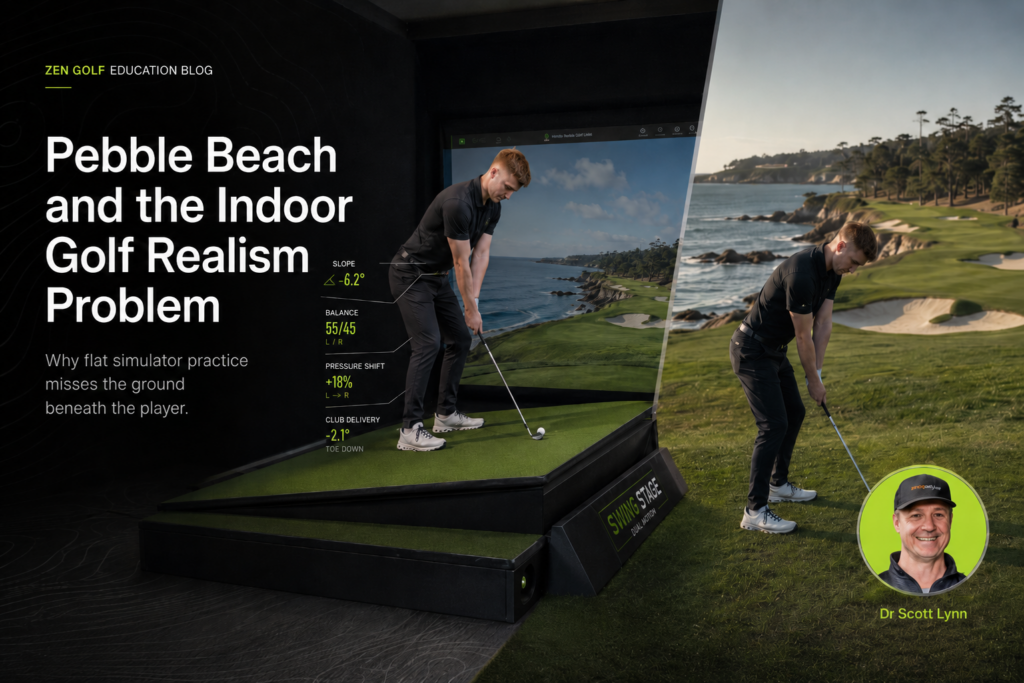
The Pebble Beach Practice Gap
Before playing Pebble Beach Golf Links, Scott rehearsed the course in a simulator.
The virtual practice helped him understand the first hole. He knew the intended line, the club choice, and the second-shot yardage. His plan was to hit three-iron toward the left bunker, then play eight-iron into the green from that position.
On the real course, the yardage matched what he had seen indoors. The strategy still made sense. Once he reached the ball, the lie changed the task.
The ball was below his feet.
That condition influenced posture, balance, start line, delivery, and shot expectation. Scott overcompensated and missed into the left bunker.
His simulator rehearsal had prepared the visual and strategic parts of the hole, but the physical interaction between player, ground, and shot had not been part of the practice task.
This is the realism problem in indoor golf.
A simulator can show a course accurately while the player still stands on a flat surface. When the screen presents one task and the body experiences another, practice loses part of its connection to performance.
Why Does Flat Simulator Practice Have Limits?
Flat simulator practice has a clear role. It helps players calibrate distance, test ball flight, measure launch conditions, and rehearse decisions in a controlled setting.
Problems appear when flat ground becomes the only version of indoor practice.
Golf is played across changing surfaces. Fairways tilt. Approach shots come from uphill, downhill, ball-above-feet, ball-below-feet, and compound lies. Each lie changes how the player organizes setup, balance, pressure, and club delivery.
Scott’s research helps explain why this matters. Ground reaction forces are the forces exchanged between the golfer and the ground during the swing, and Swing Catalyst’s force versus pressure explanation provides useful context for coaches who want to interpret those forces accurately.
A flat mat removes much of that environmental variation. The player might still get useful data, but the task has been simplified. For indoor golf to support stronger transfer, the practice environment needs to ask more of the body than a flat surface allows.
Why Indoor Golf Realism Depends On The Ground
Most simulator systems are strong at visual realism. Players see the course, target, hazards, landing areas, and ball flight.
Physical realism requires another layer.
The player needs to feel how the lie affects setup and movement. A ball-below-feet lie changes balance and often influences start direction. An uphill lie changes the player’s relationship to launch, low point, and pressure. A downhill lie changes how the golfer manages contact, braking, and rotation.
The wider Trackman × Zen Integration Explained articles explore this issue from a technology perspective. When launch data, simulator visuals, and ground interaction come from the same shot, virtual golf becomes more representative of real play.
For course-play contexts, Trackman × Zen Integration: Virtual Golf with Real-World Slopes explains how simulator golf changes when the lie under the player can match the hole on screen.
That distinction matters for facilities and coaches. Visual rehearsal helps a player understand where to hit the shot. Slope-aware rehearsal helps the player learn how the body must adapt to produce it.
How Does the Zen Swing Stage Change Practice?
The Zen Swing Stage gives coaches and players a way to recreate uphill, downhill, sidehill, diagonal, and compound lies indoors.
In Scott’s Pebble Beach example, the missing variable was the ball-below-feet lie. With the Zen Swing Stage, that lie can become part of the rehearsal instead of appearing for the first time on the course.
The player can now explore practical questions during practice:
- How does this lie change setup?
- Where does balance move during the swing?
- What start line becomes more likely?
- How does pressure shift under each foot?
- Which shot shape gives the player more margin?
- Does the intended club still suit the lie?
These questions connect indoor practice to on-course behavior. The player is no longer rehearsing a hole as a visual memory alone. They are practicing how the shot feels when the ground changes.
For coaches, that shift creates a more useful learning environment. The slope becomes part of the task design, which connects directly to Zen’s explanation of why golfers should train on slopes.
What Can Coaches Learn From Scott’s Pebble Beach Story?
Scott’s Pebble Beach experience separates strategic rehearsal from physical rehearsal.
Strategy helped him choose the correct target and club. The lie changed the movement demand. When the ball sat below his feet, the shot required a different physical solution from the one he had rehearsed indoors.
A coach using the Zen Swing Stage can make that gap visible.
For example, a player can first hit the Pebble Beach approach from a flat lie. The coach can record club delivery, ball flight, strike, and start line. After that, the player can repeat the same shot from a ball-below-feet lie.
The comparison gives the lesson practical weight. The player sees whether the slope changes face delivery, path, contact, curvature, or confidence. A coach can then adjust the task, the intention, or the environment.
This approach connects with the work of Zen’s Master coaches, where realistic practice design supports transfer from training to performance.
For coaches who want a more applied lesson-design perspective, How Coaches Use Slope in Lessons builds on the same principle by showing how slope can reveal movement, decision-making, and adaptation inside a coaching session.
Ground Reaction Forces and Representative Practice
Ground reaction forces describe how the ground pushes back against the golfer. Scott’s research materials show why this topic needs context. Golfers use horizontal force, torque, and vertical force in different ways, and pressure patterns vary across players.
Slope adds another constraint to that system. When the ground changes, the player’s movement solution often changes with it.
Representative practice matters because the coach’s goal is not to make practice complex for its own sake. The goal is to give the player enough of the real task to create relevant adaptation.
The Greg Chalmers case study gives a related example. In Scott’s work with PGA Tour winner Greg Chalmers, the Zen Swing Stage was tilted to simulate downhill lies, encouraging more rotational force and reducing excessive horizontal force patterns. Swing Catalyst data showed horizontal force decreased while rotational force increased, and Greg’s path shifted toward 1.4° after training.
That case study reinforces the same principle as the Pebble Beach story. The ground changes the problem the player must solve.
What Can Players Take From This?
Players often judge simulator practice by the quality of the numbers. Carry distance, ball speed, spin rate, club path, face angle, and launch direction all have value.
Scott’s Pebble Beach story adds another layer.
A shot can be measured well indoors and still be incomplete as preparation for the course. When a player faces slope outside, flat practice does not expose the same balance demand, setup adjustment, pressure shift, or delivery tendency.
Flat practice still matters. It gives structure, control, and repeatability. Slope-aware practice adds a different benefit because it asks the player to adapt.
That adaptation is central to playing golf well. The course rarely gives the same shot twice, so practice should help players learn how to respond when the lie changes.
For players and coaches who want to understand the mechanics behind that adaptation, How Slopes Change Your Golf Swing Mechanics explains how posture, balance, low point, club delivery, and ground interaction reorganize when the slope changes.
Applied Practice Example: Rehearsing Pebble Beach Indoors
A coach or facility could recreate Scott’s first-hole scenario in a structured session.
First, the player hits the planned tee shot and approach from a flat simulator surface. The coach records carry distance, shot shape, club delivery, and start line.
Next, the same approach is replayed from the real-world slope on the Zen Swing Stage with the Trackman integration. The target, club, and yardage stay as consistent as possible.
The coach then compares what changed:
- Setup
- Balance
- Pressure shift
- Strike location
- Low-point control
- Start line
- Curvature
- Club selection
- Player confidence
The purpose is not to make the shot harder, but make the rehearsal more representative of the shot the course might ask the player to hit.
This is where indoor golf moves from course visualization toward course preparation.
For Trackman environments, Trackman × Zen Integration: Key Trackman Metrics on Slopes gives coaches a useful framework for reading how club path, face angle, attack angle, carry, and dispersion change once slope enters the task.
Why Indoor Golf Realism Needs Slope
Indoor golf realism improves when the player sees the course, receives accurate shot data, and feels the lie underfoot.
Each layer answers a different part of the performance problem. Visuals help the player plan. Launch data helps the coach measure. Slope helps the body adapt to the task.
The Zen Swing Stage supports that third layer by bringing real-world lies into the simulator bay. For facilities using Trackman, the Trackman × Zen Integration Guide explains how moving floors, simulator software, and launch data can work together in practical indoor environments.
Scott’s Pebble Beach story shows why that matters. He did not need more knowledge of the hole. He needed prior exposure to the lie.
Key Takeaways
- Indoor golf realism includes the ground beneath the player, not only the course on screen
- Flat simulator practice helps strategy and calibration, but it does not fully prepare players for uneven lies
- Scott Lynn’s Pebble Beach experience shows how a correct plan can change when the ball sits below the feet
- Slope-aware practice helps coaches connect visuals, data, movement, and decision-making
- Zen Swing Stage gives players and coaches a way to experience and rehearse real-course lies indoors
What’s the Next Steps?
Explore how the Zen Swing Stage supports slope-aware simulator practice, or read Trackman × Zen Integration: Virtual Golf with Real-World Slopes to see how physical terrain, launch data, and virtual golf can work together.
For the wider Scott Lynn series, continue with Dr Scott Lynn: The Three Key Reasons for the Zen Swing Stage, then connect the coaching application to How Coaches Use Slope in Lessons and the performance science context in Zen Performance Science.
