
Closing the Practice Gap with Trackman and Zen Swing Stage
Overview
Most indoor practice environments remove the very information that shapes golf performance. When lies are flat and targets repeat, players train a version of golf that rarely appears on the course.
This article explores how realistic training environments change that. Drawing on insights from a playing lesson inside the Zen Swing Stage with Trackman integration, it explains why slope, stance, and environmental feedback transform practice from repetition into decision making.
Through concepts such as representative learning design, affordances, and slope awareness, the article shows how golfers begin to solve problems rather than simply repeat technique. The result is practice that transfers more effectively to the golf course.
Written by: Will Stubbs, Head of Education, Zen Golf
Last Updated: 12/03/2025
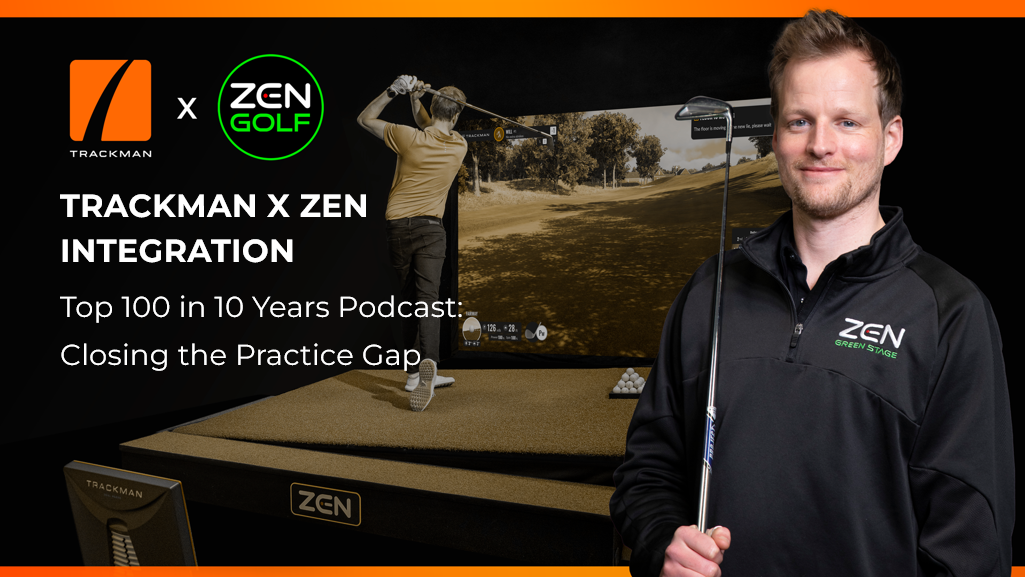
From 2D Practice to 3D Golf: Why Realism Changes Everything
Most golfers practice regularly. Yet their range performance often disappears on the course.
They struggle because practice often removes the very information that makes golf, golf.
That was the core shift in the podcast. The moment the floor started moving, the conversation stopped being about “how far is it,” and became “what is this shot asking me to do.”
This is the future of indoor golf. Not more data, but more reality.
Trackman Metrics That Reflect Speed Quality
When integrating slope and speed, monitor:
- Club speed
- Ball speed
- Smash factor
- Attack angle
- Dynamic loft
- Spin rate
- Carry distance
Speed without efficiency does not create distance.
As highlighted in previous slope-based discussions, the metric remains constant. The environment changes what they mean for the golfer.
Slope-based training exposes whether speed gains are robust or fragile.
The Gap Between Practice And Play Is Mostly Environmental
Most practice happens on flat ground, with consistent lies, repeated targets, and a single dominant variable: distance.
But on the course, distance is never the only variable. Almost every shot is shaped by:
- Slope under your feet
- Lie interaction
- Target depth, not just target distance
- Wind and weather
- Consequence and emotion
- Time pressure and social pressure
Remove those constraints and you reduce the task. The swing can look tidy, but the skill does not travel.
This is why the phrase in the podcast lands so hard:
“We’re not playing swing anymore. We’re playing golf.”
Representative Learning Design: Make Practice Carry the Same Information
In motor learning, we call this representative learning design. Practice needs to preserve the key information and constraints that shape performance.
The Zen Swing Stage is built around that principle.
When the Stage changes to match lie and slope, the player does not just see the course. They feel it.
- Their balance changes.
- Their aim changes.
- Their club choice changes.
- Their intention changes.
That is what transfer requires.
Why realistic indoor practice matters
-
Golf is played on changing ground. Most shots include slope, uneven lies, and stance adjustments that alter strike, start line, and distance control.
-
Flat practice removes key information. When the ground is neutral, golfers train swing execution without the constraints that drive real shot selection and adaptation.
-
Realism improves transfer. When practice preserves slope and lie interaction, the decisions and movement solutions are more likely to hold up on the course.
-
Decision making becomes the skill. Realistic environments force players to choose targets, manage risk, and plan for the next shot, not just select a club for a number.
-
Players learn their true tendencies. Generic rules (for example, “ball above feet equals draw”) often fail because golfers self-adjust. Realistic repetition reveals what the golfer does.
-
Coaching shifts from fixing to guiding. Coaches can observe how golfers perceive, decide, and adapt, then shape training around constraints instead of prescribing positions.
-
Psychological safety increases productive exploration. Indoors, golfers can test options, revisit shots, and reflect without pace pressure, lost balls, or social consequence.
Affordances Invite Action
As soon as Nish stood on ball above feet, then ball below feet, then downhill into a green running away, the environment began to “suggest” certain decisions.
That is an affordance.
An affordance is an opportunity for action created by the relationship between the golfer and the environment.
- A downhill stance invites a different strike intention.
- A sidehill lie invites a different start line picture.
- A severe lie invites a safer target and a better next shot.
On flat ground, many affordances disappear. That is why practice can become robotic.
On slopes, decision making returns.
Creativity Lives Between The Player and The Slope
The podcast showed something important. Nish started solving problems.
Not by being told what to do, but by interacting with the constraint and building a plan.
A downhill chip, into an upslope, onto a raised green became a strategy problem. The golfer tried to use the terrain to create a softer landing and manage speed.
This is creativity in golf.
Formed through their interaction with the environment and shot.
This is adaptability.
It is the ability to find a functional solution under changing constraints, which I discuss deeper within the blog Why Great Range Swings Fail on the Course: Rethinking Golf Practice.
Psychological Safety Changes Learning Behaviour
The other shift in the episode was emotional.
In a private environment, Nish experimented more. He was not worried about:
- Losing a ball
- Being watched
- Holding up play
- Paying for mistakes
That matters.
A psychologically safe environment increases exploration, reflection, and repetition with variation. That is how skill becomes robust, as discussed in our blog Developing Consistency Through Realistic Practice on Slopes.
You can replay the same scenario, then change one variable, then compare outcomes. That is hard to do on the course.
Stop Trusting Generic Slope Rules. Start Learning Your Tendencies.
One of the most valuable moments in the podcast was the “ball above feet should draw” myth breaking down.
The golfer described aiming right, expecting the ball to come back, and repeatedly watching it stay right. The frustration then bled into the next holes.
This is common. Not because the rule is always wrong, but because it assumes the golfer does nothing in response to the slope.
In reality, golfers self-organize. They adapt. Sometimes they neutralize the slope without realizing it.
That is why the big win is not learning rules. It is learning yourself.
This aligns with Zen’s approach to learning environments. The job is not to prescribe. The job is to reveal. To uncover what how slope tendencies need examining, explore our blog Understanding Swing Tendencies on Slopes.
A Simple Coaching Framework: Build a Slope Matrix for One Club
If you coach golfers who do not practice much, slope awareness is a shortcut to better scoring.
Pick one club, often a 7 iron or a wedge, and build a slope matrix:
- Flat baseline carry and shape
- Uphill carry and shape
- Downhill carry and shape
- Ball above feet pattern
- Ball below feet pattern
Then layer context:
- Lie type
- Pin depth and green depth
- Risk zones and safe zones
The objective is not “perfect mechanics.”
The objective is confidence in context.
That phrase from the podcast is correct. Competence builds confidence, but only when competence is trained in the same conditions the golfer competes in.
The Zen Thesis: Make Indoor Practice Feel Like Golf, Not Like a Lab
The episode framed it as moving from 2D to 3D. That is a useful simplification.
2D indoor golf often gives you ball flight data without the physical constraints that shape movement and decision making.
3D indoor golf adds the ground back in.
Takeaway
If practice only trains answers to “how far,” golfers become distance focused.
If practice trains slope, lie, and decision making, golfers become adaptable.
That is what the podcast captured. A golfer changing their mindset mid-session, because the environment finally asked the right questions.
