
Launch Control Without Over-Coaching
Overview
Putting launch control helps coaches understand whether the ball behaved in line with the player’s intention. It includes start direction, speed, strike, launch angle, skid, roll, and how the ball responds to the surface.
The coaching challenge is knowing when to intervene technically. A missed putt might come from poor face control. It might also come from a poor read, unclear pace intention, fear of the slope, or a task that does not invite the right behavior.
This is the fourth mini-blog in Zen Golf’s Putting Principles series. It follows Why Flat Putting Practice Often Fails To Transfer, Constrain To Afford In Putting Coaching, and Why A Green Reading Routine Starts Before The Stroke.
It also links back to Change The Slope, Change The Stroke: Using The Zen Green Stage To Develop The Three Principles Of Putting, where start direction sits alongside slope perception and speed control.
Written by: Will Stubbs, Head of Education, Zen Golf
Last Updated: 20/07/2026
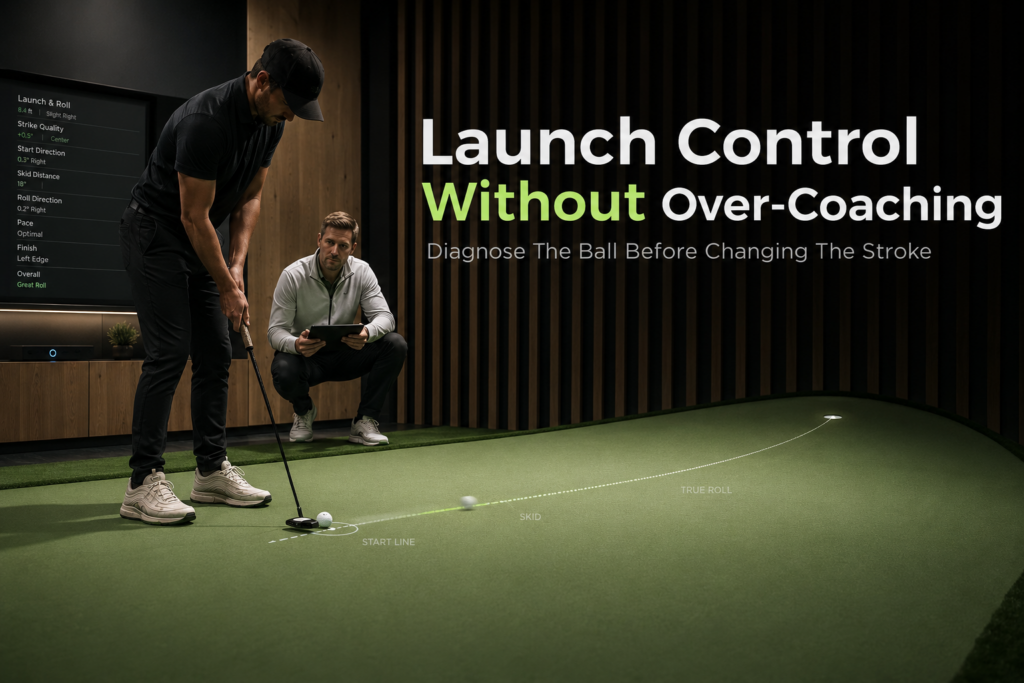
Launch Control Links The Three Principles
Launch should be assessed inside the full putting task.
The three principles are:
- Slope perception
- Speed control
- Start direction
Slope perception comes first because the player cannot choose a useful launch line unless they understand the putt.
Speed control matters because pace changes break, entry point, and miss consequence.
Start direction is the clearest link to launch control. The player must start the ball on the line required by the read.
Science & Motion’s putting education material resources note that face angle at impact is the largest influence on initial ball direction, while path also contributes to start direction. Science & Motion’s Fundamentals Of Putting is a useful technical reference for coaches who want to connect launch direction with face control and path.
The Ball Tells A Bigger Story Than The Stroke Alone
A stroke can look tidy and still produce poor ball behavior.
The ball might start offline. It might launch too high. It might skid too long. It might lose speed early. It might roll well but miss because the read was wrong.
That is why putting launch control should not become a narrow search for mechanical fault. The coach needs to compare three things:
- What the player intended
- What the stroke delivered
- How the ball behaved on the surface
Zen’s Quintic Putt Tracker & Zen Green Stage Integration Explained article makes this point clearly. It explains that putting performance is defined by how the ball rolls, while Zen Green Stage recreates slope and Quintic captures ball-roll data from impact to end roll. The same article explains how the combination helps coaches validate whether intention, execution, and outcome are aligned.
Why Slope Makes The Read More Representative
Slope changes the information available to the player:
- On a flat putt, the player might focus mainly on face control and pace.
- On a sidehill putt, the player must connect start line, speed, break, and entry point.
- On a downhill breaking putt, the player must also manage risk and leave consequence.
Zen’s Flat vs Sloped Practice: What Really Transfers explains why flat practice can remove key performance information. Zen’s Trackman × Zen Integration: Putting Training On Real-World Slopes also notes that uphill, downhill, and sidehill slopes change putting stroke patterns and reveal tendencies that flat practice can hide.
This matters for coaches because a missed putt is not always a stroke problem. The miss might begin before the putter moves.
Golf industry data also points toward the need for better learning environments. The R&A Global Golf Participation Report 2024 includes participation across on-course and non-traditional formats, while The R&A later reported more than 100 million golfers in affiliated markets across all formats. Indoor practice environments therefore need to support participation and skill transfer, rather than only repetition on flat surfaces.
Diagnose Before You Correct
Over-coaching often happens when the coach changes technique before the task has been understood.
A player misses low on a breaking putt. The coach sees the ball miss and moves straight into face angle or path. That might be the right intervention. It might also ignore the fact that the player aimed too low, hit the putt too firmly, or did not trust the high-side line.
A more useful sequence is:
- Ask the player to declare the read
- Ask the player to declare the pace
- Ask the player to declare the start line
- Watch the first 2 feet of the roll
- Track strike, launch, skid, and finish pattern where data is available
- Decide whether technique needs attention
This protects the lesson from becoming a stroke correction when the problem belongs to perception or intention.
This sequence is also consistent with representative practice design. Representative learning design research argues that practice tasks should preserve the information players use during performance, which in putting includes slope, pace, start line, ball roll, and consequence.
Applied Coaching Interventions
1: Start-Line Gate On Slope
Set an 8-foot breaking putt on the Zen Green Stage.
Place a start-line gate 12 inches in front of the ball.
Before each putt, the player states:
- Start line
- Entry point
- Entry speed
- Expected finish if the putt misses
The player then hits the putt through the gate while matching the chosen pace.
What The Gate Reveals
Run the task across different slopes:
- Flat
- Right-to-left
- Left-to-right
- Uphill sidehill
- Downhill sidehill
If the player reads well but misses the gate, launch direction needs attention.
If the player starts the ball well but misses because of speed, pace intention needs work.
If the player passes the gate on one slope direction but not another, the coach may be seeing a slope-specific aiming or stroke bias.
Zen Green Stage supports compound, double, and planar breaks on a true-roll surface, and the product page states that it integrates with Science & Motion and Quintic for putting analysis.
2: Roll-Quality Review
Set a straight or slight-breaking putt.
The player receives separate scores for:
- Start direction
- Strike quality
- Launch behavior
- Pace
- Roll quality
- Finish outcome
The coach should avoid judging the session by makes alone.
A holed putt can still provide poor feedback if the launch or roll quality was inconsistent. A missed putt can still show progress if the ball started on line, rolled well, and matched the chosen pace.
Why Ball-Roll Data Helps
Quintic Ball Roll measures ball speed, launch angle, vertical bounce, skid, backspin, roll, angular rotation, and revolutions per minute. Those data points help coaches separate impact quality from final outcome.
This matters because the ball can miss for different reasons. It might start on the intended line and roll poorly. It might roll well but start inside the gate. It might start and roll well but miss because the read or pace was wrong.
3: Slope Changes The Strike
Set the same 10-foot putt across four conditions:
- Flat
- Uphill
- Downhill
- Sidehill
Track strike location and start direction in each condition.
This intervention often reveals hidden adaptations. A player might strike the ball consistently on flat ground, then move toward the heel or toe when the slope changes.
The slope changes the player’s balance, aim, posture, eye position, confidence, and intention. The stroke follows those changes.
The goal is not to criticize the player’s movement, but to understand how the environment shapes adaption and delivery.
This connects with Trackman × Zen Integration: Putting Training On Real-World Slopes, which explains how slope-based putting tasks reveal patterns that flat practice can hide.
Where Zen Green Stage and SAM PuttStudio Enhances Context
SAM PuttStudio gives coaches another way to connect stroke mechanics with ball behavior.
Zen’s SAM PuttStudio & Zen Green Stage Integration Explained shows that SAM PuttStudio measures putting stroke mechanics and ball behavior, while Zen Green Stage introduces slope, gravity, and break.
Science & Motion also describes SAM PuttLab as supporting training strategies around putter face angle, face rotation, swing path, impact spot, swing timing, and stroke rhythm.
That makes the coaching question clearer. The coach can decide whether the next task should address the read, the pace, the launch, the strike, or the stroke pattern.
Coach Application
- Choose pace before final aim.
- Watch whether the ball starts on your intended line.
- Notice whether slope changes your tempo, aim, or grip pressure.
- Track strike quality across flat, uphill, downhill, and sidehill putts.
- Judge roll quality as well as make percentage.
- Use each miss to learn whether the issue was read, pace, or launch.
Player Application
- Read the putt before rehearsing the stroke.
- Choose pace before finalizing aim.
- Look from the low side and high side when the break is unclear.
- Commit to an entry point, not only a start line.
- Watch the whole roll, especially the final third.
- Use each miss to update your next read.
- Build a green reading routine that helps you see, decide, and commit.
Key Takeaway
Putting launch control helps coaches avoid premature technical correction. The ball’s start direction, strike, launch, skid, roll, and finish pattern show whether the player delivered the chosen intention.
The Zen Green Stage helps make that process more representative because the coach can change the ground, observe the behavior, and connect launch feedback to real slope.
To continue the Putting Principles series, read Why Flat Putting Practice Often Fails To Transfer, Constrain To Afford In Putting Coaching, and Why A Green Reading Routine Starts Before The Stroke.
Explore More
Pace control sits between green reading, stroke delivery, and ball-roll feedback. To understand the full learning pathway, start with the earlier articles in the Putting Principles series.
Read Change The Slope, Change The Stroke to see why slope changes the movement problem before the stroke begins. That article explains how representative putting practice helps players adapt to the relationship between task, surface, and intention.
Continue with Green Reading Is Educating Attention to understand how players learn to notice slope, break, pace, and entry point before they putt. Pace control builds from that same perceptual foundation because speed only makes sense when the player understands what the surface is asking the ball to do.
Explore Zen Green Stage to see how a moving floor that replicates on-course gradients supports pace-control putting, green reading, and slope-aware practice. It gives coaches a controlled way to create uphill, downhill, sidehill, compound, and double-breaking putts indoors.
For wider coaching context, explore Zen Green Stage Coaching Tips, which shows how coaches can use slope, finish zones, and adaptive tasks to make indoor putting practice more representative of on-course performance.
