
Ground Reaction Forces in Golf: A Coach’s Guide to Pressure and Force
Overview
Ground reaction forces in golf describe how the ground pushes back against the golfer during the swing.
Dr Scott Lynn, Zen Master Coach, biomechanist, and Head of Research at Swing Catalyst, has studied how elite golfers use pressure shifts and ground reaction forces during the swing.
For coaches, Dr Scott Lynn’s research helps simplify a complex topic into a practical coaching question: how does this player use the ground to organize movement, deliver the club, and control ball flight?
This article is the fifth blog in the Dr Scott Lynn ambassador series. Earlier articles explained why the Zen Swing Stage matters, how flat simulator practice misses slope, why players need lie-specific practice, and how constraint-led coaching helped Greg Chalmers change movement. The full series begins with Dr Scott Lynn: The Three Key Reasons for the Zen Swing Stage.
This explainer article focuses on the foundation beneath those ideas: pressure, force, and ground reaction forces.
Written by: Will Stubbs, Head of Education, Zen Golf
Last Updated: 30/06/2026

What Are Ground Reaction Forces in Golf?
Ground reaction forces, often shortened to GRF, are the forces exchanged between the golfer and the ground. Pressure shows where the golfer loads the feet, while force shows how the golfer pushes against the ground through horizontal force, rotational force, and vertical force.
When a golfer pushes into the ground, the ground pushes back. Scott explains this through Newton’s Third Law: for every action, there is an equal and opposite reaction.
In golf, ground reaction forces are the only external forces available to the player during the swing.
For a coach, this means the ground is part of the movement system.
The player does not create speed, stability, or rotation in isolation. The golfer organizes movement through the feet, legs, pelvis, trunk, arms, club, and ground. GRF data gives coaches a way to see how that interaction happens.
The Swing Catalyst ground reaction force resource explains that force plates measure force in three dimensions: vertical, right-left, and toe-heel.
Pressure vs Force in the Golf Swing
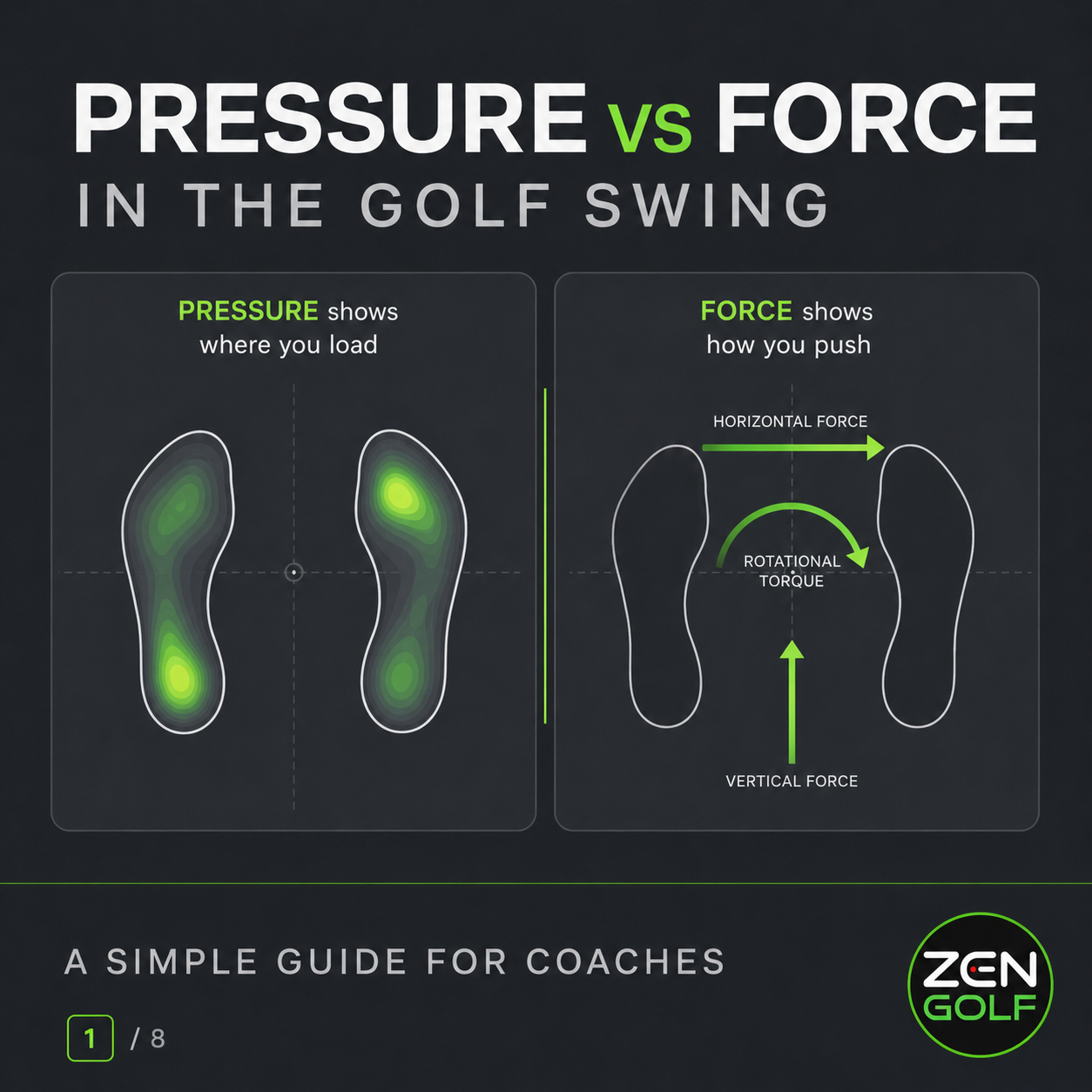


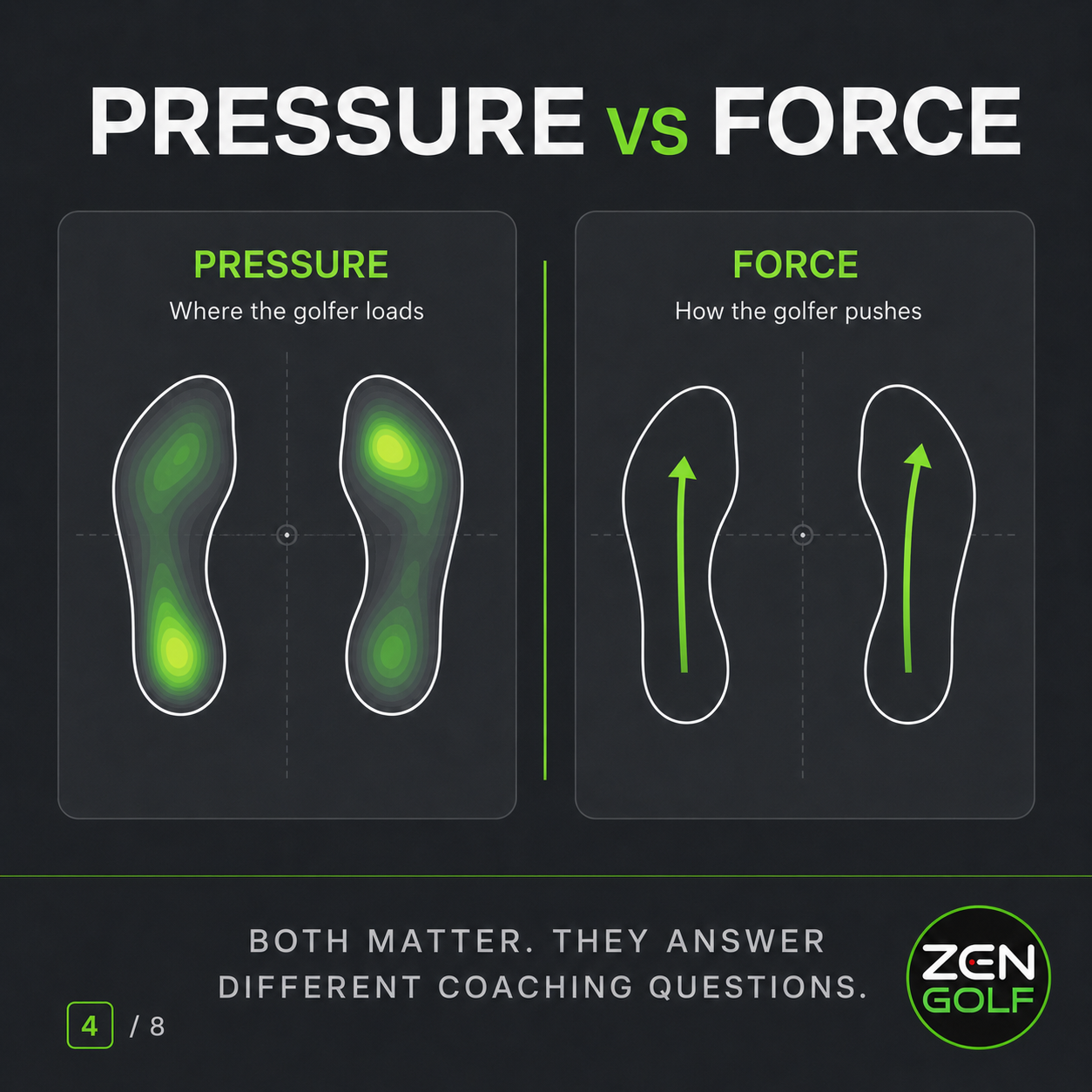

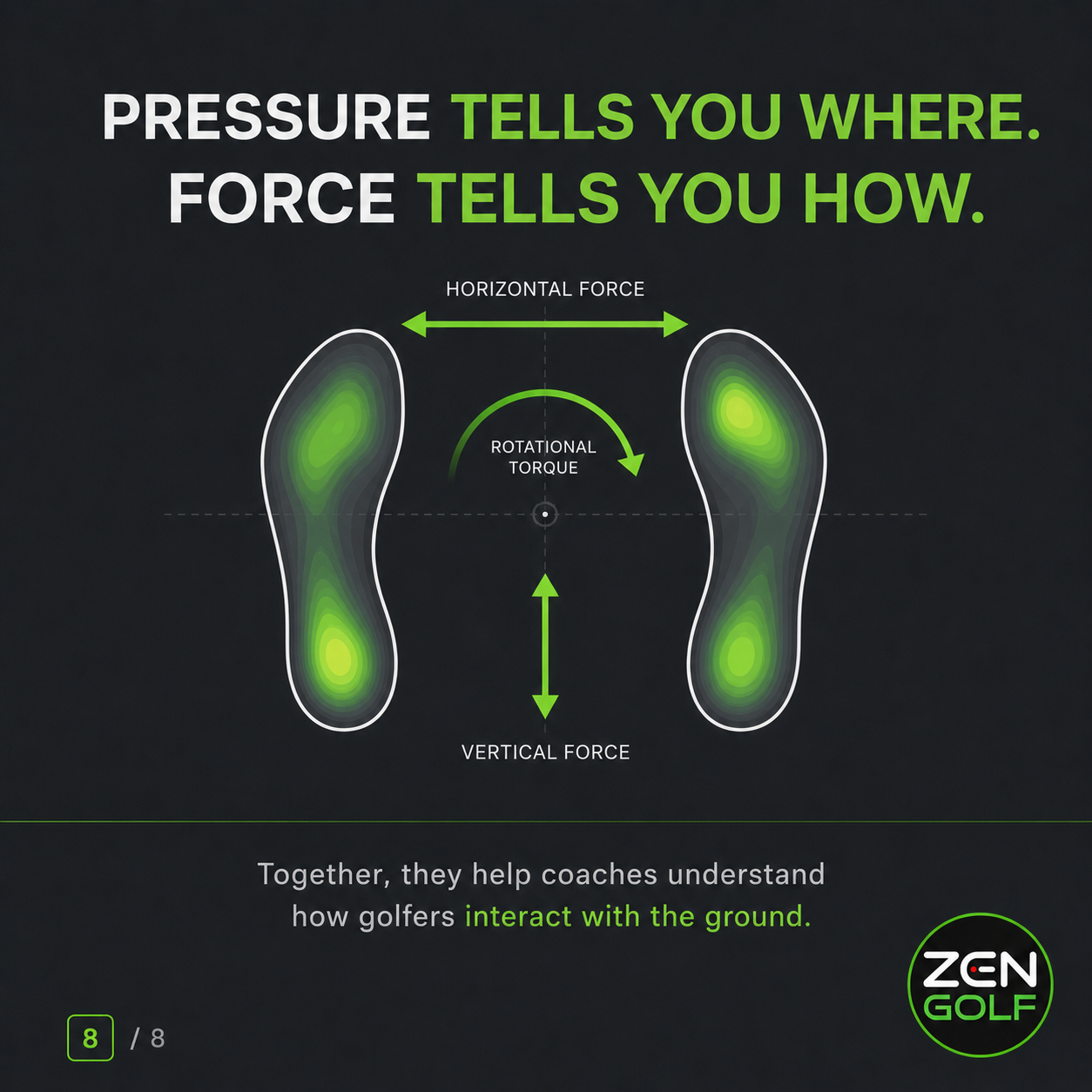
Coaches often hear pressure and force used together. They are connected, but they do not mean the same thing.
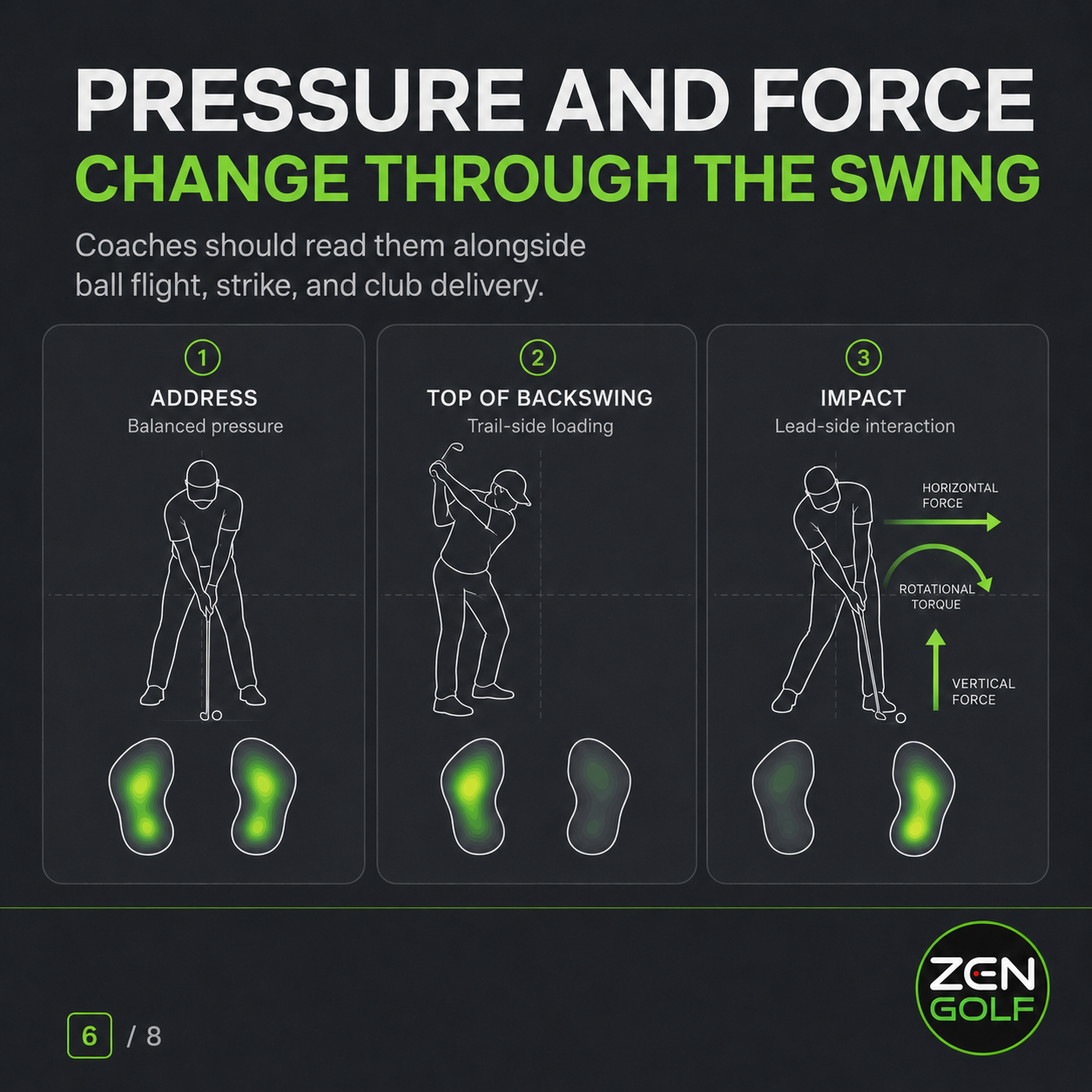
Pressure shows where the golfer is loading the feet. It helps coaches understand distribution, timing, and movement of the center of pressure.
Force shows how the golfer pushes against the ground. It includes direction and magnitude, which means it gives a fuller picture of how the player is interacting with the surface.
The Swing Catalyst force versus pressure explanation describes this distinction clearly. Pressure plates measure vertical pressure patterns, while force plates provide a fuller picture of three-dimensional ground reaction forces.
For coaches, a useful simplification is:
- Pressure tells you where the player is loading
- Force tells you how the player is pushing
- Ball flight tells you whether the movement solved the shot
- Video helps you connect the numbers to visible movement
A pressure trace can show a player loading the trail foot at the top and moving toward the lead foot through impact. Force data can show whether that player is using more horizontal, rotational, or vertical force to produce the swing.
Daniel Gray’s case study at Lake Nona gives coaches a practical example of why this distinction matters. Working with an elite U18 player, Daniel used the Zen Swing Stage and Swing Catalyst Dual Plates to examine how pressure and force timing were shaping ball-striking inconsistency.
The case study identified early rotation, excessive torque, premature vertical push-off, and limited horizontal force as connected problems. By placing Charlie on an upslope, Daniel encouraged a higher and earlier horizontal force peak, helped torque peak earlier and flatten out, and improved impact stability as pressure shifted forward.
The case study reported a cleaner impact pattern, including 80% pressure on the lead foot at impact, with more balanced use of horizontal, torque, and vertical forces.
This supports the coaching principle that pressure shows where the player is loading, while force timing helps explain how the player is pushing, sequencing, and stabilizing through the shot.
Scott Lynn’s Key Point: Golfers Use the Ground Differently
Scott’s research emphasizes the role of variability in golf kinetics. Golfers do not all use the ground in the same way. Differences can relate to body structure, movement patterns, skill, club type, and the task in front of the player.
That is important for coaching.
Golf-specific motor-control research supports this point. Variability is not automatically good or bad. It depends on where the variability occurs and whether it helps or harms the shot outcome.
In golf swing research, Morrison et al. on golf swing variability and uncontrolled manifold analysis show that skilled golfers can allow variation in some movement components while stabilizing the clubhead variables that matter for performance.
Horan et al. on movement variability in skilled golfers found that skilled male and female golfers used different upper-body movement strategies while still achieving similarly low variability in clubhead presentation.
The coaching implication is clear. Bad variability shows up when the club, strike, start line, or ball flight becomes unstable. Good variability appears when the golfer adapts movement to their body, the club, the lie, and the shot while still controlling the outcome.
This fits with Jones, Wallace, and Otto on ground reaction force variability in amateur golfers found problems can appear when the player overuses lateral motion and cannot brake it in time. This showed that variability in force patterns can provide meaningful information about swing coordination and skill.
Averages can help coaches understand context, but they should not become rigid templates.
Scott’s pressure distribution data shows typical patterns across groups. In the driver data, players averaged around 46% pressure on the back foot and 54% on the front foot at address, around 78% on the back foot at the top, and around 76% on the front foot at impact.
The same dataset also shows large ranges in pressure at impact. That means two players can produce effective shots with different pressure patterns.
A coach should therefore ask a better question than “does this match the average?”
The better question is: “Does this player’s ground interaction help produce the shot they are trying to hit?”
That question fits Zen’s wider education framework in Zen Performance Science, where performance is understood through the relationship between player, task, environment, and feedback.
The Three Main GRF Power Sources
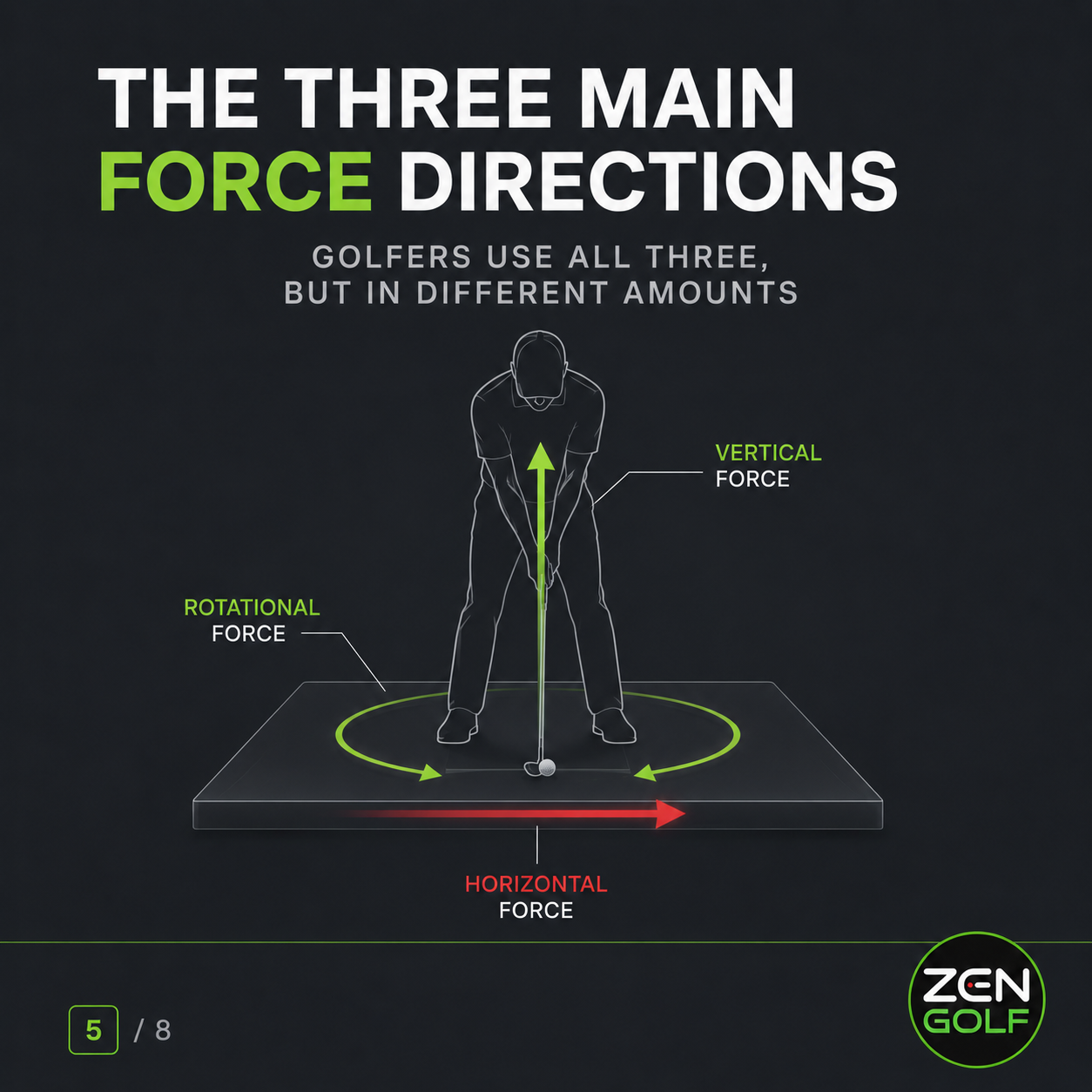
GRF can be simplified into three main power sources:
- Horizontal force
- Torque or rotational force
- Vertical force
All players use all three, but they use them in different timings and magnitudes.
This is the key point: the coach is not looking for one “correct” force pattern for every golfer. They are trying to understand which pattern this player relies on, how it affects delivery, and whether it supports the intended shot.
Horizontal Force
Horizontal force describes how the player pushes across the ground.
In a golf coaching context, this often relates to lateral motion, shifting, braking, and how the player manages movement toward or away from the target.
Scott describes horizontal force in the right-left direction, where positive force is toward the target reaction force and negative force is away from the target reaction force.
Horizontal force is not a problem by itself. Many players use it well.
That can affect low point, timing, rotation, strike, and face control. This is why GRF data should be read alongside club delivery, ball flight, and what the player is trying to do.
The Greg Chalmers case study from the previous blog gives a practical example. Scott identified high horizontal force and heavy trail-side pressure, then used a slope constraint to help Greg explore a different movement solution.
Torque or Rotational Force
Torque describes rotational force.
For coaches, this relates to how the player creates turning forces through the feet and ground. A player who uses torque well might create rotation without relying excessively on lateral motion or late timing.
Scott identifies torque as a transverse plane force and one of the GRF power sources in golf.
In practical coaching terms, torque can matter when a player struggles to rotate, gets stuck on the trail side, or relies too heavily on hand timing through impact. It may also help explain why a movement looks different under the same club delivery numbers.
The key is context. Torque should not be chased as a number in isolation, but interpreted in relation to the player’s pattern, physical capability, strike, shot shape, and task.
Vertical Force
Vertical force describes how the player pushes down into the ground and receives force back upward.
Golfers often associate vertical force with speed. That connection can be useful, but coaches should avoid treating vertical force as a universal answer. A player who mistimes vertical force can lose posture, change low point, or disrupt strike.
Scott’s presentation shows vertical force as a sagittal plane force and gives an example of peak vertical force on the lead leg. It also translates force in Newtons into body-weight terms to help explain scale.
For a coach, vertical force becomes useful when linked to timing. The question is not whether the player uses vertical force, but whether the player uses it at a time that supports delivery, contact, and ball flight.
Why Coaches Should Avoid Copying Tour Averages
Tour averages are helpful references, but they are not coaching instructions.
Scott’s presentation shows large variability across golfers, including differences in pressure shifts and dominant power sources. In one study summary, amateur golfers showed different dominant force tendencies across horizontal, torque, and vertical categories.
This matters because players solve movement problems differently.
One golfer might generate speed through more horizontal force. Another might rely more on vertical force. A third might organize the swing more around torque. Each pattern can work when the movement supports the shot.
For coaches, the risk comes from turning data into a model too quickly.
If a player does not match an average, that does not automatically mean the player is wrong. The coach needs to connect the GRF pattern to the player’s ball flight, physical tendencies, club delivery, injury history, and performance goals.
This is why How Coaches Use Slope in Lessons is a useful companion article. It explains how coaches can use slope as a task condition, then observe how the player adapts.
How Slope Changes GRF Interpretation
Flat-ground GRF data gives coaches a baseline, and slope adds context.
Zen Swing Stage changes the physical lie, Swing Catalyst measures pressure and force interaction with the ground, and Trackman measures ball flight and club delivery. Together, these systems help coaches connect the player, the lie, the movement, and the shot result.
When the player stands on an uphill, downhill, sidehill, or compound lie, balance demands change. Pressure shifts can reorganize. Horizontal force, torque, and vertical force may appear differently because the player is solving a different physical problem.
That is why the Zen Swing Stage is a key tool within the coaching environment. It gives coaches a controlled way to change the ground beneath the player and see how movement adapts in ways that resemble on-course demands.
The Trackman × Zen Integration Explained article shows how virtual lie, physical slope, and performance data can be synchronized in indoor golf. Trackman determines the ball’s lie and slope from simulator course data, Zen recreates the lie underfoot, and the player hits the shot while performance is measured with slope context.
For coaches working with launch data, Trackman × Zen Integration: Key Trackman Metrics on Slopes explains why path, face, attack angle, launch, carry, and dispersion need to be read differently when the golfer is standing on slope.
The same principle applies to GRF. Once the ground changes, the coach should expect the movement solution to change as the body self-organizes to the new constraint.
Supporting Research: Slope Type and Severity Change Pressure and Swing Dynamics
Golf-specific research supports this coaching point. Blenkinsop et al. on uphill and downhill slopes in golf studied elite male golfers hitting 6-irons from flat, uphill, and downhill lies using a system that created 5° slopes while collecting 3D kinematic and kinetic data. The study found that slope changed weight transfer, alignment, and shot outcome, with center of pressure behavior reorganizing across the swing when players moved from flat ground to uphill or downhill lies.
This matters for coaches because the slope is not a small background detail. It changes the task. Uphill and downhill lies alter how the golfer manages balance, pressure movement, body alignment, and delivery into the ball. A flat-ground pressure trace gives useful baseline information, but the same player may organize pressure and force differently when the ground angle changes. Blenkinsop et al.’s related work on center of pressure movement from uphill and downhill lies reinforces the same idea by showing that slope affects center of pressure behavior, alignment, and shot outcome.
Sidehill lies add another layer because the player is no longer only managing the target-line gradient. Li et al. on slope changes and amateur golf swing kinematics studied amateur golfers hitting 7-irons from flat ground, ball-below-feet, and feet-below-ball conditions at 10° slopes. Their findings showed that slope changed swing kinematics, body center of gravity movement, and shot parameters. This supports the coaching expectation that slope type and severity influence how the player organizes the swing, particularly when the ball position relative to the feet changes.
Older slope-shot research also points in the same direction. Kawashima on golf slope shots and ground reaction data analyzed through ground reaction data on slopes and highlighted how the action of the feet influences swing mechanics on uneven ground.
The coaching implication is clear. Slope changes the movement problem, and steeper slopes increase the adaptation demand. A 2° slope may subtly alter pressure and alignment. A 5° or 10° experimental slope creates a stronger balance and coordination challenge.
For coaches using the Zen Swing Stage, this means slope type and severity should be treated as practice-design variables. The question is not only what the player’s pressure or force pattern looks like on flat ground. The more useful question is how that pattern adapts when the lie becomes uphill, downhill, sidehill, or compound.
A GRF Framework for Coaches
GRF data can help support coach decision-making within the session.
A simple framework can keep the lesson grounded:
1. Start With the Ball Flight
Begin with the shot pattern.
Is the player missing right, left, thin, heavy, high, low, short, or long? The ball flight gives the data a purpose. Question the trajectory against the player’s intention for the shot.
2. Check the Club Delivery
Use launch monitor data to understand face, path, attack angle, strike, launch, spin, and carry. This helps the coach see what the club is doing at impact.
3. Read Pressure as a Loading Pattern
Look at where the player loads at address, top, transition, and impact. Pressure helps explain how the player is organizing weight, balance, and timing.
4. Read Force as a Pushing Strategy
Look at how the player is pushing against the ground. Is the pattern mainly horizontal, rotational, vertical, or a blend? What is the timing of the force sequence?
5. Connect the Pattern to the Player
Ask whether the pattern fits the player’s body, intention, shot requirement, and movement history.
6. Change the Task and Retest
Use a new target, club, lie, or slope to see whether the pattern is adaptable. The Zen Master coaches provide a useful applied reference point for this type of coaching environment, where movement, task, and feedback are connected in practice.
Optimal Ground Reaction Force Sequence
Scott Lynn describes the most common force sequence seen in good golfers as:
- Horizontal force
- Torque, or rotational force
- Vertical force
He states that almost every good golfer measured used this sequence, with Matt Kuchar noted as a rare exception.
Scott describes the sequence as “horizontal, torque, then vertical force,” with horizontal force peaking near the top of the backswing, torque peaking next as the golfer begins rotating, and vertical force peaking last as the golfer moves through the downswing.
1. Horizontal Force: The First Peak
Horizontal force peaks first, around the top of the backswing.
This is when the golfer pushes away from the target, which drives the pelvis toward the target. Players who use more horizontal force are described as “gliders.”
Coaching meaning:
- More horizontal force often links to a more inside-out club path
- Increasing horizontal force can help a player who is too leftward or over-the-top
- Reducing horizontal force can help a player who is too inside-out, blocks shots, or hooks the ball
Scott links high horizontal force with more inside-out swing direction, based on work with Ping.
2. Torque: The Second Peak
Torque is the second force in the sequence.
As the golfer rotates, the lower body clears and creates more space for the hands and club.
Coaching meaning:
- More torque often links to a more leftward or out-to-in swing direction
- Increasing torque can help players who are too inside-out
- More rotational force may help reduce blocks and hooks when the player is trapped too far to the inside
Horizontal force and torque often work as a trade-off. More horizontal force can move club path more to the right, while more torque can move swing direction more to the left.
3. Vertical Force: The Third Peak
Vertical force peaks last.
Vertical force is closely related to angle of attack. Coaches often see this relationship clearly in players who use upward motion through impact, although the exact pattern should be verified with force data rather than assumed from video alone.
Players do not need their feet to leave the ground to use vertical force, but Some tour players show visible upward movement through impact, but visible movement alone does not quantify vertical force.
Coaching meaning:
- More vertical force can help create a shallower or more upward angle of attack
- Less vertical force often links to a more downward angle of attack
- Drivers usually benefit from more vertical force than irons because the desired attack angle is often more upward
- Players who hit too far down or catch shots fat may benefit from learning to use vertical force more effectively
GRF Summary Table
| Force | Sequence Position | Main Movement Influence | Common Ball-Flight or Delivery Link |
| Horizontal force | First | Pelvis shifts toward target | More inside-out path |
| Torque | Second | Lower body rotates and clears | More leftward or out-to-in direction |
| Vertical force | Third | Body rises through the ground | Shallower or more upward angle of attack |
Coaching Interpretation
The optimal sequence Scott identifies is:
Horizontal force first, torque second, vertical force third.
For coaches, the value is not to make every golfer produce the same amount of each force.
Scott makes clear that players vary in how they use the ground. The coaching opportunity is to understand which force is dominant, how that affects club delivery, and whether the player needs to “turn up” or “turn down” a force to match the shot they are trying to hit.
Coaching Examples: What GRF Might Reveal
GRF data helps coaches move from generic instruction to specific diagnosis.
A player who slides too far toward the target might show excessive horizontal force and poor braking. The coach may see contact problems, path instability, or timing dependence.
A player who struggles to rotate may show low torque contribution or a pattern that keeps pressure trapped too long on the trail side. The lesson might focus on how the player turns through the lead side rather than adding another hand path cue.
A player who jumps early may show vertical force too soon. The result might be loss of posture, strike inconsistency, or face control issues.
A player who produces good numbers on flat ground may struggle when the lie changes. In that case, slope can reveal whether the player owns an adaptable movement solution.
These examples should not become fixed rules. The coach still needs video, ball flight, player feedback, and task context.
Where Zen Swing Stage Fits
The Zen Swing Stage does not replace force plates, launch monitors, video, or coaching judgment.
It changes the practice environment.
GRF data from flat ground is only one version of the player’s movement. Golf is played on changing lies, so a player’s pressure and force pattern may look different when the ball is below the feet, above the feet, uphill, downhill, or on a compound slope.
As explored in How Slopes Change Your Golf Swing Mechanics, slope influences posture, balance, low point, pressure shift, and club delivery. When coaches combine slope with GRF feedback, they can see how the player adapts to a more representative task.
This connects directly to the earlier Scott Lynn blogs. The Pebble Beach article showed how flat simulator practice can miss the lie. The Bryson article showed why normal ranges rarely allow lie-specific repetition. The Greg Chalmers case showed how slope can act as a constraint for swing change.
GRF gives the coach another lens for understanding those adaptations.
What Coaches Should Say to Players
Coaches do not need to explain every GRF detail to every player.
A player may only need one clear sentence:
“You are loading into the trail side, but you are not getting back to the lead side in a way that supports the shot.”
Another player may need a feel:
“Use the slope to sense how your lead foot accepts pressure earlier.”
A more advanced player may benefit from seeing force data:
“Your horizontal force is high, but your rotational force is low for the shot you are trying to hit.”
The coach decides how much information the player needs. GRF data should simplify the coaching conversation, not overload it.
How This Connects to the Scott Lynn Ambassador Series
Scott’s three core reasons for the Zen Swing Stage are connected by one idea: golfers learn through interaction with the ground.
The first blog, Dr Scott Lynn: The Three Key Reasons for the Zen Swing Stage, introduced realism, lie-specific practice, and constraint-led coaching.
The second blog, Pebble Beach and the Indoor Golf Realism Problem, explained why simulator practice needs physical slope.
The third blog, Why Golfers Need to Practice Lie-Specific Shots, showed why normal ranges rarely give players the exact lies they need to rehearse.
The fourth blog, Greg Chalmers and Constraint-Led Change, explained how slope can guide a player toward a different movement solution.
This fifth article gives coaches the force and pressure language behind the series.
Key Takeaways
- Ground reaction forces describe how the ground pushes back against the golfer
- Pressure shows where the player is loading, while force shows how the player is pushing
- Scott Lynn’s research highlights variability, so coaches should avoid treating averages as fixed swing models
- Golfers use horizontal force, torque, and vertical force in different amounts
- GRF data becomes most useful when connected to ball flight, club delivery, video, and player feedback
- Slope changes the task, so coaches should expect pressure and force patterns to adapt
Zen Swing Stage gives coaches a way to test ground interaction under more representative lies
Explore More
Explore how the Zen Swing Stage supports slope-aware coaching, or read Trackman × Zen Integration: Key Trackman Metrics on Slopes to understand how launch data changes when the player is no longer on flat ground.
For the wider education framework, continue with Zen Performance Science and How Coaches Use Slope in Lessons.
To deepen the practice-transfer pathway, continue with Why Great Range Swings Fail on the Course, The Science of Transfer in Golf Practice, and Golf Coaching on the Course: How Practice Transfers to Play.
