
Green Reading is Educating Attention
Overview
Green reading improves when players learn to notice the slope information that shapes the putt before they choose a line, commit to a pace, or make a stroke.
That makes green reading more than an aiming skill.
It is a perceptual skill.
A player must learn to notice gradient, direction of fall, pace demand, break pattern, entry point, and consequence. Those pieces of information shape the intention behind the putt. The stroke then becomes the movement response to that intention.
This article is the second part of the Putting Principles series. The first article introduced the three putting principles: green reading, pace control, and launch control. It also explained why slope is the dominant environmental constraint in putting.
The coaching implication is clear.
When you change the slope, you change what the player must perceive. When perception changes, intention changes. When intention changes, the stroke often reorganizes around the task.
That is why effective green reading practice should not only ask, “Where should the player aim?”
It should ask, “What information did the player pick up to make that decision?”
Written by: Will Stubbs, Head of Education, Zen Golf
Last Updated: 08/06/2026
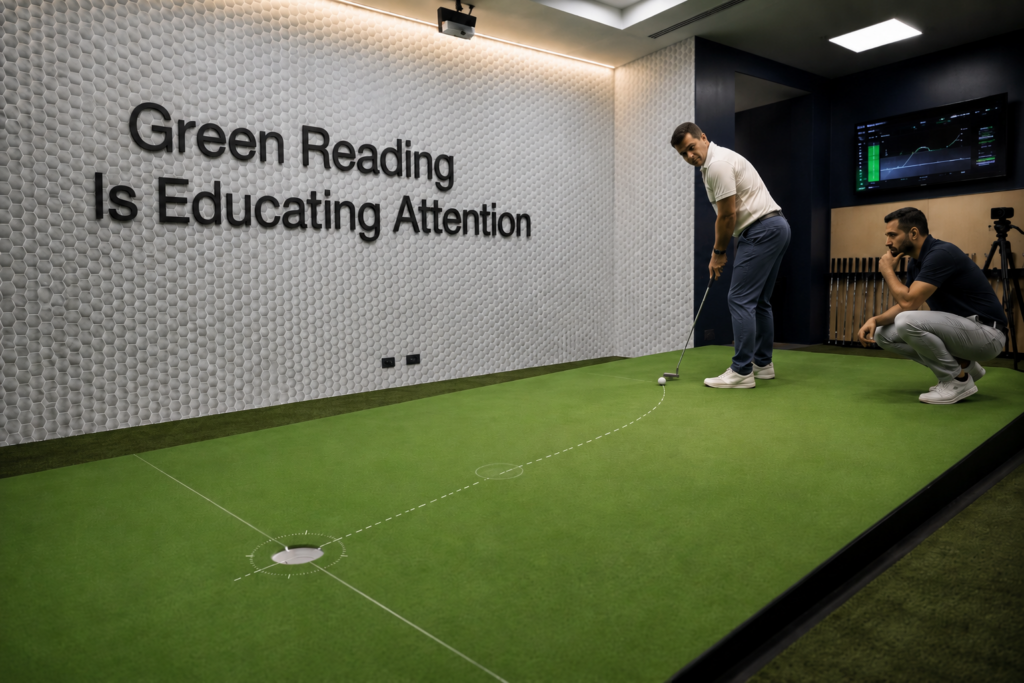
What is Green Reading?
Green reading is often taught as a method for choosing an aim point. That can help, but it does not go far enough.
A line only makes sense when it belongs to a speed.
A player can choose the right start line for a soft pace, then hit the putt too firmly. The ball starts close to the intended line, takes less break, and misses low. Another player can under-read the break, then subconsciously slow the stroke to make the ball turn more. The ball finishes short and still misses.
In both cases, the issue started before the stroke.
Green reading practice should help players connect:
- Slope direction
- Slope severity
- Distance
- Green speed
- Start line
- Entry point
- Entry speed
- Finish zone if the putt misses
The Constraints-Led Approach (CLA) gives coaches a practical way to train green reading through task and environmental design. Coaches do this by changing slope, distance, available information, read positions, target size, feedback timing, and scoring.
The Zen Green Stage gives coaches a controllable way to train those relationships indoors because it recreates real slopes and integrates with putting technologies such as Science & Motion and Quintic for stroke and ball-roll feedback.
Why Green Reading Is More Than Choosing a Line
Many golfers describe green reading as “seeing the line.”
That phrase is useful, but incomplete.
The ball does not follow a line in isolation. It responds to gravity, speed, launch, surface, and the player’s delivery, whereby the same:
- Start line can produce different outcomes depending on pace.
- Pace can produce different outcomes depending on slope.
- Read can fail if the player does not deliver the intended start direction.
That is why green reading must be trained as part of the whole putting task.
A player needs to answer four questions before the stroke:
- What does the slope invite?
- What pace fits that read?
- What start line matches the chosen entry point?
- How does the speed and entry point affect the hole shape and size?
- What delivery will send the ball into that solution?
This connects directly to the first principle from the article on putting principles: slope perception.
Green reading is the player’s ability to perceive useful information before action. It is not just the ability to stand behind the ball and pick an aim point.
The coach’s job is to help the player notice better information.
The Science of Attention in Green Reading
Green reading depends on where players look, what they compare, and how they use information before action.
Gaze Behavior
Campbell and Moran studied gaze behavior across professional, elite amateur, and club golfers during a virtual green-reading task. The players read putts from six different positions. Professional golfers showed a more economical gaze pattern, with fewer fixations of longer duration than the amateur and club golfers.
That finding matters for coaching because expertise did not appear as longer looking. It appeared as more organized perceptual behavior.
Less skilled players often gather information without knowing which information matters. They may look from behind the ball, walk around the hole, crouch low, and still choose a line from a vague impression.
More skilled players tend to search with clearer purpose. They compare high side and low side, notice fall line, connect entry point to pace, and cross-evaluate all this visual information to prepare action.
Quiet Eye
Quiet eye research supports the broader role of visual attention in putting. Vine, Moore, and Wilson studied a quiet eye training intervention with elite golfers and reported improvements in competitive putting performance under pressure.
This does not mean every player needs the same gaze routine.
It means attention is trainable.
A green-reading lesson should therefore train perception as deliberately as it trains face control, start direction, or tempo.
Educating Attention in a Constraints-Led Putting Session
Educating attention means designing practice so the player becomes more sensitive to useful information.
The coach does not need to explain every slope variable verbally. The coach designs the task so the player must notice the relevant information to succeed.
In the Constraints-Led Approach, movement emerges from the interaction between the individual, the task, and the environment. Newell’s constraints model is widely used as a foundation for understanding how coordination emerges through individual, task, and environmental constraints.
The CLA in Green Reading
For green reading, the coach can tune three categories of constraint.
Environmental constraints include slope type, slope severity, green speed, surface quality, visual context, and pressure.
Task constraints include distance, target size, start-line gate, entry-speed zone, scoring, and time.
Perceptual constraints include where the player reads from, what information is available, when feedback arrives, and whether visual aids remain in place during the stroke.
The Zen Green Stage coaching tips page reinforces this applied coaching logic by positioning slope, pace control, and stroke adaptation as trainable parts of putting practice on variable gradients.
This is where green reading becomes coachable, where the:
- Coach changes the environment.
- Player makes a prediction.
- Ball reveals the relationship between perception, intention, and action.
Representative Learning Design and Green Reading Practice
Representative learning design means practice should preserve the key information players use during performance.
Pinder, Davids, Renshaw, and Araújo proposed representative learning design to help sport scientists, coaches, and educators connect practice tasks more closely to performance environments. Their work emphasizes functionality and action fidelity in training and learning environments.
In putting, green reading becomes less representative when the surface stays flat, the break is shown only as a graphic, or the player receives too much external guidance.
The course gives the player a physical slope – now the player must perceive it with the eyes, feet, body position, and movement around the putt, and the ball then responds to gravity, pace, and surface.
A representative green-reading task should preserve that relationship.
That does not mean every practice putt must be difficult. It means the information in the task should match the information the player needs on the course.
Zen Golf’s Articles on Representative Learning Design
Zen’s article on Indoor Golf Practice: Why Slopes Change Learning and Performance makes the same transfer argument across indoor practice. Practice becomes more useful when it contains the key constraints players must solve in performance.
Zen’s separate article on tilting putting greens explains that slope influences start line and speed, and that slope-based practice helps golfers learn how gravity affects ball movement and green-reading decisions.
This supports a clear coaching principle. To improve green reading, the player needs to see the ball respond to the slope they read.
The Six-Position Read
One of the simplest ways to educate attention is to change where the player gathers information.
Set a breaking putt on the Zen Green Stage. Ask the player to read from six positions:
- Behind the ball
- Behind the hole
- Low side
- High side
- Halfway along the putt
- At the intended entry point
The player then states three predictions before putting:
- Entry point
- Entry speed
- Start line
The coach should avoid correcting too early. Let the first putt reveal how the player used the information.
After the putt, ask four review questions:
- Did the ball start where intended?
- Did the ball break more or less than expected?
- Did the speed match the chosen entry point?
- Did the player’s read change after watching the ball roll?
This turns each putt into a perception-action cycle.
The goal is not for every player to use all six positions on the course. The goal is to expose them to each viewpoint so they can identify which ones provide the most useful information.
Some players need the low side to understand the fall. Others need to stand behind the hole to understand entry point. More advanced players may only need two or three viewpoints because their attention has become more attuned.
Coaching Applications
Coaching Intervention 1: Read, Predict, Roll, Review
This intervention connects perception with outcome.
Set one breaking putt between 8 and 12 feet.
The player reads the putt and predicts:
- Entry point
- Entry speed
- Start line
- Finish zone if the putt misses
The player then hits the putt.
The coach records whether the error came from read, pace, launch, or commitment. The player repeats the putt only after making a new prediction.
This shifts the session away from trial-and-error repetition. Each attempt must carry a clear intention.
Use this scoring structure:
- 1 point for correct zero break line direction
- 1 point for matching the intended entry point
- 1 point for matching the intended pace window
- 1 point for accurate start-line prediction
- 1 point if they commit to their pre-shot read and putt routine
The task rewards learning behavior, aligned to the three principles of putting.
This is especially useful for players who react emotionally to missed putts. A miss now becomes information that helps the player understand whether the issue was perception, intention, launch, or commitment.
Coaching Intervention 2: Same Putt, Three Speeds
Many green reading errors are speed errors in disguise.
Set a 10-foot breaking putt.
Ask the player to hole the putt or finish it in a defined zone using three different speeds:
- Soft entry
- Medium entry
- Firm entry
Before each putt, the player must verbalize their entry point and pace, with adjusted the start lines for each speed.
The coach should ask:
- How did the amount of break change?
- Which pace made the hole feel biggest?
- Which pace created the highest risk beyond the hole?
- Which pace matched the player’s natural intention?
This intervention trains the player to understand that line and pace form one decision.
From an ecological-dynamics perspective, this type of differential practice can help develop degeneracy within the task space: the capacity to achieve a stable task outcome through multiple functional perception-action solutions. This supports adaptability, because the player learns to perceive and exploit affordances under changing constraints.
Rather than training one perfect stroke, the task develops a player who can solve the same putting problem in several functional ways. This builds adaptability, exposes perception-action biases, and helps the coach understand how the player organizes intention, attention, and touch in context.
Coaching Intervention 3: High-Side Awareness Gate
Many golfers miss breaking putts low because they do not perceive enough break.
- Set a breaking putt.
- Place one marker pointer down the zero-break-line – this point directly into the hole and identifies gravity’s flow.
- Ask the player to decide what the fast pace putt would be captured by the hole – this point on the clockface sets the second marker.
- These two markers create a gravity funnel for the ball the captured by the hole.
- Ask the player to choose three different points on the clockface to roll the ball in at – each of these are possible as long as they reside within the funnel.
- Encourage the player to explore different entry points with different speeds – layer in a ghost hole or start gate to help diagnose launch control issues.
This task changes the player’s visual commitment. The markers give the player an external reference, but the slope still provides the main information.
The coach should remove the markers after the player starts to show more accurate read and pace coupling. This ensures the player begins to pick up on the visual cues organically, and stops them becoming dependent on a training aid for support.
How Zen Green Stage Supports Green Reading Development
Green reading requires controllable slope exposure.
On a fixed indoor mat, the player can repeat start-line practice. That has value, especially when launch control is the coaching priority. The limitation is that the player does not experience the key environmental information that shapes a real breaking putt.
On an outdoor putting green, the coach gains slope but loses control and repeatability.
The Zen Green Stage sits between those needs. It gives coaches a controllable moving putting surface that can recreate uphill, downhill, sidehill, and compound putts indoors. The Zen Green Stage integrates with putting technologies such as Science & Motion and Quintic, which helps coaches connect slope, stroke, and ball behavior.
For green reading, that matters because a missed putt does not always explain itself.
The player might read the slope correctly and deliver the wrong pace. They might choose the right pace but start the ball off line. They might under-read the break, then make a compensating stroke. They might produce good launch on a poor read.
Slope gives the coach a controllable task, and the ball-roll feedback provides evidence to support active reflection.
Together, they make the lesson more precise and engaging.
Zen Masters and Applied Coaching Context
Green reading improves when coaches combine skill acquisition principles with applied putting expertise.
The Zen Masters ecosystem provides useful applied context because coaches are using Zen technology in real coaching environments with elite players, college golfers, and serious amateurs.
Preston Combs uses Zen Green Stage with Quintic Overhead Putt Tracker. His Zen Master profile describes how he uses the Green Stage to replicate real-world putting conditions and support adaptive training environments.
Darren Webster-Clarke uses Zen Green Stage, SAM PuttStudio, Quintic Overhead Putt Tracker, Trackman, and other technologies at Zen Golf Studio. His page frames the Green Stage to distinguish whether a player’s challenge is stroke mechanics or green reading.
The coach designs the slope, controls the task, watches the player’s attention, listens to the prediction, and uses outcome plus feedback to decide what should change next.
A Coaching Scenario
A player keeps missing 12-foot right-to-left putts on the low side.
The stroke looks stable, the ball starts close to the intended line, and the player feels the stroke is fine, but the same result keeps appearing: the ball never climbs high enough, then falls below the hole.
A technique-first lesson might move quickly toward face aim, path, or stroke mechanics. A constraint-led lesson on the Zen Green Stage starts with how the player is reading and organizing the task.
First, the player identifies the zero-break line: the straight uphill-downhill reference line through the hole. This gives the player a stable reference for understanding how the putt will fall in line with gravity.
Next, the coach asks the player to decide the intended entry point on the clock face of the hole, relative to the zero-break line and the ball start position. Instead of aiming simply “higher,” the player now must predict how the ball should enter the hole: for example, at 4 o’clock rather than 6 o’clock.
The coach then asks the player to place a ghost hole on the apex of the putt trajectory. This is not the target, but a visual constraint that represents where the ball should pass at the highest point of its curve.
The player takes position on the apex, looks back toward the ball, then toward the hole, and begins to see the full shape of the putt rather than just the start line.
Problem Solving in Action
The player now has three reference points:
Zero-break line — helps diagnose the read.
Entry point — helps diagnose the speed.
Apex ghost hole — helps diagnose the start line.
The learning is not just “aim higher.” The player can now develop a more complete putting system:
Slope perception improves because the zero-break line gives the player a clearer reference for reading the green.
Direction control improves because the apex gives the player a precise start-line checkpoint.
Speed control improves because the entry point shows whether the ball is arriving with the correct pace.
The stroke changes only after the player’s attention changes. The Zen Green Stage turns slope into feedback, and the player learns to diagnose misses through the three principles of putting: read, start line, and speed.
Why This Matters For Coaches, Players, and Facilities
For coaches, green reading becomes more coachable when it is treated as a perceptual skill. The coach gains more tools than verbal explanation, aim correction, or stroke adjustment.
For players, the benefit is ownership. The player learns to read, predict, test, reflect, and adapt. That builds confidence because the player understands why a putt missed.
For indoor facilities, green reading creates a stronger performance offer. A flat or a fixed-slope putting area often becomes a stroke-groove space. A slope-aware putting environment becomes an ever-changing learning space.
That matters commercially.
A facility with Zen Green Stage can offer green reading assessments, slope-based putting sessions, short-putt performance programs, member challenges, college team training, and data-led putting evaluations.
The Trackman × Zen putting article also reinforces the wider point that putting stroke patterns change when slope changes, and that slope-based sessions reveal tendencies flat practice can hide.
That is the practical value of representative putting practice. It helps the player experience the information the course will later demand.
Key Takeaways
- Green reading is a perceptual skill before it is an aiming skill.
- Players need to learn which slope information matters.
- Line and pace should be trained together.
- The coach should use slope, read position, target size, feedback, and scoring as constraint tuners.
- Zen Green Stage supports green-reading development by giving coaches controllable slope exposure indoors.
- SAM PuttStudio and Quintic can help separate read errors from delivery and ball-roll errors.
- The best green-reading practice teaches players to predict, perform, review, and adapt.
Explore More
For coaches, start with one breaking putt and turn the session into a prediction task. Ask the player to declare start line, entry point, pace, and finish zone before every attempt. Review the putt through the three putting principles: green reading, pace control, and launch control.
For players, stop judging every missed putt as a bad stroke. Track whether the miss came from read, pace, launch, or commitment. A low miss may be a read problem. A short miss may be a pace intention problem. A putt that starts away from the chosen line may be a launch control problem.
For academies and indoor putting studios, use slope as a controllable learning variable. Build green-reading assessments, slope ladders, pace windows, and read-predict-review tasks into your coaching programs.
To continue the series, return to Change The Slope, Change The Stroke, explore how Zen Green Stage supports putting practice on slopes, or review applied integration content on SAM PuttStudio, Quintic, and Trackman × Zen putting training.
