
A 60-Minute Indoor Golf Training Session Built Like a Gym Program
Overview
A 60-minute indoor golf training session should have the same clarity as a gym program. It needs an objective, warm-up, working sets, rest periods, progression, feedback, and a review.
Zen’s Indoor Golf Practice Series gives the wider context for this approach by positioning indoor practice around realistic training, slope, data, and transfer.
This article sets out the structure to help players and coaches move beyond hitting balls. The session becomes a planned training stimulus with a clear adaptation goal.
Written by: Will Stubbs, Head of Education, Zen Golf
Last Updated: 25/05/2026
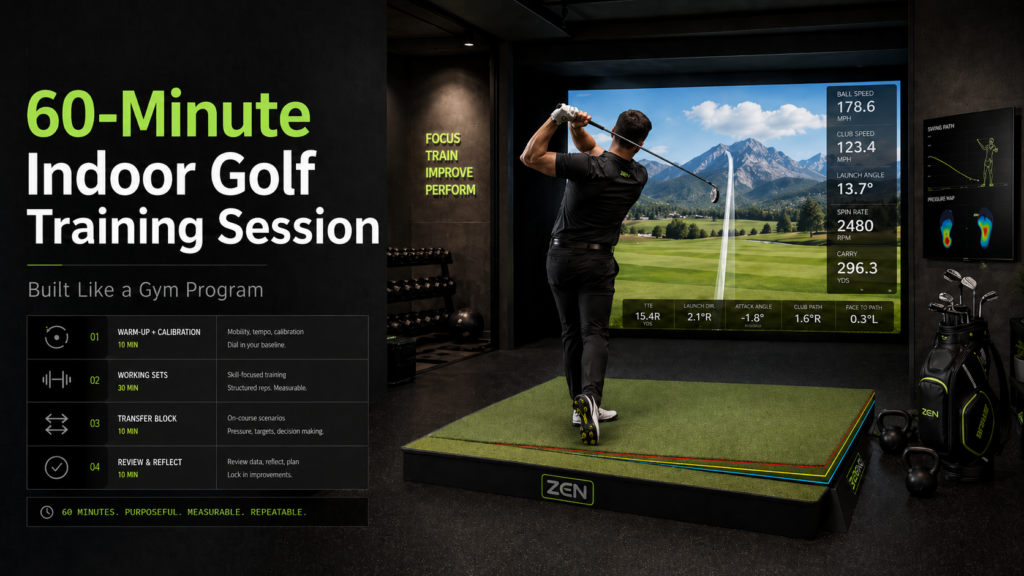
Full 60-Minute Session Map
|
Time |
Block |
Goal |
Main decision |
|
0 to 8 min |
Calibration |
Establish baseline |
Is the planned load appropriate? |
|
8 to 36 min |
Working sets |
Stabilize one constraint |
Is the pattern organized? |
|
36 to 52 min |
Transfer block |
Add consequence and variation |
Does the pattern hold? |
|
52 to 60 min |
Review |
Decide next progression |
Increase, hold, or reduce load |
The Practice Session
This example session targets control.
The goal is to stabilize approach performance from a sidehill lie while keeping dispersion inside the player’s expected benchmark.
Best for: Mid-handicap to low-handicap players
Products: Zen Swing Stage, Trackman integration
Primary data: Start line, carry, lateral dispersion, strike
Skill phase: Ball flight control
Session length: 60 minutes
Pre-Session Readiness Check
Before the first ball, the coach or player checks readiness.
|
Readiness Signal |
Adjustment |
|
HRV above baseline |
Use planned session |
|
HRV normal |
Use planned session |
|
HRV below baseline |
Reduce volume by 20 percent |
|
Player reports fatigue |
Reduce slope or scoring pressure |
This prevents every session from being treated as a maximum-load day. HRV should inform coaching judgment, not replace it, aligned with recommendations of Addleman and colleagues.
Block 1: Calibration
Time: 8 minutes
Volume: 12 balls
Slope: Flat to 2% side slopes, approx. 1.1°
Club: 7-iron or player-specific approach club
Feedback: Full launch monitor data
Purpose:
The player establishes baseline contact, start line, and dispersion. The coach observes whether the player is ready for the planned load.
Block 2: Working Sets
Time: 28 minutes
Volume: 4 sets of 8 balls
Slope: Ball above feet – Gradient severity varied based on success criteria
Target: Landing zone adjusted by handicap
|
Set |
Task |
Feedback |
|
1 |
Centre target |
Full data |
|
2 |
Left target zone |
Selected path and impact data |
|
3 |
Right target zone |
Selected path and impact data |
|
4 |
Random target call |
Review after set |
The player does not chase one perfect shot, but to build a pattern.
Zen Swing Stage is well suited to this block because it allows the coach to hold the environmental constraint constant while changing the task constraint. Zen’s guidance on full swing coaching highlights this kind of variable lie training to develop adaptability and transfer.
Block 3: Transfer Block
Time: 16 minutes
Volume: 12 balls
Format: One ball per target
Slope: Varied sidehill types with varied severity
Scoring: GIR zone or Strokes Gained vs Handicap band
The player now performs with consequence. Each shot has a score. The coach watches whether the pattern holds when realism is increased.
Use handicap baseline data from Shot Scope to benchmark against:
- 15 handicap ≈ 4.1 GIR per round
- Scratch golfer ≈ 9.3 GIR
- PGA Tour ≈ 12 GIR
The Trackman × Zen integration for GIR testing supports this transfer block because the physical slope, simulated lie, and performance data can relate to the same shot.
Block 4: Reflection And Progression
Time: 8 minutes
Review: dispersion, strike, start line, decision-making
The coach / player reviews the pattern, not only the best shots.
|
Review question |
Coaching decision |
|
Did dispersion stay inside the player’s expected band? |
Maintain or progress load |
|
Did strike remain stable? |
Keep slope or add target variation |
|
Did the pattern break down with no clear miss? |
Reduce slope or target complexity |
|
Did readiness look low? |
Reduce next session volume |
The review is part of the training effect. It helps the player understand what has changed, rather than only remembering good and bad shots.
The GIR Testing on Slopes article gives a useful next step when the coach wants to evaluate transfer through scoring outcomes.
Zen Relevance
The session works because the environment is adjustable. Zen Swing Stage allows the coach to repeat a sidehill lie with precision, then change the task around it.
For whole-game environments, Zen Golf Stage connects full-swing practice and putting inside one training system. Facilities and coaches can also explore Zen’s For Coaches resource for applied coaching context.
Key Takeaways
A 60-minute indoor golf training session should have an objective, calibration block, working sets, transfer block, and review.
The coach regulates load through slope, target, shot order, feedback, scoring, and readiness.
Zen Swing Stage helps the coach make the environmental constraint repeatable indoors, which improves the quality of the training problem.
Explore Indoor Golf Practice with Zen Golf and Trackman to connect this session template with a wider indoor training plan.
