
What Is Skill Load In Indoor Golf Practice?
Overview
Skill load in golf practice is the level of challenge created by the task, the environment, and the player’s current state.
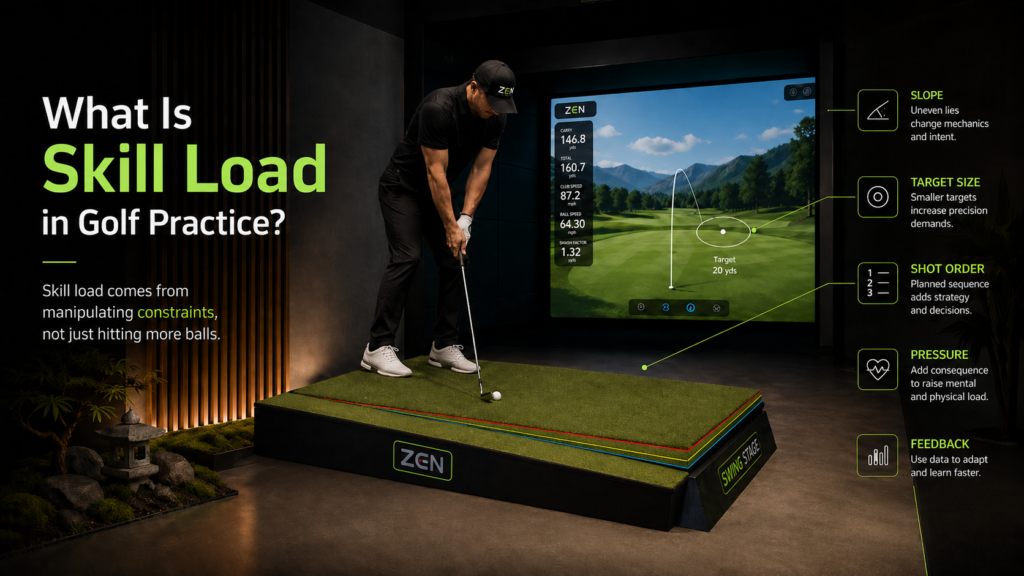
A gym program increases load by changing weight, speed, volume, or rest. A golf practice session increases skill load by changing slope, lie, target size, shot order, scoring pressure, feedback, and readiness.
Indoor golf practice becomes more proactive when coaches adjust skill load intentionally to the conditions they train in, instead of adding more balls to the session.
This idea sits at the heart of Zen’s Indoor Golf Practice Series. Indoor practice becomes more valuable when coaches and players stop treating it as ball-striking volume and start treating it as structured training.
Zen’s philosophy frames indoor environments as places where players can train for transfer, not only maintain technique through the off-season.
This article explores the concept of skill load, and how we can consider applying strength and conditioning theory for physiological adaption to skill adaption through representative learning environments.
Written by: Will Stubbs, Head of Education, Zen Golf
Last Updated: 13/05/2026
Why Skill Load Matters Indoors
Flat indoor practice often reduces the task too far. The player receives clear numbers, a repeatable stance, and a stable surface. That environment helps calibration, yet it may underload the perception and balance demands of golf.
Golf on the course rarely asks the same shot twice. The player must organize movement around lie, wind, target, consequence, stance, and visual information.
The Flat vs Sloped Practice article explains how static, flat repetition may build confidence without preparing the player for ground interaction. Skill load fills that gap by giving the coach a way to scale difficulty.
In the gym, training load comes from weight, reps, tempo, range of motion, and recovery. In golf, skill load comes from slope, lie, club, target, shot order, scoring pressure, feedback, and readiness.
Skill Load Comes from Changing Constraints
Newell’s constraints model helps explain why skill load is more than volume. The player adapts to the relationship between individual constraints, task constraints, and environmental constraints.
| Constraint | Low-load example | Higher-load example |
| Individual | Self-paced learning, healthy and fresh player | Fatigue, low readiness, confidence issue |
| Task | One club, one target | Changing clubs, targets, scores, and shot shapes |
| Environment | Flat lie | Uphill, downhill, sidehill, or compound slope |
By manipulating the environment, through changing slope type, severity and randomness, we can regulate difficulty, akin to increasing load in the gym.
Zen Swing Stage introduces environmental load for full-swing coaching. Zen Green Stage introduces environmental load for putting and green reading. Zen Golf Stage connects full-swing and putting tasks when the session needs whole-game realism.
How A Coach Adjusts Skill Load
A coach can raise or lower skill load without changing technique. In line with Newell’s model, they can change the ground, the target, the feedback, the shot order, or the consequence.
| Coaching decision | Reduce load | Increase load |
| Slope | Return to flat or mild slope | Add severity or complexity of slope |
| Target | Use a larger landing zone | Use a smaller landing zone |
| Shot order | Blocked practice | Randomized practice |
| Feedback | Full data after every shot | Delayed or selected feedback |
| Pressure | No score | One-ball consequence |
The 70 Percent Rule in Golf Practice gives a practical reference point. The task should be demanding enough to require adaptation yet structured enough for the player to keep solving the problem.
Applied Example: A 7-Iron from a Sidehill Lie
A coach working with a 10-handicap player might begin with 10 flat 7-irons to establish baseline start line, carry, and lateral dispersion.
If the player produces a stable pattern, the coach adds a mild ball-above-feet lie on Zen Swing Stage. The task now asks the player to manage posture, balance, aim, and delivery under a changed ground condition.
If the pattern remains playable, the coach adds target variability or scoring. If the pattern becomes chaotic, the coach reduces slope or increases target size.
This is skill-load management. The coach does not simply correct the swing. They adjust the learning environment to help functional behavior to emerge naturally.
Zen Relevance
Zen Swing Stage gives coaches a practical way to apply skill load indoors because slope becomes adjustable, repeatable, and measurable. The Zen Swing Stage Coaching Tips guide shows how full-swing sessions can use slope to train balance, strike, shot selection, and data interpretation.
For putting, Zen Green Stage Coaching Tips applies the same principle to read, pace, start line, and stroke adaptation. Zen Green Stage is a moving floor that replicates on-course gradients, so putting practice includes the ground information the player must manage on the course.
Key Takeaways
Skill load is the learning demand created by the player, task, and environment.
Indoor golf practice often underloads the environment when it stays flat and repetitive.
A coach can adjust skill load through slope, target, club, feedback, shot order, pressure, and readiness.
Zen Swing Stage, Zen Green Stage, and Zen Golf Stage support skill-load design by making slope and ground interaction part of the indoor task.
Explore Zen Swing Stage Coaching Tips for full-swing slope training, then connect the concept with Key Trackman Metrics on Slopes to see how data interpretation changes when the ground changes.
