
Trackman × Zen Integration: A New Framework for Skills Testing Indoors
Overview
This article outlines how the Trackman x Zen integration reframes skills testing by reconnecting indoor measurement with the physical realities of golf. By combining Trackman’s trusted ball-flight data with Zen’s accurate, repeatable slope environments, skills tests move beyond flat-ground execution and begin to reveal adaptability, decision-making, and true course readiness.
The blog explores how this integrated framework deepens insight across the Trackman Performance Center, Combine, and Test Center; providing players, coaches, academies, and institutions with a more representative, transferable, and meaningful approach to testing, practice design, and long-term development.
Written by: Will Stubbs, Head of Education, Zen Golf
Last Updated: 04/02/2025
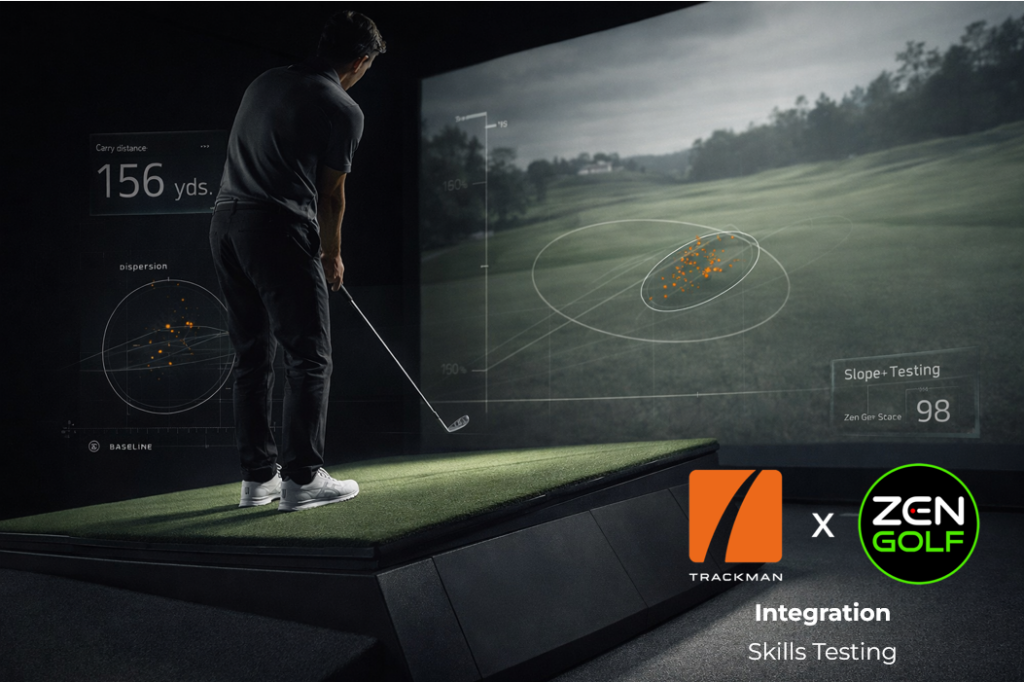
Trackman x Zen Integration: A New Framework for Skills Testing
Most golfers understand testing better than ever before. Scores, combines, benchmarks, dispersion circles, distance windows, all now feel familiar. They help us quantify performance and give us something objective to measure against.
Yet many players test well indoors, but those results feel less reliable once performance is judged on the course. This is not a failure of testing, nor of technology. It reflects a missing constraint within the environment where those tests are performed.
The Trackman x Zen Golf integration exists to close that gap by reconnecting skills testing to the physical realities of the game.
The Hidden Limitation of Skills Testing
For all the advances in testing platforms, one condition has remained almost universal indoors: flat ground.
Golf is not played on flat ground. Every shot is shaped by slope, lie, gravity, and balance demands that influence how the body organizes itself and how the club is delivered.
When testing removes those elements, scores become cleaner, but also less representative. Players may pass tests, yet struggle when balance, perception, and decision-making are challenged on the course.
This is not a limitation of launch monitors, rather a misuse of them.
For example, Trackman is the gold standard for measuring performance precisely. The limitation has always been what we ask the golfer to do while that performance is being measured.
The Trackman x Zen integration changes to that starting point.
What the Zen × Trackman Integration Adds
The integration synchronizes two elements that have historically been separate:
- Zen Swing Stages introduce controlled, accurate, repeatable slope under the player’s feet.
- Trackman captures performance through the Performance Center, Combine, and Test Center.
When skills tests are run inside this environment, the golfer is no longer standing on a neutral platform trying to perform abstract tasks. They are standing inside realistic problems that resemble those found on the course.
This means all data we’ve previously used as a ‘baseline’ isn’t a true meaning of performance. The Trackman x Zen integration now sets the new standard for how we test skills and consider data.
No longer should we be considering absolutes, but how many ways can we complete the task. This is adaptation, and the true test of skill.
From Flat Benchmarks to Behavioral Insight
In flat testing environments, scores tend to describe execution in isolation. They show how repeatable a solution is when the task is stable.
When slope is introduced, testing begins to describe behavior.
- Carry distances change subtly uphill and downhill.
- Strike patterns shift as balance reorganizes.
- Dispersion widens or tightens depending on adaptability.
- Decision-making reveals itself under the task-environment relationship.
None of this requires additional instruction. It emerges naturally as the golfer responds to the task, gravity and terrain.
With Trackman x Zen, these responses are no longer hidden, and the same trusted metrics are now collected while the golfer is solving more realistic problems.
This is where skills testing gains depth and variability stops looking like inconsistency and starts revealing adaptability.
Using the Trackman Performance Center on Slopes
The Trackman Performance Center is designed to build personalized skill profiles across driving, approaches, wedges, and scoring shots.
With Zen integrated, these same tests can now be completed on:
- Uphill lies that challenge distance control and trajectory
- Downhill lies that expose strike and tempo
- Sidehill stances that influence start line and shape
The structure of the test remains similar, but what changes are what the results represent.
Patterns begin to emerge quickly.
Some skills remain stable regardless of slope, while others degrade under specific balance demands.
Some players adapt smoothly, and others become rigid.
This turns the Performance Center from a static assessment into a diagnostic tool for how course-ready the golfer is.
Rethinking the Trackman Combine
The Trackman Combine has long been used as a standardized benchmark of skill.
In a Trackman x Zen environment, the Combine shifts from a consistency test to an adaptability assessment.
The question shifts from:
“How close can you hit this shot on demand?”
To:
“How well does this solution hold up when the ground changes?”
Running Combines across flat, uphill, downhill, or mixed slopes reveals where skills are robust and where they are fragile.
For elite players, this highlights readiness for competition.
For developing players, it clarifies where practice should be focused.
The Combine remains standardized, but its meaning becomes richer.
Building Personalized Tests in the Test Center
The Trackman Test Center allows coaches, academies, and college programs to design bespoke skills tests.
Zen adds an environmental layer that allows those tests to progress beyond simple score chasing.
Examples include:
- Repeating the same test as slope severity increases
- Alternating slopes between shots to challenge reorganization
- Comparing flat results directly against slope-based results
- Adding on-course data from UpGame to scaffold personalized challenges
- Using slope indexes and scenarios from future competition venues to create tests that are purposefully preparative
Zen Golf Stage slopes are both accurate and repeatable, this means results remain transferable and comparable across sessions.
This makes longitudinal tracking far more meaningful, so we can see the non-linearity of player development.
Improvement is no longer judged solely by higher scores, but by reduced drop-off under evolving constraints. We now see skill as progressive, rather than within the vacuum of single point in time tests.
A Framework for Colleges, Academies and Universities
For academies, colleges, and university programs, consistency and comparability matter.
Trackman x Zen allows programs to:
- Establish baseline skills tests under realistic conditions
- Re-test players under identical slopes across the season
- Standardized testing across squads and cohorts
- Use historical on-course data to build personalized training programs
- Adopt slopes as part of physical screening to enhance strength and conditioning plans
Skills testing becomes a shared language between coaches, support staff, and players. They become part of a holistic approach to player development, rather than a timestamp of skill.
Tracking Progress Over Time
One of the most valuable shifts slope-based testing introduces is how progress is defined.
Improvement may appear as:
- Greater consistency across varied slopes
- Faster adaptation to unfamiliar lies
- Smaller performance drops under pressure
- Tighter dispersion circles on the course
- Greater confidence and creativity
- Greater ability to control shot shape and trajectory
For players, this builds confidence grounded in understanding. For coaches, it provides clarity about whether practice design is working.
Testing stops being an endpoint and becomes part of a holistic learning process.
When Testing and Training Begin to Align
Perhaps the most important change is how closely testing and training begin to connect.
The same slopes, distances, and targets used in testing can be revisited immediately in practice. Problems identified through the Performance Center or Combine can be explored without changing environments.
- Test.
- Explore.
- Re-test.
The learning loop tightens, and practice becomes purposeful rather than generic.
Skills Testing That Reflects the Game
Skills tests should prepare golfers for the conditions they will face, not just the sim bay they stand in.
By combining Zen’s physical realism with Trackman’s Performance Center, Combine, and Test Center, skills testing evolves from flat measurement to representative evaluation.
We’re now moving analysis from how well a shot is executed to how well it survives when balance, gravity, and decision-making enter the equation.
For players tracking development, coaches guiding learning, and programs building standardized assessments, this creates a clearer and more honest picture of skill.
That is what meaningful testing has always been about.
Explore What Skills Testing Could Reveal in Your Environment
For Players
Explore how slope-based skills tests help you understand which parts of your game hold up under changing lies, allowing you to track progress over time and build confidence that transfers to the course.
For Coaches
See how integrating slopes into the Performance Center, Combine, and Test Center turns skills testing into a diagnostic tool, helping you identify adaptability, guide practice design, and monitor development beyond flat-ground scores.
For Colleges & Universities
Learn how standardized, slope-based skills testing creates consistent benchmarks across squads, supports longitudinal athlete tracking, and connects testing, training, and on-course performance within a single framework.
For Indoor Golf Centers
Discover how realistic skills tests and challenges create repeatable benchmarks, engaging member experiences, and academy-ready assessment tools that differentiate your facility beyond flat simulator bays.
Book a Call to explore how the Trackman x Zen integration can support skills testing, benchmarking, and performance tracking in your players, programs, or facility, and whether it fits the way you want learning to happen in your environment.
Explore the Trackman x Zen Integration Overview
Discover how Zen Golf and Trackman work together to bring representative learning, transferable data, and course realism into a single performance framework.
Take a Deep Dive into our Trackman x Zen practice series to learn about how you can apply it to your whole training plan.
