
Trackman × Zen Integration: Purposeful Indoor Golf Practice With Data & Slopes
Overview
The Trackman × Zen integration brings together Trackman’s trusted performance data and Zen Golf’s real-world slope technology to create a single, purposeful practice framework.
Rather than treating data, technique, and realism as separate elements, the integration aligns them inside representative learning environments. Here practice reflects the physical, perceptual, and decision-making demands we experience on the course.
At its core, the ecosystem is designed to:
- Use slopes and lies to shape movement and decisions naturally
- Turn Trackman data into learning cues
- Support repetition without repetition, so skills adapt rather than repeat
- Help players and coaches target specific weaknesses within whole, realistic practice
The result is practice that feels meaningful, transferable, and engaging; whether you’re a player, coach, programme, or facility. This creates practice that genuinely transfers to the golf course.
This article is designed for players, coaches, programs, and facilities seeking indoor practice that reflects real on-course demands.
Written by: Will Stubbs, Head of Education, Zen Golf
Last Updated: 06/02/2025
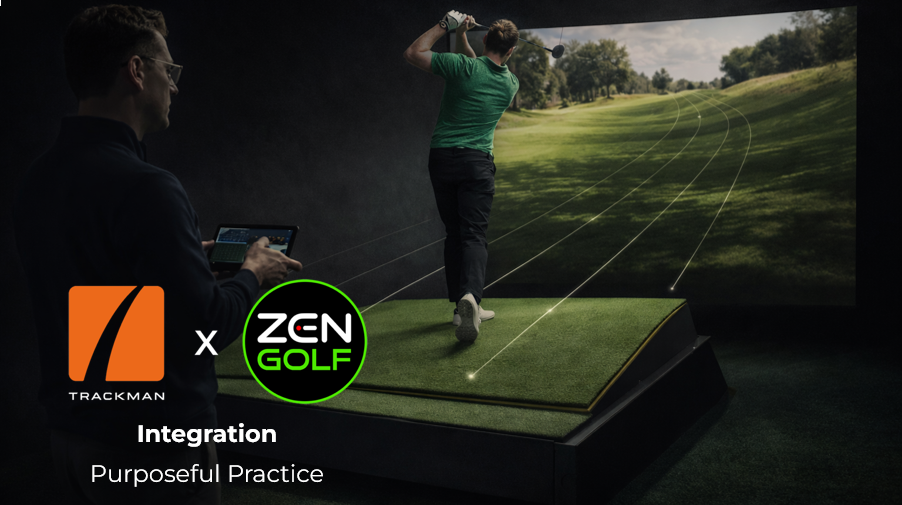
Trackman × Zen Integration: Purposeful Indoor Golf Practice With Data & Slopes
Many golfers practice regularly, but fewer feel that their practice genuinely prepares them for the course.
Balls are struck cleanly. Numbers look good. Confidence grows indoors, only to fade when slopes, lies, and consequence re-enter the picture.
The issue is rarely effort, but intention.
More specifically, how practice environments are designed to guide learning with a realistic indoor golf experience.
The Trackman × Zen integration reframes practice away from repetition of shots toward purposeful interaction with problems, using data and slopes together to create learning that transfers.
Trackman × Zen Integration: Purposeful Indoor Golf Practice With Data & Slopes
Traditional simulator practice often relies on:
- Flat lies
- Static targets
- Narrow success criteria
- Repeating the same task until numbers improve
This block practice approach can improve short-term consistency, but it carries a hidden cost.
The golfer learns a solution for one environment, not adaptability across environments.
Motor learning research describes this as repetition of movement rather than repetition without repetition—a term coined by Bernstein to describe how skilled performers achieve stable outcomes through variable movement solutions.
Golf is not played from one lie, with one intention, on one surface.
Indoor golf practice that ignores this reality creates fragile skills that don’t hold up under pressure.
Common Indoor Practice Mistakes This Integration Solves
Most indoor practice limitations aren’t caused by lack of effort or technology, but come from how practice is structured and what players are asked to focus on.
The Trackman × Zen integration addresses three issues that quietly limit progress in traditional simulator environments.
1. Chasing Numbers Without Context
Ball data is valuable only when it’s connected to the conditions that produced it. Flat bays encourage players to optimize numbers in isolation, often creating results that don’t hold up on the course. By introducing slope and lie variation, Zen provides context so Trackman data reflects how performance adapts under changing constraints.
2. Repeating Flat Shots That Rarely Exist on the Course
Golf is rarely played from flat lies. Practice that relies on them narrows movement options and under develops balance and adaptability. Zen Stages reintroduce uphill, downhill, sidehill, and compound slopes, supporting repetition without repetition—stable outcomes achieved through variable solutions, just as they are on the course.
3. Practicing Without Consequence
When decision-making and risk are removed, practice becomes mechanical. Trackman’s on-course modes, combined with Zen slopes, restore consequence by placing shots in context and making targets matter. Practice shifts from executing swings to solving real problems, aligning learning with performance.
What Makes Indoor Golf Practice Purposeful?
Purposeful practice does three things simultaneously:
- Preserves variability
- Maintains consequence
- Provides feedback that informs decisions, not judgement
The Trackman × Zen integration allows all three to coexist.
Zen Swing Stages introduce physical variability through slope, lie, and balance demands.
Trackman provides informational feedback that helps golfers make sense of what just happened.
Together, they move practice from doing more to learning better.
Slopes as the Primary Constraint
Slopes change everything:
- Perception
- Balance
- Ground reaction forces
- Club delivery
- Shot shape expectations
- Visualisation
A ball above the feet does not just alter path. It alters how the golfer organizes themselves to solve the shot.
By adjusting slope rather than prescribing technique, the coach changes the problem, not the player.
This is the critical distinction.
When slope is the constraint:
- Movement self-organizes
- Coordination adapts naturally
- Awareness increases without instruction overload
Zen Golf Stages allow coaches and players to dial slope direction, severity, and variability, turning each shot into a slightly different problem with the same intention.
That is repetition without repetition in practice.
Using Trackman Data as Learning Fuel
Trackman data becomes most powerful when it stops being an answer and starts being a reference point.
In a Zen × Trackman environment:
- Data tiles act as external focus cues
- Players explore how changes in slope alter numbers
- Attention shifts from “fixing” mechanics to shaping outcomes
For example:
- A player trying to reduce a fade is not told how to change their path
- They explore ball-above-feet slopes and watch how path values respond
- Movement adapts ground-up, driven by intention rather than instruction
The data supports sense-making:
- What changed?
- Why did that work?
- Where does it hold up?
This aligns with how skilled performers learn, through interaction, not explanation.
Targeting Specific Skills Without Isolating Them
One of the strengths of the integration is its ability to target skills without breaking them apart.
A session might focus on:
- Distance control under uphill lies
- Start-line tolerance on sidehill slopes
- Decision-making on compound slopes
Yet the golfer is still:
- Aiming at a target
- Managing consequence
- Interpreting outcomes
Trackman’s on-course modes and target practice, combined with Zen slopes, allow players to:
- Identify patterns during virtual rounds
- Recreate specific troublesome shots
- Explore alternative solutions under similar constraints
Practice remains whole, representative, and purposeful, improving transfer to the course.
From Flat Confidence to Functional Confidence
Many golfers leave indoor sessions feeling confident, but fewer trust that confidence on the course.
Zen slopes close that gap.
By practicing under realistic balance and lie demands:
- Confidence becomes grounded in adaptability
- Success reflects robustness, not repetition
- Errors become informative rather than discouraging
Trackman validates this process by showing where performance holds together and where it leaks.
Confidence comes from solving a variety of problems in context, rather than in isolation.
Why This Matters for Coaches
For coaches, the integration supports a subtle but important role shift.
Less:
- Prescribing positions
- Correcting errors shot-by-shot
More:
- Designing environments
- Guiding exploration
- Facilitating reflection
The coach shapes the constraints, and the player does the learning.
Making Practice Engaging
Purposeful practice does more than improve performance.
It sustains engagement.
When golfers:
- Understand why a shot worked
- Feel agency in problem-solving
- See relevance to the course
They want to return.
This is how the Trackman × Zen integration supports Zen’s mission:
More People. Playing Better. For Longer.
A Final Reflection
Before adding another practice block, ask:
- What problem am I asking the golfer to solve?
- What information matters here?
- What does success look like in the real game?
Practice designed with purpose does more than improve numbers.
It builds understanding and awareness that transfers to lowers scores on the course.
Explore What Purposeful, Realistic Practice Could Unlock
For Players
Experience how training on real slopes with meaningful data builds awareness you can trust, so decisions made in the simulator hold up when it matters on the course.
For Coaches
See how environment-led practice reveals how players adapt under pressure, allowing you to coach behaviour, decision-making, and adaptability.
For Colleges & Universities
Discover how representative indoor environments help bridge practice and competition, supporting performance, player health, and long-term development across squads.
For Indoor Golf Centres
Learn how moving beyond flat bays creates memorable experiences members return for—driving engagement, retention, and clear differentiation in a crowded market.
Book a Call to explore how the Trackman × Zen integration could fit your players, programme, or facility—and what’s the right next step for your environment.
Explore the Trackman x Zen Integration Overview
Discover how Zen Golf and Trackman work together to bring purposeful practice to your performance plan.
Take a Deep Dive into our Trackman × Zen Practice Series to see how purposeful use of data and slopes can be applied across your entire training plan.
