
Trackman × Zen Integration for Coaches: Key Insights
Overview
The Trackman x Zen integration brings together Trackman’s trusted performance data and Zen Golf’s real-world slope technology to create a coaching environment where learning is shaped by context, not instruction alone.
Rather than treating data analysis, technique work, and realism as separate phases of a session, the integration aligns them within representative practice environments. Here, coaching reflects the physical, perceptual, and decision-making demands players face on the course, allowing behaviour, not just mechanics, to surface.
At its core, the integration is designed to help coaches:
- Use slope, lie, and variability to shape movement and decisions naturally
- Turn Trackman data into informational feedback rather than prescriptive correction
- Support repetition without repetition, so players develop adaptable solutions
- Reveal how players organise themselves under constraint, pressure, and consequence
The result is a coaching environment where players learn through interaction, coaches guide through design, and performance becomes more transferable to the course.
This article is written for coaches, and university programs seeking to move beyond flat, instruction-heavy simulator sessions toward environment-led practice that develops understanding, adaptability, and confident decision-making.
Written by: Will Stubbs, Head of Education, Zen Golf
Last Updated: 13/02/2025
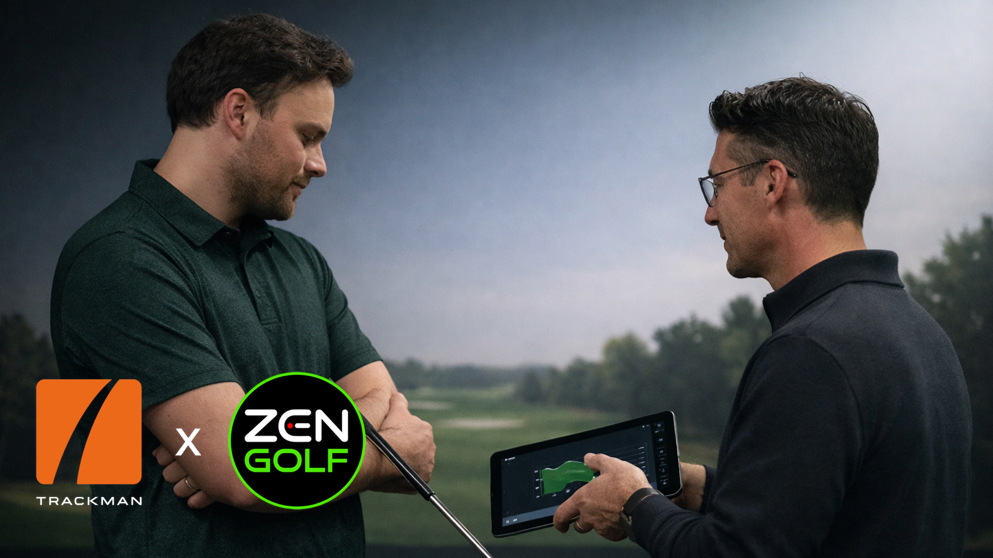
What Does Trackman x Zen Integration Mean for Coaches?
Most of us frame coaching through a familiar lens.
There is a task to perform and there is a player trying to perform it.
When progress slows, or performance plateaus, the next step often feels obvious. We turn our attention to the player and look for something to adjust.
A grip change.
A new position.
A posture change.
Technique becomes the lever and instruction becomes the tool.
Coach education has largely reinforced this approach. We are taught how to refine movement, so the task looks cleaner, more repeatable, easier to control. And in many ways, that has served the game well. It’s allowed us to create lesson blocks largely built around quick fixes, and this has shaped ‘where we start’ when learning stalls.
Time to in-lesson fix becomes our KPI, rather than learning transfer to the course.
When the Environment Stays Silent, Instruction Gets Louder
In most coaching bays the environment barely enters the conversation.
Flat lies.
Balanced stances.
Predictable outcomes.
We’re chasing neutral.
These conditions quietly sit in the background while our attention narrows onto mechanics. When the environment doesn’t speak, coaches tend to fill the silence.
We talk more.
Demonstrate more.
Explain more.
Not because coaches enjoy hearing themselves speak, but because something essential is missing from the learning picture. When the surroundings don’t provide information, instruction and analogies work harder to compensate for lack of context.
The challenge is that golf, as it is played on the course, is never silent, it’s always asking us questions.
The Zen Stage Changes the Starting Point
The Zen Swing Stage introduces a different place to begin.
Here, the environment is no longer passive. It becomes controllable, intentional, purposeful and informative.
Slope, variability, and consequence stop being background conditions and start shaping behavior directly. The ground is no longer just something to stand on, it becomes a source of information the player must respond to.
Once real-world slopes enter the equation, the nature of the task changes. There is no longer a single “correct” way to move. Movement starts to organize itself around what the environment demands, not just what the coach describes.
This is a subtle but powerful shift. Instead of asking players to reproduce positions, we invite them to solve problems.
What Trackman Adds When the Task Changes
When Trackman is layered into this environment, the task evolves again.
Immersive graphics and data bring every shot to life.
Targets shift.
Scoring systems adapt.
Success criteria become contextualized.
Now every shot requires something more meaningful.
Rather than confirming isolated shots on a flat surface, metrics begin to describe behavior under constraint. We start to see how solutions hold together, or fall apart, as conditions change.
This is an important reframing.
Data moves from validation to sense-making and instead of asking, “Was that number good?”, we begin to ask, “Why did that solution work here, and not there?”
A Shift in the Role of the Coach
As the environment becomes more informative, the role of the coach naturally evolves.
Less instruction to more facilitation.
Less emphasis on positions and more emphasis on decisions.
This is not a philosophical preference or a rejection of technique. It reflects how skill develops through a deeper connection to context. When players are placed in environments that provide clear, relevant information, they begin to organize movement without being told exactly how.
The coach’s value shifts from telling to designing. No longer should coaches be seen as mechanics at the garage, but as personal training taking their students on a journey of self-improvement.
Where Skill Really Lives: Environment, Context, and Learning Transfer
Skills are often talked about as something stored, like computer programs waiting to be recalled upon request.
Modern motor learning science discovered a much deeper, more natural relationship.
Skill doesn’t live in isolation. It lives in the ongoing relationship between the performer and the environment they act in.
Good performance reflects what we call attunement. The ability to pick up information, adapt timing, and respond to context as it unfolds. That attunement cannot be explained into existence.
It develops through exposure and experience.
Through time spent solving real problems in environments that reflect the demands of play.
This is where Zen coaching and product development philosophy sits. As Zen Master Coach Liam Mucklow puts perfectly “Whoever does the work does the learning.”
The environment carries more of the teaching load than we consider. Zen Golf Stages become the bridge between the practice bay and the golf course. Only now can the data we capture in the sim become real and can learning truly transfer into performance.
Learn more about purposeful practice with slopes HERE.
Knowledge About the Swing vs Knowledge Of the Game
A useful way to understand the shift enabled by the Trackman × Zen integration is through the distinction between knowledge about and knowledge of performance.
Most coaching environments, particularly those built around flat, static practice, are very effective at developing knowledge about the swing. This includes:
- Understanding what club path, face angle, and attack angle represent
- Knowing what a “good” number looks like
- Recognizing when a movement deviates from a preferred model
- Being able to explain why a shot curved or launched the way it did
This form of knowledge is descriptive and analytical. It helps us label performance and talk about it with clarity. It is valuable, but on its own, it is incomplete.
How is Knowledge Of the Game Different?
Knowledge of is experiential, functional, and embodied, and reflects a golfer’s ability to:
- Sense when a solution will hold up under pressure
- Recognize how their swing behaves on different lies
- Adjust intention, shape, or expectation without conscious recalculation
- Make decisions confidently when the ground, target, or context changes
Where knowledge about answers the question “What happened?”, knowledge of answers “What should I do here?”
This distinction matters deeply for coaches, because most breakdowns in performance are not caused by a lack of information. They occur because players cannot use what they know when conditions change.
Flat, instruction-led practice environments tend to reinforce knowledge about. The golfer learns to associate specific movements with specific outcomes, but only within narrow conditions. When those conditions disappear, as they do on the course, knowledge of is what’s needed.
Slope-based, environment-led practice develops knowledge of, as every shot starts with an environmental decision, rather than declarative knowledge about what to do.
When golfers practice on real slopes, they are learning how to organize themselves relative to gravity, balance, and intention. The body must solve the problem in real time. Trackman data then supports this process by helping the player recognize patterns across different situations, rather than confirming correctness in a single one.
How Does This Reframe Feedback?
This shifts learning from instruction-dependent to self-actualized. Players begin to build a bibliography of lived solutions rather than a bookshelf of technical rules. They develop confidence that is grounded in context, not compliance.
This is the deeper value of the Trackman × Zen integration for coaches. It does not replace technical knowledge. It contextualizes it, so that knowledge about the swing can evolve into knowledge of the game, where it truly matters.
Designing Environments That Teach
This is where the opportunity now sits for coaches.
Slope.
Targets.
Scoring.
Consequence.
These stop being features of a session and start becoming teachers within it.
Instead of thinking, “How should I manipulate their positions?”, a more productive starting point often is, “What can I change in the environment to let that movement happen naturally?”
Once that shift happens, the swing behavior begins to reorganize. Patterns of comfort, hesitation, risk-taking, and commitment emerge naturally. Often, they reveal more than technical commentary ever could. Now, the learning is owned by the golfer and their awareness of their swing skyrockets.
This has a second order effect, they develop a greater depth of understanding in how they move and solve problems. This means greater connection to you as the coach who facilitated that to occur.
This also means that they also become easier to coach and your lessons move from problem-solution quick-fix relationships, to a more human-to-human one.
The coach’s job becomes one of observation, timing, and subtle intervention.
A move from mechanic to mentor.
To read deeper about how we can understand swings on slopes please read our blog on swing tendencies HERE.
Why Zen × Trackman Matters for Coaches
Together, Zen Golf and Trackman support a move toward environment-led coaching.
- Zen Stages introduce real-world slope that shapes perception and intention
- Trackman anchors those experiences with trusted, contextual accurate data
- Coaches gain insight into how players solve problems, not just what the ball and club did
This integration does not replace coaching expertise but creates better conditions for it to emerge.
Trackman brings the reality of the shot to life. Zen brings the reality of the course to life. Together they’re the gold standard for every coaching and entertainment golf space.
Final Thoughts
The future of coaching is unlikely to be defined by more instruction or more data.
It will be shaped by how effectively we design environments that invite learning, adaptation, and understanding.
As a coach, your perspective matters, and shapes the future of this sport.
- Which elements of environment design are most powerful in your setting?
- Where does slope change behavior most clearly?
- How do task constraints, scoring, and feedback influence decision-making?
These are not questions with fixed answers, but we see them as invitations to explore.
Explore What Coaching on Slopes Could Unlock
For Players
Experience practice that reflects how golf is actually played. Training on real slopes helps players understand how their swing responds to gravity, balance, and intention—so decisions on the course are guided by lived experience rather than technical rules learned on flat ground.
For Coaches
See how environment-led practice transforms Trackman data from technical confirmation into insight about behaviour. Real slopes expose how players self-organise through the ground, revealing adaptability, robustness, hesitation, and commitment.
For Colleges & Universities
Create learning environments that scale across squads. Representative practice links trusted performance data with realistic constraints, supporting long-term athlete development, healthier movement strategies, and resilient decision-making under pressure.
For Indoor Golf Centers
Move beyond flat-bay instruction and novelty features. Deliver coaching and practice experiences members remember, return for, and talk about—where Trackman data makes sense because the environment mirrors real golf.
Book a Call to explore how the Trackman × Zen integration can support coaching, clearer interpretation of performance data, and learning that genuinely transfers to the course.
Explore the Trackman x Zen Integration Overview
Discover how Zen Golf and Trackman work together to bring real slopes, contextual data, and representative learning into a single performance framework.
Take a Deep Dive and learn how to apply slope-based constraints, task design, and Trackman metrics across your entire coaching programme—turning instruction into insight and practice into transferable skill.
