
Trackman × Zen Integration: Virtual Golf with Real-World Slopes
Virtual Golf 3 – Real Course Play, Real Slopes, Real Decisions
Trackman launch monitor data has always been accurate.
The missing variable in simulator golf has been slope.
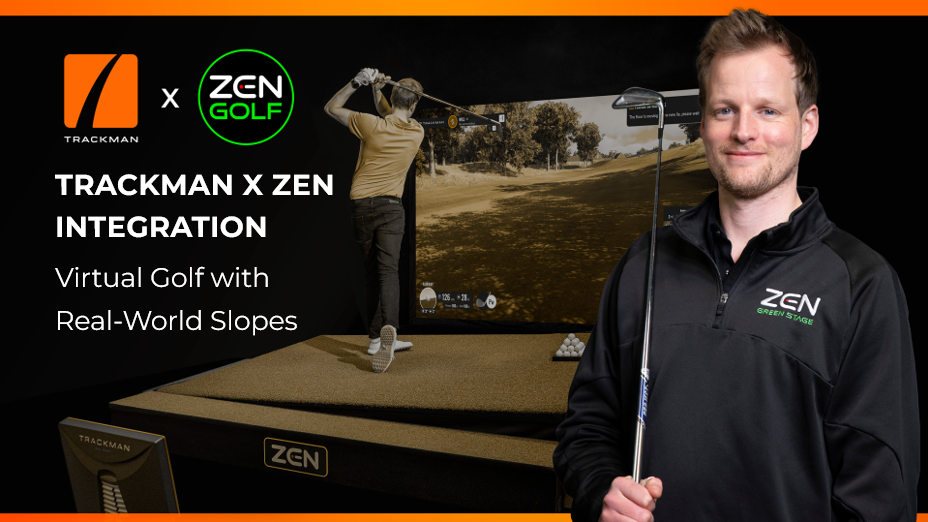
The Trackman × Zen integration brings real slopes into Virtual Golf by synchronising Trackman course-play data with physical gradient underfoot through the Zen Swing Stage.
Now, indoor golf replicates:
- Real course slopes
- Real balance demands
- Real ground interaction
- Real shot decisions
Trackman provides the data.
Zen provides the slope.
Real data.
Real slopes.
Real golf.
Written by: Will Stubbs, Head of Education, Zen Golf
Last Updated: 02/03/2025
What Changes with the Integration?
In a traditional simulator session, you see:
- Distance
- Wind
- Elevation
- Carry numbers
But you stand on flat ground.
With the Trackman × Zen integration, when your ball finishes on a side slope at Royal County Down, the floor moves. If your next shot is from an uphill lie in the rough, the stage tilts. If you are on a right-to-left gradient, you feel it before you swing.
The result?
You don’t just calculate yardage.
You make decisions.
This directly builds on the principles explored in:
- Key Trackman Metrics on Slopes
- Using Trackman Optimizer on Slopes
- Developing Consistency Through Realistic Practice
The metric has never been the issue.
The missing piece has been context.
From “Numbers Hitter” to Shot Maker
In the YouTube demo, the experience is clear.
After a tee shot finishes on a strong right-to-left slope, the next decision changes. Traditionally, you might pull a rescue club based purely on distance.
But off that slope:
- Can you deliver that club with control?
- Will the face close?
- Will the ball over-draw?
- Does the lie influence low-point control?
Instead of blindly selecting a club, you must adapt strategy.
You might choose:
- An iron to stabilize strike
- A knockdown to manage spin
- A shape that works with the slope rather than against it
This is real golf, because every shot becomes:
- Distance + Slope + Shot Shape + Risk
Not just a carry number.
Why This Matters for Course Play
Virtual Golf 3 is now not just about perfect ball-striking indoors.
It is about closing the gap between practice and play.
When you stand on a real slope:
- Ground reaction force patterns reorganize
- Dynamic loft shifts
- Balance demands increase
- Face-to-path relationships adapt
- Strike tendencies reveal themselves
These adaptations come to life, and become measurable the Zen Swing Stage tilts beneath you while Trackman captures the data.
This creates a powerful feedback loop:
Real slope → Real movement adaptation → Real data → Real understanding.
Decision-Making Becomes a Trainable Skill
In the video, a wedge shot from an uphill, left-to-right slope demonstrates something critical.
Instead of attacking a tight pin directly, the player:
- Anticipates slope-induced loft changes
- Understands the face may open
- Aims middle of green
- Accepts dispersion pattern
The result?
A safe putt rather than bunker trouble.
Without slope, this learning never occurs.
Flat indoor golf reinforces distance control.
Slope-integrated indoor golf reinforces decision quality.
How the Zen Swing Stage Enables This
The Zen Swing Stage is designed for full swing slope integration with launch monitor systems like Trackman. It recreates:
- Uphill lies
- Downhill lies
- Sidehill gradients
- Compound slopes
This transforms Trackman from a measurement tool into a representative learning environment.
Instead of practicing swings, you practice golf.
Why Is This Different from Standard Simulator Play?
Traditional simulator play improves:
- Ball striking
- Club delivery awareness
- Distance gapping
Trackman × Zen improves:
- Shot selection
- Risk management
- Balance control
- Adaptive delivery
- Course intelligence
This aligns directly with what we outlined in:
Because golf performance is not built on stable repetition.
It is built on adaptable execution.
The Bigger Picture: Closing the Practice–Play Gap
The most important shift is psychological.
When the floor moves, your perception changes.
You feel:
- Instability
- Tilt
- Pressure shift
- Club delivery awareness
Now you must commit to a shot.
You are no longer just hitting numbers, you are playing golf.
Virtual Golf 3 completes the integration by bringing:
- Real course visuals
- Real ball-flight data
- Real slope feedback
- Real decision consequence
The Core Takeaway
Trackman has always told you the truth.
The missing variable has been context.
By bringing real slopes into virtual golf, the Trackman × Zen integration transforms simulator sessions into decision-driven, course-relevant experiences.
You stop being a numbers hitter.
You become a shot maker.
