
Trackman × Zen Integration: Using Optimizer on Slopes
Overview
Trackman Optimizer gives golfers a clear benchmark for launch, spin, ball speed, and carry. It shows how close impact conditions sit to an efficient window for a given club.
Most golfers use Optimizer on flat ground.
Golf is not played on flat ground.
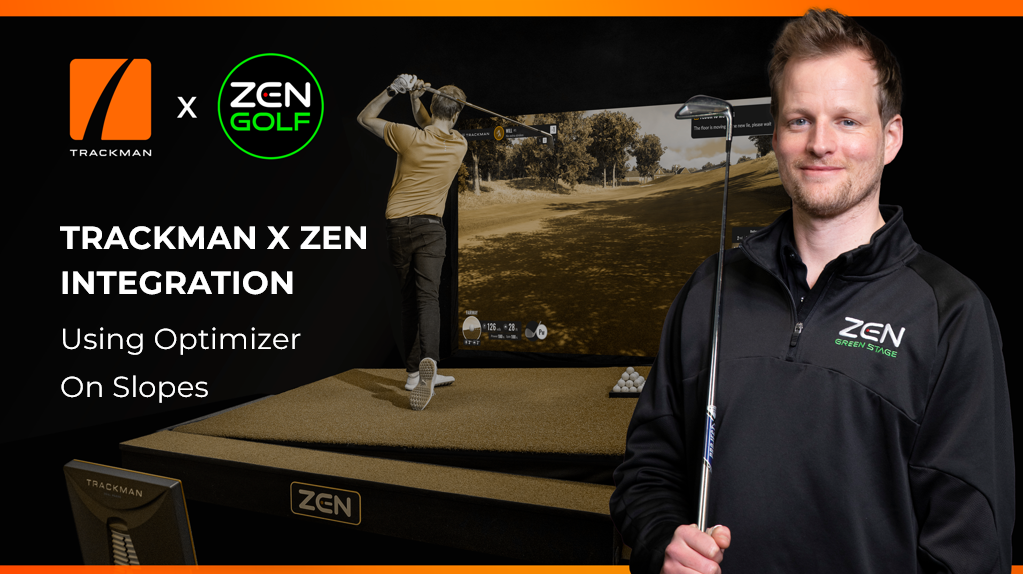
The Trackman × Zen integration, explained in Real Slopes, Real Data, Real Golf, introduces a moving floor that replicates on-course gradients. When you run Optimizer on real slopes through a Zen Swing Stage, numbers stop being neutral targets and start reflecting how delivery adapts under gravity, balance, and constraint.
This changes how we fit clubs and how we design practice.
It aligns with Zen’s Mission to bring the golf course indoors and create learning environments that replicate the game, not simplify it.
Written by: Will Stubbs, Head of Education, Zen Golf
Last Updated: 27/02/2025
What Is Trackman Optimizer and What Does It Measure
Trackman Optimizer compares your impact conditions against an optimal window based on club speed and delivery.
Key parameters include:
- Ball speed
- Launch angle
- Spin rate
- Attack angle
- Dynamic loft
- Carry distance
On flat ground, Optimizer answers one question:
“How efficient is this strike in neutral conditions?”
That is useful.
But it does not answer a second question:
“Does this efficiency hold when the ground changes?”
Why Flat Optimizer Data Has a Blind Spot
A player can sit inside the Optimizer window with a driver on flat ground and still struggle on the course.
Reasons include:
- Effective loft shifts on uphill lies
- Low point shifts on downhill lies
- Face-to-path relationships change on side slopes
- Strike location drifts under balance constraint
On flat ground, those interactions remain hidden.
As outlined in Key Trackman Metrics on Slopes, slopes change the meaning of metrics without changing the metrics themselves.
Club path, face angle, attack angle, and carry remain measurable. What changes is what they represent.
When you combine Optimizer with a Zen Swing Stage, a moving floor that replicates on-course gradients, you expose how robust those numbers are.
Using Optimizer on Slopes in Club Fitting
Custom fitting traditionally follows this structure:
- Optimize launch and spin on flat ground
- Confirm gapping and dispersion
- Deliver recommendation
The Trackman × Zen integration adds a fourth step:
- Validate performance on slope
The club is optimized on flat ground first. Then the fitter selects representative slopes:
- 3 percent uphill
- 3 percent downhill
- Sidehill with ball above feet
- Sidehill with ball below feet
The player hits the same club under each condition while Optimizer remains visible.
This reveals:
- Whether dynamic loft spikes excessively uphill
- Whether spin stability collapses downhill
- Whether strike efficiency drops under lateral balance demand
- Whether carry gaps compress or stretch
This mirrors the real-world fitting model described in Real-World Club Fitting on Slopes. where equipment is validated under the same constraints players face outdoors.
Optimizer becomes both a validation and a sales tool.
A Practical Club Fitting Example
Driver fitting on flat ground:
- Club speed 100 mph
- Launch 13 degrees
- Spin 2300 rpm
- Carry 250 yards
- Optimizer shows green zone
Then slope is introduced.
On a 3 percent uphill gradient:
- Launch increases to 16 degrees
- Spin rises to 2800 rpm
- Carry window narrows
- Peak height increases
Optimizer shifts away from the ideal band.
This does not mean the club is wrong. It shows how effective loft changes under slope.
Now the fitter can decide:
- Adjust loft
- Adjust shaft profile
- Retain setup but coach expectation
The decision is informed by behavior under the real-world slopes of the Swing Stage.
Using Optimizer on Slopes in Practice
Optimizer is not only for fitting. It is a powerful practice design tool when paired with slope.
On flat ground, players chase green zones.
On slopes, players learn to stabilize windows across conditions.
A structured practice session might include:
Phase 1
- Establish flat baseline with a 7 iron using Optimizer
Phase 2
- Introduce 3 percent uphill
- Observe launch and spin drift
Phase 3
- Introduce 3 percent downhill
- Observe low point and strike shifts
Phase 4
- Return to flat
- Compare stability
The goal is not perfect numbers on each lie. The goal is reducing volatility across lies.
As discussed in Purposeful Indoor Practice with Data and Slopes, skill improves when practice preserves variability and provides meaningful feedback.
Optimizer gives the feedback. Zen supplies the variability.
What Changes When You Use Optimizer on Slopes
On flat ground, Optimizer measures efficiency.
On slopes, Optimizer measures adaptability.
You start to see:
- Where ball speed efficiency collapses
- Where spin control destabilizes
- Where attack angle becomes slope-dependent
- Where carry consistency narrows or widens
Dispersion and efficiency together reveal robustness, a principle explored in Developing Consistency Through Realistic Practice on Slopes.
Robust skills survive environmental change.
Coach Application
When coaching with Optimizer on slopes:
- Use flat ground to establish a reference band
- Introduce slope deliberately, not randomly
- Keep slope consistent for five to six shots
- Observe pattern drift, not one swing
- Ask the player what changed in perception before showing data
This develops knowledge of performance, not only knowledge about the swing.
The environment teaches first. The data confirms second.
Club Fitter Application
When fitting with Optimizer on slopes:
- Optimize on flat first
- Select two representative slope conditions
- Compare dynamic loft and spin under each
- Observe strike efficiency and ball speed loss
- Confirm carry gapping under slope conditions
This improves:
- Confidence in recommendation
- Conversion in premium fitting
- Reduced post-fit doubt
- On-course transfer
Why This Matters for Zen Golf’s Philosophy
Zen Golf exists to connect the learning environment with the performance environment.
Using Optimizer only on flat ground separates those environments.
Doing it on a Zen Golf Stage reconnects them.
Trackman measures what happened.
Zen recreates the terrain where it happened.
Together they align precision with realism.
This approach supports:
- Realism
- Data integrity
- Learning transfer
- Trust
Key Takeaways
Trackman Optimizer defines efficiency windows.
Zen introduces slope, gravity, and balance demand.
Running Optimizer on slopes reveals robustness, which allows fitters to validate decisions under realistic constraints, and coaches to design practice around stability across lies.
Optimizer does not change. The environment does.
That is where insight emerges.
Explore What Slope-Optimizer Sessions Could Mean for You
Book a Call to explore how the Trackman × Zen integration and slope-based Optimizer sessions could fit your environment.
For Custom Fitters
Validate launch and spin windows under real-world gradients. Increase trust and premium positioning.
For Coaches
Design sessions where players stabilize performance across lies, not chase isolated numbers.
For Indoor Golf Centers
Offer advanced fitting and slope-based performance validation that flat bays cannot replicate.
For Players
Understand how your delivery behaves when gravity enters the equation. Build confidence based on experience, not assumption.
Explore the Trackman x Zen Integration Overview
Discover how Zen Golf and Trackman work together to bring real slopes, contextual data, and representative learning into a single performance framework.
Take a Deep Dive and learn how to apply slope-based constraints, task design, and Trackman metrics across your entire coaching programme—turning instruction into insight and practice into transferable skill.
