
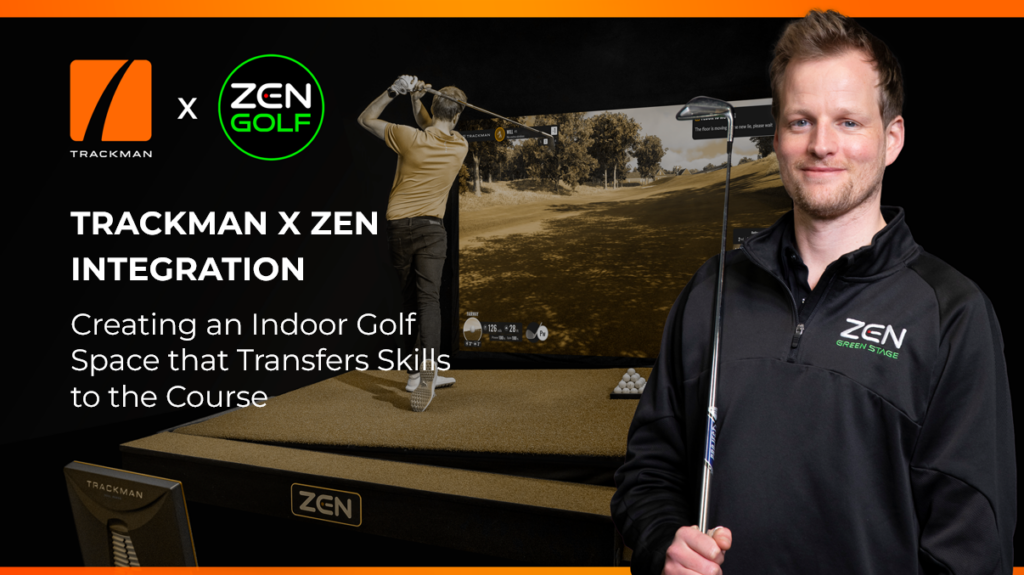
Trackman × Zen Integration: Creating an Indoor Golf Space that Transfers Skills to the Course
Overview
Indoor golf technology has advanced rapidly.
- Launch monitors provide precise data.
- Simulators recreate famous courses.
- Players can practice year-round.
Yet one critical part of the golf environment is often missing.
The ground.
Golf is played on uneven terrain. Uphill, downhill, compound and sidehill lies influence balance, club delivery, launch conditions, and decision making.
When practice environments remove these environmental constraints, golfers may improve their swing mechanics but struggle to transfer those improvements onto the course.
The Trackman × Zen integration addresses this gap.
By combining Trackman performance measurement with Zen’s moving floor technology, indoor facilities can recreate one of the most important elements of real golf: terrain.
This creates a practice environment where perception, movement, and decision making develop together.
The result is practice that transfers more effectively to the course.
Written by: Will Stubbs, Head of Education, Zen Golf
Last Updated: 20/03/2025
Why Most Indoor Practice Environments Struggle with Transfer
A common challenge in golf coaching is the practice–performance gap.
Players hit the ball well in lessons or on the range yet struggle to reproduce the same performance during a round.
This often occurs because the practice environment removes key information from the game.
Flat surfaces simplify the task.
The golfer does not need to adjust posture, balance, or strike location relative to the lie.
They repeat the same movement pattern repeatedly.
However, on the course:
- Slopes influence club delivery
- Lies alter launch and spin
- Balance shifts under the golfer’s feet
- Decisions must adapt to the environment
This difference between the practice environment and the performance environment reduces transfer.
Creating practice that transfers requires representative learning design.
The practice environment must contain the same information players experience on the course; explored further in our article Purposeful Indoor Practice with Data and Slopes.
Why Terrain Is the Missing Element
Terrain is one of the most influential constraints in golf.
Slope affects:
- Posture and balance
- Ground reaction forces
- Dynamic loft
- Angle of attack
- Strike location
- Ball flight and rollout
For example:
- An uphill lie increases effective loft and launch.
- A downhill lie often reduces launch and shifts low point forward.
- Sidehill lies influence path, strike, and balance.
These changes alter both shot execution and shot selection.
If players never practice these situations indoors, they must adapt to them for the first time during competition.
That is rarely a recipe for confidence.
The Role of Trackman in the Learning Environment
Trackman provides the measurement layer.
It captures detailed performance data including:
- Ball speed
- Launch angle
- Spin rate
- Carry distance
- Dispersion patterns
This allows players and coaches to understand how the ball behaves and how the club is delivered.
However, data alone does not create transfer.
If the environment is unrealistic, the numbers may not represent real golf situations.
This is where terrain becomes critical in providing meaning to the metrics. This is something we’ve explored deeper within our article Key Trackman Metrics on Slopes.
Bringing Terrain into the Indoor Environment
Zen Swing Stages recreate the physical slopes of the golf course.
The platform moves to create:
- Uphill lies
- Downhill lies
- Sidehill lies
- Compound slopes
This introduces the same environmental constraints players encounter outdoors.
When combined with Trackman, the result is a practice environment where:
- The golfer feels the slope
- Trackman measures the shot
- The simulator shows the outcome on the course
The golfer experiences a complete feedback loop.
What they feel, what they see, and what the data shows are all aligned.
Coupling Perception and Action
Golf performance depends on the relationship between perception and movement.
Players must interpret the environment before selecting a shot.
They scan the terrain, evaluate risk, and visualize the trajectory.
This process is known as perception–action coupling.
Flat practice environments weaken this relationship.
Players focus primarily on movement mechanics.
When slopes are introduced, the environment becomes part of the task again.
The golfer must adapt their movement to the terrain.
This encourages:
- More realistic decision making
- Stronger shot visualization
- Greater awareness of ball flight tendencies
Practice becomes closer to playing golf rather than simply hitting balls.
Designing an Indoor Environment That Transfers
Creating effective indoor practice requires more than purchasing technology.
Facilities must design the entire learning environment intentionally.
Three factors play a major role.
1. Choosing the Right Technology
Not all uneven-lie solutions replicate real golf conditions.
Some platforms tilt the player without replicating the full interaction between golfer, club, and ball.
When evaluating technology, coaches and facility owners should consider:
- Whether the golfer and ball sit on the same surface
- The range of slopes available
- Stability and safety during movement
- Integration with launch monitor technology
A fully integrated system ensures the golfer experiences the same relationship between the lie and the strike as they would on the course.
2. Designing the Practice Space
The physical setup of the environment influences how players use the technology.
Effective indoor training spaces often include:
- Sufficient room for full swings across multiple slopes
- Alignment between the hitting surface and launch monitor
- Simulator projection that supports course visualization
- Clear sightlines for players and coaches
When the technology, space, and simulation are aligned, players can move seamlessly between technical practice and course play.
3. Integrating Practice and Play
Technology alone does not create learning.
Practice design is equally important.
Coaches can combine Trackman and Zen slopes to create representative training tasks.
Examples include:
Slope-based distance control
Players hit the same approach shot from flat, uphill, and downhill lies.
Course-based practice sessions
Players repeat a challenging hole multiple times to explore strategy.
Slope-specific skill challenges
Players learn how trajectory and carry distance change across lies.
These environments help players connect lesson insights with on-course performance.
What This Means for Coaches
Indoor golf centers are evolving.
Players increasingly expect more realistic training environments.
Facilities that combine Trackman with terrain-based technology can offer experiences that go beyond traditional simulators.
These environments allow players to:
- Practice real golf scenarios
- Develop course management skills
- Train across all parts of the game
For facilities, this creates opportunities to deliver premium coaching experiences and differentiate their offering.
The Goal: Bringing the Course Indoors
The philosophy behind Zen Golf technology is simple.
Practice environments should resemble the environments where performance occurs.
Trackman measures performance.
Zen recreates terrain.
Together they create indoor environments where golfers do not simply practice swings.
They practice golf.
Key Takeaways
Indoor golf technology has transformed practice.
However, flat practice environments remove one of the most important constraints in the game: terrain.
Slope influences movement, ball flight, and decision making.
The Trackman × Zen integration restores this missing element.
By combining performance measurement with moving terrain, indoor facilities can create practice environments that resemble real golf.
When practice environments mirror performance environments, skills transfer more effectively.
Ultimately, golfers improve where it matters most.
On the course.
Explore What the Trackman × Zen Integration Could Mean for You
For Players
Experience how slope changes your strike, trajectory, and decision making so practice feels closer to real golf.
For Coaches
Use terrain-based training to reveal player tendencies and connect lesson insights with on-course performance.
For Colleges and Academies
Create structured development environments that combine performance data with realistic playing conditions.
For Indoor Golf Centers
Deliver premium training experiences that replicate real golf terrain and strategy.
Explore the Trackman × Zen Integration Overview to see how slopes and data combine to bring the golf course indoors.
Book a call to discuss how slope-based sessions could strengthen your coaching program or facility.
