
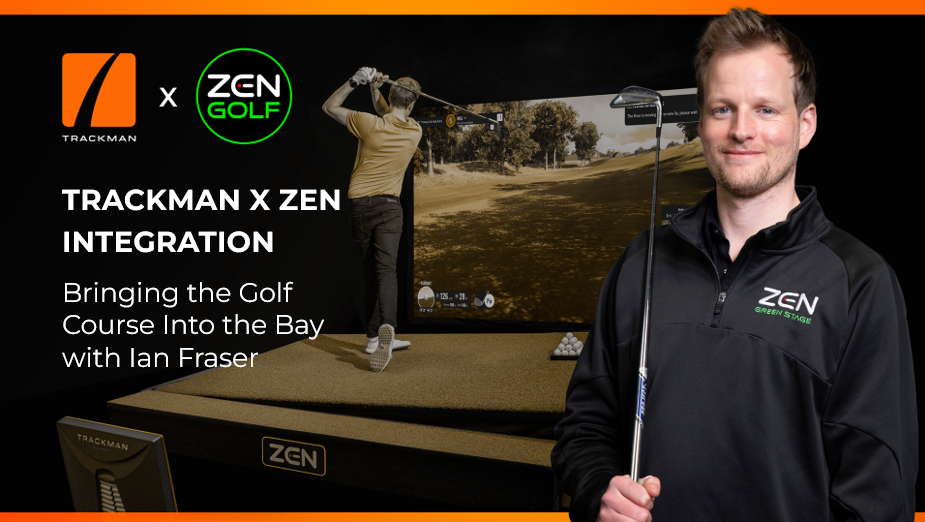
Trackman x Zen Integration: Bringing the Golf Course Into the Bay with Ian Fraser
Overview
Indoor golf has become exceptional at showing us what happened in a shot.
The next step is understanding why it happened.
That is where the Trackman x Zen integration moves the experience forward.
In a recent walkthrough with Ian Fraser from The Golf Institute, this shift became clear. The updated Zen Swing Stage is not just about adding slope. It is about recreating the conditions that shape decision-making, movement, and performance in golf.
Trackman provides:
- Ball data
- Club data
- Shot outcome
Zen provides:
- The environment that shapes the shot
Together, they move indoor golf from:
Shot execution → Problem solving
With the Trackman × Zen integration overview, indoor golf starts looking less like a simulator experience and more like golf.
Written by: Will Stubbs, Head of Education, Zen Golf
Last Updated: 27/04/2026
The Key Upgrade: Speed, Precision, and Realism
The latest Swing Stage has been redesigned specifically for indoor golf environments.
Key developments include:
- Faster movement between shots
- Lower profile for better integration
- Ability to twist and create compound lies
- Seamless integration with Trackman Virtual Golf
One insight from Trackman’s software team during development was critical:
Players are not always standing on a single plane. The feet and the ball often experience different slopes.
This led to the ability to recreate:
- Flat feet with tilted ball lies
- Compound slopes across multiple axes
- Non-uniform terrain conditions
This is explored further in Trackman x Zen Integration Explained, where the core principle is simple:
The shot is shaped by the environment, not just the swing.
Seamless Play: Maintaining Flow and Engagement
One of the biggest challenges in indoor golf is maintaining flow.
Players are:
- Paying by the hour
- Expecting continuity
- Looking for immersion
The integration solves this.
As soon as the ball lands:
- Trackman captures the data
- The system calculates the next position
- The stage moves instantly
There is no delay.
In the demo:
- A par five was played in under 90 seconds
- The stage transitioned between slopes without interrupting focus
This is critical.
If the environment breaks immersion, the experience becomes artificial.
If the environment flows, the player stays in the game.
This aligns directly with the ideas in Closing the Practice Gap with Trackman and Zen Swing Stage:
Practice transfers better when it feels like the game.
From Numbers to Decisions
One of the most important shifts observed in the session was how quickly the conversation moved away from “numbers” and toward “decisions.”
A simple example:
Flat lie thinking:
- “This is 116 yards. It’s a 9 iron.”
Slope-based thinking:
- “This is 116 yards uphill.
Do I launch a wedge?
Do I open the face?
Do I flight a 9 iron?”
That is golf.
This is the same transition explored in:
The metric stays the same., but the meaning changes.
Slope Changes the Shot, Not Just the Setup
Throughout the session, several consistent themes emerged around how slope influences performance:
1. Launch and Trajectory
An uphill lie:
- Increases launch
- Reduces effective distance
A downhill lie:
- Lowers launch
- Increases rollout
In one example:
- A 5-wood effectively became a 7-wood due to slope
This connects to Trackman x Zen: Fixing Data Misinterpretation:
Data without context can mislead.
2. Strike and Ground Interaction
Players must consider:
- Leading edge interaction
- Bounce usage
- Turf interaction
This becomes especially relevant in short game scenarios where:
- Upslope changes strike depth
- Down slope increases risk of thinning
3. Decision-Making and Strategy
Slope introduces:
- Risk vs reward thinking
- Safe miss awareness
- Club selection trade-offs
Instead of:
“Can I hit this club?”
The question becomes:
“Should I hit this shot?”
Coaching: Understanding the Player, Not Just the Swing
For coaches, this integration is a step change.
It allows you to:
- See how a player adapts to different environments
- Identify tendencies under constraint
- Understand decision-making patterns
In the session, this became clear when testing:
- Ball above feet vs below feet
- Different slope directions
- Different gradient severities
What emerged:
- Preferential slopes
- Changes in delivery patterns
- Different psychological responses
This is where the system goes beyond technical coaching.
It allows coaches to:
- “Catch the human, not just the golfer”
This aligns with:
Club Fitting: The Missing Link
One of the most powerful applications discussed was club fitting.
Traditionally:
- Fitting happens on flat ground
- Testing happens later on the course
This creates a gap.
With Trackman x Zen:
- You can test equipment under real conditions immediately
Example:
- Test a driver on flat
- Then test it on:
- Uphill lies
- Downhill lies
- Sidehill lies
This creates:
- Immediate validation
- Real-world feedback
- Better equipment decisions
This is the “range to course” loop being closed in real time.
Practice Design: Creating Representative Challenges
The system also opens up new possibilities for structured practice.
Examples include:
Target Practice on Slopes
- Fixed yardage
- Variable lies
- Same target, different solutions
Constraint-Based Training
- Player struggles with ball below feet
- Increase exposure gradually
- Build adaptability
Psychological Training
- Recreate “fear scenarios”:
- Water carries
- Bunker carries
- Tight pins
This is not random practice.
This is designed variability, which sits at the heart of ecological dynamics.
Data Integration: A Complete Performance Picture
When combined with other systems, the insight deepens further:
- Trackman → ball and club data
- Swing Catalyst → ground reaction forces
- Motion capture → biomechanics
- Zen → environmental constraints
Together, this creates:
- A full performance system
- A real understanding of how the player organizes movement
This is where indoor golf becomes a true performance environment.
What This Means for Different Users
For Players
Practice becomes:
- More engaging
- More realistic
- More transferable
You are not just hitting shots, you are solving golf problems.
For Coaches
You gain:
- Better insight into player tendencies
- More effective coaching conversations
- A clearer link between cause and effect
For Facilities
You offer:
- A premium, differentiated experience
- Faster throughput with better engagement
- A stronger link between entertainment and performance
For Universities and Colleges
You can:
- Prepare players for competition environments
- Build adaptability under pressure
- Combine data with real-world context
The Bigger Picture: From Range to Course
One of the most important insights from the session was this:
Tour players do not validate performance on the range.
They validate it on the course.
This integration brings that validation into the bay.
It allows players to:
- Find a baseline
- Test it immediately
- Adjust based on real outcomes
That is the next evolution of indoor golf.
Key Takeaways
Trackman measures the shot.
Zen recreates the conditions that shape the shot.
Together, they:
- Move practice from repetition to adaptation
- Turn data into insight
- Bring the golf course into the indoor environment
The biggest shift is not technological.
It is conceptual.
Indoor golf is no longer just about:
“How well did you hit it?”
It becomes:
“How well did you solve the problem?”
Explore What the Trackman x Zen Integration Could Mean for You
For Players
Train in environments that reflect real golf and build confidence that transfers to the course.
For Coaches
Understand how players think, adapt, and perform under realistic constraints.
For Indoor Facilities
Deliver a premium experience that connects entertainment with performance.
For Universities and Colleges
Prepare players for competition through representative practice environments.
Explore the Trackman x Zen Integration Overview.
Explore Zen Swing Stage, Zen Green Stage, and Zen Golf Stage.
Book a call to discuss how the next evolution of sim golf could support your players, program, or facility.
