
The Science of Transfer in Golf Practice: Why Training Must Match the Course
Overview
Many golfers practice regularly. Ball striking improves. Trackman numbers tighten. Confidence grows inside the practice environment.
Then the golfer returns to the course.
The swing feels different. Strike quality changes. Decisions feel less clear.
Practice success does not always lead to on course performance, a problem explored in Why Great Range Swings Fail on the Course.
The issue rarely sits with effort or commitment. The issue sits with transfer.
Transfer describes how well skills learned in practice appear during real performance. In golf, strong transfer requires practice environments that resemble the course itself.
When practice removes the information present on the course, learning becomes fragile.
Written by: Will Stubbs, Head of Education, Zen Golf
Last Updated: 07/04/2025
Why Golf Practice Often Fails to Transfer
Most practice environments share similar characteristics, a theme discussed in Closing the Practice Gap with Trackman and Zen Swing Stage.
- Flat ground
- Stable balance
- Repetitive tasks
- Minimal decision making
These conditions create clean feedback. Ball flight becomes easier to control and patterns become easier to repeat.
Golf on the course operates differently.
- Lies change
- Slope alters balance
- Wind influences ball flight
- Targets vary
- Risk influences decisions
Each shot presents a new problem.
Practice often removes the problems the game requires golfers to solve.
The result becomes familiar. The swing works in practice and struggles on the course.
Understanding Transfer in Skill Learning
Research in skill acquisition shows a consistent principle.
Learning transfers best when the practice environment contains the same information that guides performance.
This concept is often called representative learning, a principle explored further in Trackman × Zen Integration Explained: Real Slopes, Real Data, Real Golf.
Representative learning means practice tasks reflect the conditions of the real environment. The player perceives similar information and organizes movement in response.
In golf this information includes:
- Slope under the feet
- Lie of the ball
- Visual target structure
- Distance judgement
- Decision making under consequence
When these elements appear during practice, the golfer learns how movement adapts to them.
When these elements disappear, practice teaches a simplified version of the game.
Why Flat Practice Creates Fragile Skills
Flat practice provides stability, which helps explain why many swing changes fail to transfer to the course as discussed in Trackman × Zen Integration: Take Swing Changes to the Course.
Balance remains neutral. Ground interaction remains predictable. Delivery patterns remain easier to repeat.
These conditions help players establish baseline movement patterns. They also hide how those patterns behave when the environment changes.
On the course, slope influences:
- Balance orientation
- Ground reaction forces
- Dynamic loft
- Low point control
- Face to path relationship
The golfer reorganizes movement around these constraints.
Flat practice does not expose these adaptations.
As a result, the golfer learns a swing that works under neutral conditions rather than a skill that adapts across different lies.
The Missing Ingredient in Learning Transfer
For transfer to occur, practice must contain the same environmental constraints that shape performance.
Golf presents several critical constraints.
- Uneven lies
- Changing slopes
- Distance variation
- Visual complexity
- Strategic decisions
When these constraints appear during practice, players develop solutions that remain stable under pressure.
When they disappear, players develop movements that rely on controlled environments.
Uneven lies, slopes, and terrain shape how golfers organize movement, which is explored in Why You Should Train on Slopes: The Missing Element in Modern Golf Practice.
This difference explains why many golfers hit the ball well on the range and struggle to reproduce the same shots on the course.
How Realistic Practice Environments Improve Transfer
Practice environments that reflect the course strengthen learning in three important ways.
Movement Adaptability
Slopes force the golfer to reorganize posture, balance, and force production.
This develops movement solutions that remain stable across different lies.
Perception and Decision Making
Golf requires constant judgement.
Players must read the lie, evaluate the slope, and choose the appropriate shot.
When practice includes these decisions, players develop strategic awareness alongside technical skill.
Meaningful Feedback
Performance feedback becomes more informative when it reflects realistic conditions.
Players begin to understand how their tendencies appear across different situations rather than only neutral conditions.
This strengthens confidence and reduces surprises on the course.
Technology and the Practice Environment
Modern technology measures performance with remarkable precision.
Launch monitors capture ball flight, spin, launch angle, and dispersion patterns. These measurements help explain how the club interacts with the ball.
The environment in which these measurements occur still shapes the learning process.
When slope enters the practice environment, measurement begins to reflect real golf behavior rather than neutral swings.
For example, combining launch monitor data with slope-based training environments allows players to see how delivery patterns adapt across different lies. This provides insight into why certain shots succeed or fail on the course.
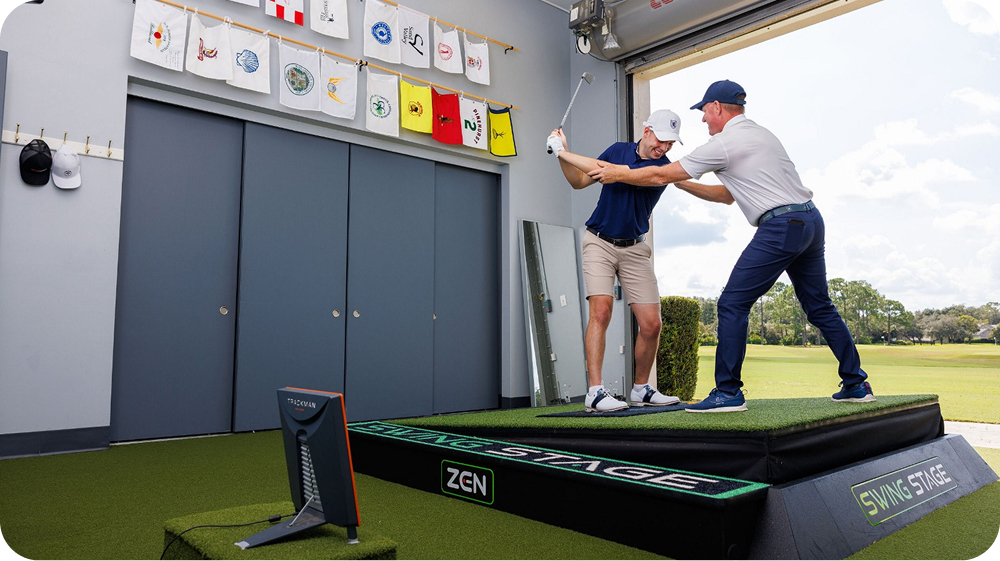
This approach appears in technologies such as the integration between Trackman and Zen Swing Stage. The system pairs ball flight data with physical slope beneath the player’s feet so golfers experience the same environmental constraints present on the course.
When the environment resembles the course, the data becomes more meaningful.
Transfer begins to improve because practice mirrors performance.
From Repetition to Problem Solving
Traditional practice often focuses on repeating the same movement.
Modern learning research suggests a different approach.
Skilled performers repeat the problem rather than the exact movement.
The target remains consistent. The environment changes. The golfer adapts.
Slope provides a simple example.
An uphill lie requires a different balance strategy than a downhill lie. The golfer adjusts posture, force production, and delivery without consciously changing technique.
This variability strengthens coordination patterns that survive environmental change.
Instead of protecting a single swing, the golfer learns how to solve the problem of hitting the shot.
Designing Practice That Transfers
Coaches and players can strengthen transfer by adjusting how practice sessions are structured.
- Introduce environmental variation
- Practice from uneven lies, slopes, and varied targets.
- Link perception and action
- Read the lie before every shot. Visualize trajectory before executing.
- Use realistic tasks
- Simulate on course scenarios such as approach shots to specific targets or recovery shots from difficult lies.
- Measure performance under constraint
Track how ball flight behaves when the environment changes rather than only in neutral conditions.
These changes move practice closer to the conditions of the course.
The result becomes more robust learning.
Closing the Practice Gap
Golf improvement does not come only from technical repetition.
It develops through interaction with the environment.
When practice environments resemble the course, players learn how their movements adapt to real situations. Skills become less dependent on perfect conditions and more capable of surviving unpredictable lies.
Transfer improves because learning occurs inside the same information that guides performance.
The closer practice resembles play, the stronger the connection between the two becomes.
Explore More About Slope Based Training
If this topic interests you, explore the following articles in the Zen learning series.
- Closing the Practice Gap with Trackman and Zen Swing Stage
- Trackman × Zen Integration: Make Swing Changes That Transfer to the Course
- Trackman × Zen Integration: Virtual Golf With Real World Slopes
- Why Great Range Swings Fail on the Course
These articles expand on how slopes, data, and representative training environments improve golf performance.
