
Slope As a Golf Coaching Constraint
Overview
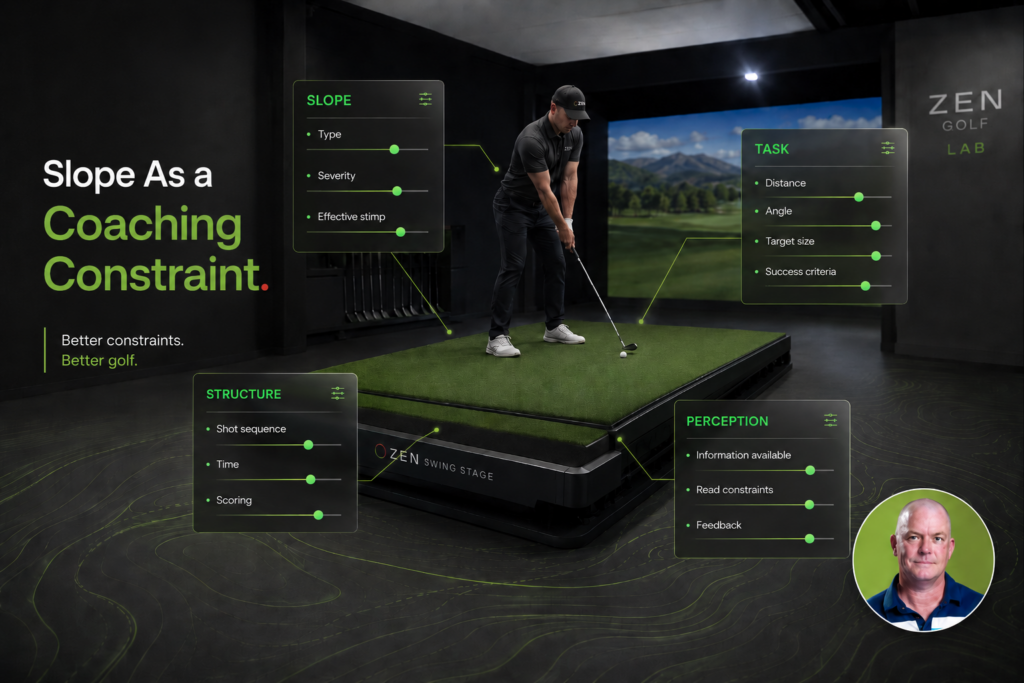
Slope works as a coaching constraint because it changes the movement problem the golfer must solve. Liam Mucklow uses the Zen Swing Stage within The Golf Lab model to help players adapt through the task, the environment, and measurable feedback.
A coaching constraint is any condition that shapes player behavior. In golf, that can include slope, lie, target, club, surface, stance, ball position, equipment, pressure, or scoring consequence.
The pillar article, How Zen Master Coach Liam Mucklow Uses the Zen Swing Stage to Improve GRF, shows this through an 8-degree incline used to change lower-body force behavior in an NCAA Division I player.
This article explains how slope acts as a coaching constraint in golf by changing the task the player must solve. Through Liam Mucklow’s work with the Zen Swing Stage, it shows why uneven ground is not simply a practice variation. Slope changes balance, pressure distribution, posture, force timing, shot intention, and decision-making.
The article also connects slope training to wider coaching science. It explains how constraints-led coaching, representative learning design, and the Challenge Point Framework help coaches scale difficulty, preserve real performance information, and avoid over-relying on verbal instruction.
Written by: Will Stubbs, Head of Education, Zen Golf
Last Updated: 16/07/2026
Why Verbal Instruction Has Limits
A player can understand a verbal instruction and still fail to produce the movement.
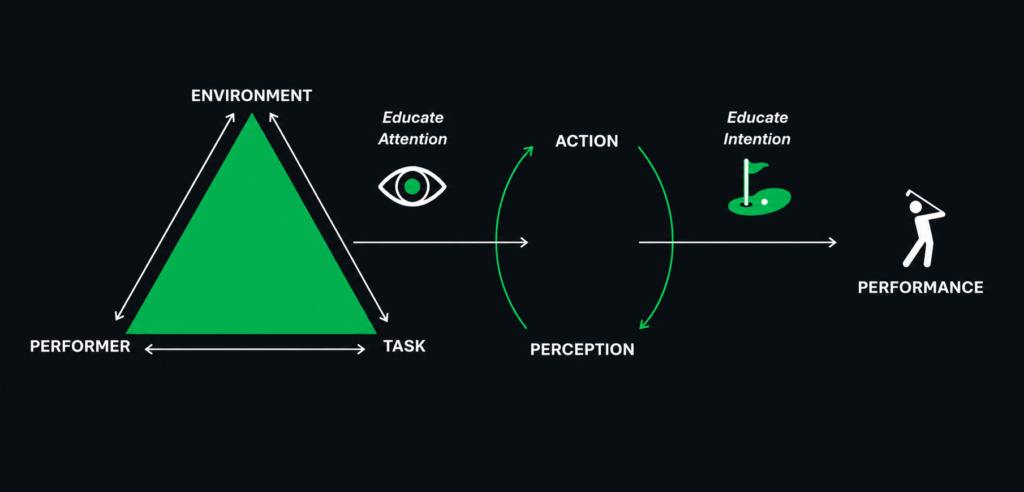
The body may continue solving the task through the old pattern. That happens because movement is shaped by perception, physical capacity, intention, environment, equipment, and feedback.
The Golf Lab System Architecture reflects this complexity. It captures Eyes, Mind, Body, Environment, Equipment, Launch Monitors, 3D Motion Capture, and Force Plates before diagnosis. Root Cause Diagnosis then determines why the pattern exists before one Key Performance Indicator is selected.
That structure respects a reality every experienced coach recognizes. The player may not need more words, but they may need a different task.
In Liam Mucklow’s coaching model, slope is used as a structured constraint because it changes the player’s interaction with the ground, giving the coach clearer evidence about balance, pressure, force timing, and adaptability.
This connects directly with Zen’s education article How Coaches Use Slope in Lessons, which explains how slope helps coaches observe balance, strike, aim, speed control, and decision-making under conditions closer to the course.
What a Constraint Changes
A coaching constraint in golf is any condition that changes the task and shapes how the player moves, such as slope, lie, target, club, stance, pressure, or scoring consequence.
The constraints-led approach comes from motor learning and ecological dynamics. It treats movement as a solution that emerges from the interaction between the player, task, and environment.
In golf, this matters because the swing is not produced in a vacuum. The player responds to the lie, the target, the club, the stance, the slope, and the shot intention.
A downhill lie changes posture and low-point demand. An uphill lie changes pressure and launch tendency. A sidehill lie changes balance and distance from the ball. These conditions reshape behavior before the coach adds any technical explanation.
The research article Representative Learning Design and Functionality of Research and Practice in Sport explains why training tasks should preserve the information and actions present in real performance settings. In golf, slope is part of that performance information.
This is why the Zen article Flat vs Sloped Practice: What Really Transfers is a valuable internal link from this blog. It develops the same learning principle through a practical indoor golf lens.
Slope Inside The Golf Lab System
The Golf Lab model does not use constraints randomly.
The system first captures baseline data. It then identifies root cause. It selects one KPI. Prescription follows from that KPI. The player then enters a feedback loop.
Slope fits inside that sequence.
If the player’s root cause is late force timing, slope may become a useful intervention. If the root cause is equipment, slope may act as a test condition. If the root cause is visual perception, slope might reveal the pattern but not solve it by itself.
This is why the Zen Swing Stage should be framed as a coaching environment, not a shortcut.
The Stage gives Liam a controlled way to change the ground, repeat the task, and observe whether the player adapts. It adds information to the coaching process. It does not replace the coach’s judgment.
For readers who want the wider diagnostic framework, Liam Mucklow and the Golf Lab Model: A Guide for Coaches should be used as a related internal pathway, alongside the Liam pillar article.
Liam’s Case Study as Constraint-Led Coaching
In Liam’s NCAA case study, the player showed late force peaks, pelvic over-rotation, and inconsistent vertical force application. The intervention used an 8-degree incline on the Zen Swing Stage to encourage trail-leg stability and earlier horizontal force application.
The slope changed the task.
The player could no longer rely on the same sway pattern. The environment encouraged a different movement solution. Swing Catalyst data then helped Liam verify whether force timing changed.
That makes the intervention constraint-led rather than instruction-led.
The coach still guided the process. The difference was that the environment carried part of the teaching load. The player received information from the ground, not only from verbal instruction.
This is also why Ground Reaction Forces In Golf: Why Owning Your Stock Motion Matters is a strong supporting Zen article. It explains why golfers do not all use the ground in the same way, and why coaches should understand the player’s stock motion before prescribing change.
Matching the Constraint to the Player
A constraint only works when it fits the player.
The Golf Lab architecture states that drill recommendations should include two options matched to cognitive disposition, physical capacity, and real-world constraints. Each feedback cycle helps reveal how the individual learns.
That principle applies directly to slope training.
One player may respond well to visual feedback. Another may need a feel-based task. Another may need a smaller gradient because confidence or balance is the limiting factor. Another may need more challenge because the original pattern only appears under higher load.
The coach selects the constraint based on the player.
The Challenge Point Framework supports this idea. Guadagnoli and Lee explain that learning depends on the relationship between performer skill level and task difficulty. A task that is too easy may not create enough useful information. A task that is too hard may reduce learning quality.
For golf coaches, that means slope should be scaled.
A beginner may need a small slope, a short club, and a simple target. A college player may need stronger gradients, force plate feedback, and a performance goal. A tour player may need compound slopes, randomized lies, and scoring consequence.
Zen’s Indoor Golf Practice Series gives coaches a broader pathway for structuring this type of practice progression indoors.
Why Research Supports Slope as a Coaching Constraint
Slope is useful in coaching because it changes the information available to the player.
A golfer standing on a sidehill lie does not receive the same balance, pressure, or posture information as a golfer standing on a flat mat. The ground changes the task before the club moves.
Research on uphill and downhill lies supports this practical observation. The study The Effect of Uphill and Downhill Slopes on Weight Transfer, Alignment, and Shot Outcome in Golf examined shots from flat, uphill, and downhill slopes. It found that slope changed weight transfer, alignment, and shot outcome.
The Loughborough Research Repository version of the same study, The Effect of Uphill and Downhill Slopes on Weight Transfer, Alignment and Shot Outcome in Golf, reports that 12 elite male golfers hit 30 six-iron shots from flat and 5-degree slope conditions while 3D kinematics, kinetics, and launch monitor outcomes were captured.
Slopes as For Coaches
For coaches, this evidence matters because it confirms the principle behind slope training. The ground changes the task. When the task changes, movement changes.
TPI also supports the importance of task-specific ground interaction. In Ground Reaction Forces in the Full Swing vs. the Short Game, TPI explains that players use the ground differently depending on the shot, and that objective force data helps coaches match instruction to task demand.
This evidence supports Liam’s use of the Zen Swing Stage. The Stage lets the coach control the ground condition, repeat it, and adjust it as the player adapts. The coach can then connect the player’s response to force data, movement data, ball flight, and the selected KPI.
Slope becomes more than variety. It becomes a structured coaching constraint.
Why This Matters for NCAA Golf Programs
NCAA golf programs need practice environments that develop adaptability, not only repetition.
Student-athletes face travel, academic demands, tournament pressure, course variation, changing lies, and limited preparation windows. The NCAA reported a record 554,298 student-athletes participating in championship sports in 2024-25, an all-time high.
The time demand is also significant. The NCAA GOALS Study 2025 reported median in-season athletics time commitments of 41 hours per week for Division I men’s golf and 36 hours per week for Division I women’s golf.
That creates a practical coaching challenge.
College players need efficient, structured practice that prepares them for real competition conditions. A flat indoor bay helps with technical work, launch monitor calibration, and repetition. It does not fully reproduce the terrain demands of tournament golf.
How Zen Golf can Support NCAA Teams
The Zen Swing Stage adds controlled slope to the training space. When combined with force plates, video, and launch monitor data, it gives coaches a way to train uneven lies indoors and test whether movement changes hold up when the environment changes.
Zen’s For Universities & Colleges page positions Liam Mucklow alongside other Zen Master coaches for college and university environments, making this a relevant internal product and education pathway for NCAA programs.
This does not replace on-course practice. It gives NCAA coaches a controlled environment where players can rehearse course-like constraints when weather, travel, academic schedules, or facility access limit outdoor preparation.
How Zen Golf Supports Constraint-Led Coaching Environments
Zen Golf supports constraint-led coaching by making the ground part of the learning task.
Most indoor environments already provide useful ball and club data. Trackman, force plates, and video help coaches see what happened and how the player moved. The missing piece is often the surface beneath the player.
The Trackman × Zen Integration Guide explains how Zen’s moving-floor technology connects physical slope with Trackman performance data, so the player experiences the lie while the system measures club delivery, ball flight, and shot outcome.
That matters because a constraint-led session needs a clear relationship between task and feedback.
The ground gives the player a problem to solve. The launch monitor shows the shot outcome. Force plates show how the player used the ground. The coach interprets the pattern and adjusts the next task.
This is why Indoor Golf Practice with Zen Golf and Trackman is a strong supporting article. It explains how slope can be used to train coordination, adaptability, and performance in an indoor practice plan.
For a broader transfer pathway, The Science of Transfer in Golf Practice explains why practice should include the environmental constraints that shape performance.
Practical Applications for Coaches
Slope-based constraints can be used in several ways:
- Reveal hidden instability – A player who looks balanced on flat ground may struggle when the ball sits below the feet.
- Guide force timing – An incline may encourage earlier trail-leg stability or earlier pressure organization.
- Test learning transfer – After a technical change on flat ground, the coach can see whether the movement holds up on uphill, downhill, sidehill, and diagonal lies.
- Create decision-making tasks – The player must choose club, trajectory, target, and intention based on the lie.
The Zen article Why Golfers Need to Practice Slope-Specific Shots develops this idea further by explaining why normal ranges rarely give players repeated access to the lies that shape scoring shots on the course.
Key Takeaways
Slope is a coaching constraint because it changes the movement problem.
The Golf Lab model uses constraints after diagnosis, not as random difficulty.
Representative learning design supports the idea that practice should preserve information from the performance environment.
The Challenge Point Framework helps coaches scale the difficulty of slope tasks to the player.
Research on uphill and downhill lies shows that slope changes weight transfer, alignment, and shot outcome.
The Zen Swing Stage gives coaches controlled slope conditions indoors.
Liam’s case study shows how an environmental constraint can support earlier force organization and improved stability.
NCAA golf programs can use slope-aware indoor environments to prepare players for course variability within limited practice windows.
Explore More
Start with the Liam Mucklow pillar article, How Zen Master Coach Liam Mucklow Uses the Zen Swing Stage to Improve GRF, then continue through the wider Zen Golf Resource Hub for more education on learning design, indoor practice, slope, and performance transfer.
For coaching application, read How Coaches Use Slope in Lessons, Flat vs Sloped Practice: What Really Transfers, and Why Repetition Alone Does Not Build Transferable Golf Skill.
For technology integration, explore Trackman × Zen Integration Guide and Indoor Golf Practice with Zen Golf and Trackman.
For facilities, academies, and college programs, the relevant product pathways are Zen Green Stage for putting, green reading, pace control, and short-game training on realistic gradients, Zen Swing Stage for full-swing training from uneven lies and slope interaction, and Zen Golf Stage for integrated putting and hitting environments.
The aim is to create practice that reflects the game more closely, so players learn how to adapt before the course asks them to.
