
Moving Floor Golf Simulators: Buyer Guide for Coaches & Facilities
Overview
Indoor golf technology has advanced rapidly, yet one challenge remains consistent: replicating the ground conditions golfers face on the course.
Traditional simulators provide accurate ball data and visual environments, but most are built on static floors that cannot recreate slopes, lies, or gradients.
Moving floor golf simulators were developed to solve this problem.
By adjusting the surface beneath the player, these systems recreate the uphill, downhill, and sidehill slopes golfers experience outdoors. The result is a practice environment that connects indoor learning with real on-course performance.
For coaches, academies, and golf facilities, this technology introduces a new category of simulator design—one focused not only on ball flight simulation but also on how players interact with the ground during the shot.
This buyer guide explains:
- Why moving floor simulators were developed
- What problems they solve in coaching and practice environments
- The key features facilities should evaluate before investing
Understanding these principles helps decision-makers select technology that supports realistic training, better transfer of learning, and long-term player development.
Written by: Will Stubbs, Head of Education, Zen Golf
Last Updated: 04/03/2025
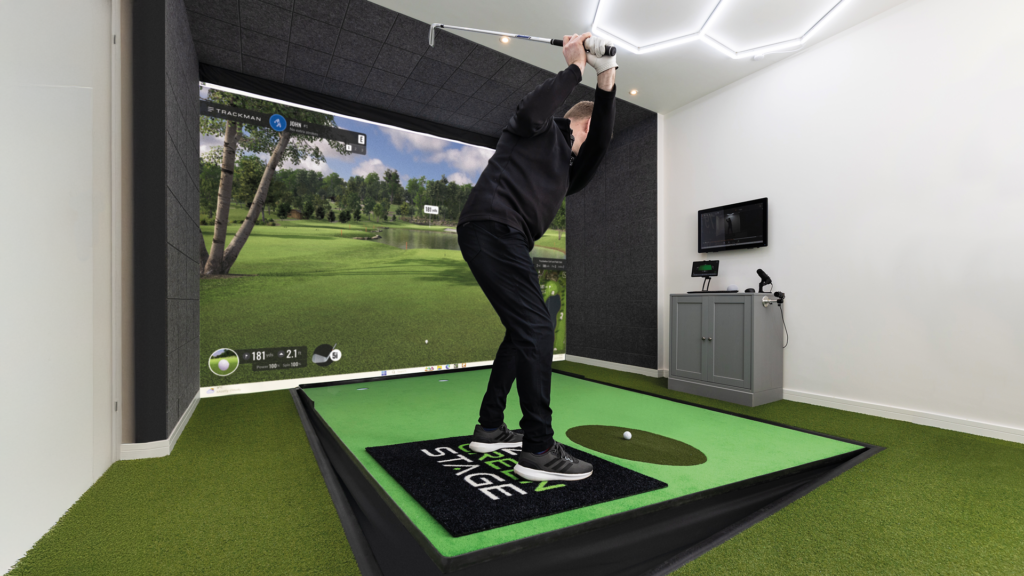
Why Moving Floor Golf Simulators Exist
Most golf simulators focus on ball flight measurement and visual simulation. Launch monitors, projectors, and software recreate the flight of the ball and the appearance of the course.
However, the golf course itself is rarely flat.
Players regularly face:
- Uphill lies
- Downhill lies
- Sidehill slopes
- Compound slopes
- Uneven stances
These slopes influence club delivery, balance, and strike quality. Practicing only on flat surfaces removes an important variable from the learning environment.
Moving floor simulators address this limitation by introducing controlled gradients beneath the player. Instead of practicing every shot from a level surface, golfers can experience the same slope conditions they would encounter on the course.
For coaches, this enables training that is closer to the realities of the game. For facilities, it expands the simulator from a ball-flight tool into a complete performance environment.
The concept aligns with modern coaching principles such as representative learning design, where practice environments mirror real playing conditions.
Why “What Slope” Is Often the Wrong Question
A common mistake in evaluating moving floor systems is asking:
“What degree slope does it go up to?”
The true question is how realistic is it? A moving floor can look realistic on the surface, but when it tilts and rolls, the feel under your feet is lost unless it’s responsive, accurate, safe and reliable.
When a floor moves dramatically to correct gradients you’d feel on the course and scenes you see on the sim screen the experience comes to life.
Without this, players question it as it doesn’t feel real. The challenge fades into question, the engagement is lost, and players fail to improve their skills.
From a learning perspective, realism is defined by whether the environment preserves the information that guides action. If the slopes, lies, and task demands do not meaningfully shape perception, judgement, and movement solutions, then the system risks becoming an expensive novelty.
The most effective systems do not simply tilt the floor. They preserve the informational consequences of slope: how gravity is felt, how balance is challenged, and how decisions emerge under changing conditions.
This is why systems that prioritize responsiveness, precision, and consistency under load tend to outperform those that rely on headline slope numbers.
The goal is not tilted angles, but realistic experiences, and that means twists and compound slopes. Only Zen Golf’s Stages can create these with unmatched accuracy, repeatability and reliability.
What Determines Long-Term Value
1. Terrain Capability and Resolution
Not all slope is created equal. Buyers should look beyond headline numbers and ask:
- Can slopes be adjusted continuously, or only in discrete steps?
- Is the system capable of subtle gradients as well as more severe ones?
- Can the same slope be reproduced reliably across sessions?
High-quality learning environments rely on fine-grained control, not just extremes. Subtle changes are often more important than dramatic ones, particularly for elite players and coaches.
In practice, this means the difference between a platform that demonstrates slope and one that can recreate true terrain.
Systems capable of combining subtle gradients across multiple axes allow coaches to recreate real-world scenarios rather than isolated tilts. This distinction becomes critical when designing progression, assessments, and repeatable learning environments.
Zen Stage’s are designed around this second principle, allowing coaches to compose subtle, compound slopes that can be reproduced session to session. This enables progression and comparison over time, rather than one-off demonstrations of difficulty.
2. Learning Design Support
A moving floor without a learning framework places the burden entirely on the coach to invent structure.
Facilities should ask:
- Does the system come with a clear philosophy for practice design?
- Are there examples of session progressions, assessments, or programs?
- Does it have learning playlists built into it?
- Can difficulty be scaled intentionally, rather than guessed?
In reality, very few moving floor systems arrive with an integrated learning architecture.
When learning design is absent, usage becomes coach-dependent, outcomes vary wildly, and facilities struggle to scale quality across staff.
Systems that embed learning principles into the environment itself reduce this reliance on individual expertise and create consistency across sessions and coaches.
Without this, even the most advanced hardware risks inconsistent use and declining engagement over time.
The most effective environments provide shared language, shared reference points, and shared progressions, allowing learning to compound over time rather than reset each session.
3. Measurement and Feedback
More data does not automatically lead to better learning.
Effective systems:
- Connect with 3rd party technology to provide feedback that explains why an outcome occurred
- Distinguish between task difficulty and player performance
- Support reflection and adjustment rather than compliance
Buyers should be cautious of feedback that removes judgement or tells players exactly what to do. Learning environments should develop adaptability, not just move to a slope.
Measurement becomes transformative when it is contextual. Data disconnected from terrain risks explaining what happened without explaining why it happened.
Systems that link real-world slope, ball behavior, and player decisions create feedback loops that accelerate understanding rather than overwhelm it.
In the Zen system, slope is not treated as background context. It is a measurable part of the task. When we link real terrain to ball behavior and decision outcomes, coaches and players can see not just what happened, but why it happened under those specific conditions.
4. Integration Certainty
Modern facilities operate complex technology stacks. Moving floor systems rarely exist in isolation.
Important questions include:
- What integrations are officially supported today?
- What integration is suited to what customer?
- Who owns troubleshooting when systems interact?
Clarity here is not just technical detail; it is a risk-management issue.
Integration certainty is not only about compatibility. It is about orchestration, in how hardware, software, data, and learning experiences are designed to work together as a single system.
Platforms that treat integration as an afterthought often push complexity onto the facility. Systems designed as ecosystems simplify decision-making by making clear what is supported, how it is used, and who owns the outcome.
Zen was built as an ecosystem rather than a standalone product. Terrain, visualisation, and measurement are designed to work together, with clearly defined integrations and ownership. This reduces operational risk and gives facilities clarity on what is supported today, not just what may be possible in theory.
5. Utilization and ROI
The true cost of a moving floor system is not its purchase price. It is the opportunity cost if it sits unused.
Facilities should evaluate:
- Can this system support group coaching?
- Does it enable leagues, assessments, or seasonal programs?
- Will it help coaches fill diaries and retain members?
- Can it be used for multiple use-cases, like coaches, players and club fitters easily?
Systems that support this level of programmability turn terrain into a revenue-generating asset rather than a discretionary feature.
Facilities using Zen typically shift from ad-hoc use to structured offerings with assessments, leagues, and development programs, because the system is designed to support repeatable formats that ignite engagement.
Common Pitfalls When Buying a Moving Floor System
Many facilities encounter similar issues:
- Investing in slopes without a method to use them
- Over-engineering the solution without onboarding staff
- Confusing variability with learning value
- Underestimating the importance of coach confidence
These issues are rarely solved with better hardware alone. They are solved by choosing systems designed around coaching reality, learning progression, and long-term community use.
How to Evaluate Any Moving Floor Golf Simulator
A simple way to assess a system is to imagine using it for ten consecutive sessions with the same player.
Ask:
- How would difficulty progress?
- What would the player learn in weeks 3–5 that they could not in week 1?
- Would the environment still offer new information, or would it repeat itself?
The best systems continue to reveal new challenges over time, not just new angles.
A More Effective Way Forward
Moving floor simulators are most powerful when treated as learning environments, not equipment upgrades.
Facilities that succeed focus less on slope angles and more on:
- Practice design
- Decision-making
- Measurement of adaptation over time
When terrain is embedded within a coherent coaching system, it becomes a tool for sustained improvement rather than short-term novelty.
The most successful facilities increasingly choose systems designed as complete performance environments; where terrain, data, visualisation, and education are unified.
When slope becomes part of a coherent system rather than an isolated feature, practice stops being about repetition and starts becoming about understanding. That is where lasting value is created.
Moving Floor Systems: Evaluation Lens Used by Zen
| Evaluation | Typical Moving Floor | Zen Systems |
| Slope control & realism | Discrete tap-to-slope adjustments, primarily planar | Continuous, compound, and double-break terrain that recreates how real greens and lies behave, not just how they tilt |
| Accuracy & repeatability | Approximate gradients, center-weighted control | 0.1% gradient variation independently at all four corners, enabling precise replication and progression across sessions |
| Movement range | Limited slope envelope | Up to 12% uphill/downhill and 10% sidehill, supporting everything from subtle calibration work to elite-level challenge |
| Learning framework | Coach-dependent usage | Embedded progressions, presets, playlists, and independent-use pathways, reducing reliance on ad-hoc session design |
| Utilization model | One-off or novelty sessions | Programs, leagues, assessments, and development pathways that drive repeat use and long-term engagement |
| Integration approach | Partial or siloed integrations | Ecosystem-led integration design, tailored to each customer rather than forced into a single tech stack |
| Digital tooling | Basic controls or manual setup | Presets, Playlists (“Spotify for Golf”), and Famous Putts activations, enabling scalable delivery and consistent experiences |
| Reliability & uptime | Variable, often usage-dependent | 95%+ uptime, engineered for high-frequency commercial and coaching environments |
| Safety & compliance | Not certified for man-riding in all regions | The only UKCA & KC Mark certified man-riding moving floor, setting the benchmark for operational safety |
| Robustness in coaching use | Coach-off-platform operation | Designed for stand-on-stage control, allowing coach and player to interact directly within the learning environment |
| Versatility of deployment | Fixed formats | On-floor and in-floor configurations with modular accessories, adapting to facility constraints and growth |
| Putting surface quality | Standard off the shelf synthetic turf | Zen Master putting surface, exclusive to Zen and validated at Tour level |
| Full-round capability | Putting or hitting only | The Golf Stage hybrid model, the industry’s first system delivering full-round play (putting + hitting) with maximum movement and Tour-quality surfaces |
| Long-term value | Feature novelty | A compounding learning system, where terrain, data, and education reinforce one another over time |
