
Indoor Golf Practice: What It Gets Right, What It Gets Wrong, and What Must Change
What a Practice Thinkers conversation revealed about realism, physiology, and designing indoor environments that transfer
Indoor golf is not the future. It’s already here.
Franchise models are expanding.
Simulator centers are multiplying.
Universities and federations are investing heavily in indoor facilities.
The real question is no longer:
“Is indoor practice valuable?”
The better question is:
“What kind of indoor practice actually transfers?”
In my recent conversation with Pete Arnott on the Practice Thinkers Podcast, we explored the pros and cons of indoor golf practice — not from a technology-first perspective, but from a learning-design and performance perspective.
Because indoor environments can either accelerate skill development…
Or quietly reinforce the same transfer gap we discussed on the Mind Caddie podcast.
To listen to the full conversation, follow along on:
Written by: Will Stubbs, Head of Education, Zen Golf
Last Updated: 25/03/2025
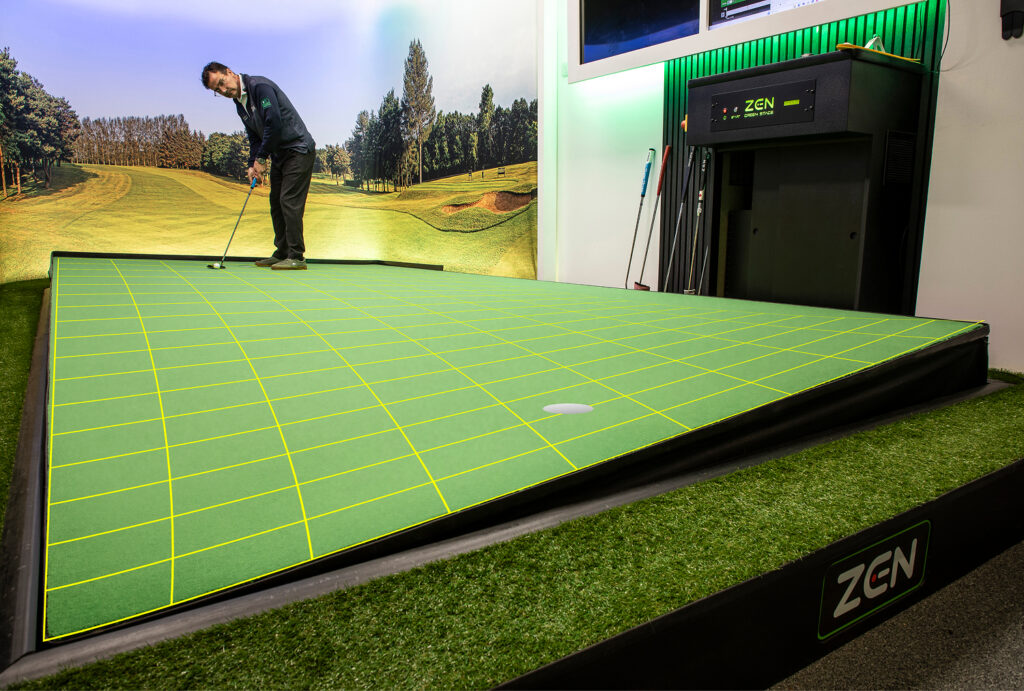
What Indoor Golf Gets Right
Indoor environments provide:
- Controlled lighting
- Controlled weather
- Measurable feedback
- Repeatable conditions
- Immediate data
From a physiological standpoint, they also allow:
- Strength and conditioning integration
- Rehab and physiotherapy under one roof
- Biomechanical testing
- Ground reaction force profiling
- Fatigue monitoring
In other words:
Indoor spaces can become performance laboratories.
But here’s the issue…
Laboratories are sterile, and golf courses are messy.
If the lab doesn’t prepare you for the mess, it creates fragile skill.
The Core Limitation: Sterile Context
Most indoor setups unintentionally remove:
- Slope
- Lie variability
- Uneven balance demand
- Wind perception
- Visual intimidation
- Emotional consequence
The result?
Technically clean swings in controlled environments, but golf is not played in control.
Golf is played in variable environments that change from moment to moment.
This is the same theme we explored in:
Developing Consistency Through Realistic Practice on Slopes
Consistency in golf is not repeatability; it’s adaptability across changing conditions.
Indoor golf practice transfers the best when it preserves these key conditions.
The Ecological Question
During the conversation with Pete, one idea kept resurfacing:
“Are we designing indoor spaces around instruction…
or around interaction?”
Traditional simulator sessions often follow this pattern:
- Hit ball
- Look at numbers
- Adjust technique
- Repeat
This is reductionist.
Instead, ecological dynamics suggests:
- Define the task
- Introduce constraint
- Let behavior emerge
- Use data as feedback
This is why slope-based environments change the equation.
When you combine simulator data with real, physical gradient, as explored in:
Key Trackman Metrics on Slopes
When the environment changes, the golfer’s delivery reorganizes naturally to become functional.
Therefore, the numbers don’t change, but their meaning does.
Indoor as Laboratory — If Designed Correctly
One of the most exciting parts of the discussion was physiology.
Indoor centers can become:
- Performance labs
- Movement screening hubs
- Fatigue testing environments
- Return-to-play rehabilitation spaces
- Integrated strength + skill centers
This happens only if the environment reflects performance demand.
A lab that tests flat ground mechanics without slope exposure misses a key variable in golf: gravity interacting with balance.
That’s where integrated systems matter.
For example:
- Ground reaction force plates embedded in slope platforms
- Ball-flight data linked to gradient
- Decision-making tasks layered onto simulator play
Now the indoor space becomes interdisciplinary and not just swing-focused.
The Federation & University Opportunity
For federations and elite programs, the stakes are higher.
Indoor practice must:
- Standardize skill calibration
- Preserve transfer to the course
- Develop adaptable players
- Support long-term athletic development
Flat-only indoor programs risk creating athletes who are technically refined, but environmentally fragile.
Slope-based and constraint-led environments prepare players for:
- Championship setups
- Uneven championship lies
- Pressure variability
- Strategic decision-making
This is particularly relevant when integrated with:
Trackman × Zen Integration — What It Means for Coaches
When coaching becomes environment-led rather than instruction-heavy, we start coaching for the game, and not just the swing.
The Commercial Indoor Centre Question
For indoor franchises and commercial facilities, the question becomes:
“What keeps members coming back?”
Entertainment works short term, but skill development drives long term love for the game.
When speaking with the world’s top indoor facilities, sustainable communities are built when people:
- Experience improvement
- Feel challenged
- Solve meaningful problems
- See measurable progress
This aligns directly with the puzzle-based framing of golf:
A round is 60–100 unique problems.
If indoor golf removes the puzzle, engagement drops.
If indoor golf recreates the puzzle, motivation rises.
The Shift Required
Indoor golf does not need more data. It needs better context.
Instead of asking:
“How do we perfect the swing indoors?”
We should ask:
“How do we design indoor environments that teach the body to adapt?”
That means:
- Introducing slope
- Introducing variability
- Introducing decision
- Reducing over-instruction
- Increasing representative tasks
The goal is not pristine repetition, but to develop robust skills and players who can own them.
Practical Applications for your Indoor Practice This Week
- Randomize Shot Tasks
Instead of 20 drivers in a row, simulate a hole. - Add Consequence
Miss left = next shot from rough scenario. - Introduce Gradient
Even a 1–2% slope changes perception and delivery. - Rotate Slopes
One uphill. One downhill. One sidehill. One flat. - Integrate Physical Testing
Measure balance shifts pre and post fatigue block. - Reduce Verbal Overload
Let the environment teach through awareness.
The Core Takeaway
Indoor golf is not the problem. Sterile indoor golf is.
The future of indoor performance environments lies in:
- Realism
- Constraint-led design
- Integrated physiology
- Data used intelligently
- Context preserved
The question isn’t:
“Is indoor good or bad?”
It’s:
“Is this indoor environment preparing the player for the course?”
Because the course will always ask different questions, and practice must prepare golfers to answer them.
