
4. Golf Adaptability Training For Slope, Lie, Wind, Pressure, And Shot Consequence
Overview
Golf adaptability training helps players solve changing shot problems across slope, lie, wind, pressure, and consequence. For coaches, researchers, and academics, it reframes skill as the ability to regulate perception, decision-making, movement, and attention when the performance environment changes.
The previous three articles in this advanced coaching series built the foundation for this idea. The first looked at golf skill through attractors and invariants. The second examined functional and rate-limiting movement patterns. The third explored how coaches design practice to stabilize performance principles rather than fixed techniques.
This article extends that sequence into adaptability. A player has not finished learning when a movement pattern looks organized in practice. The next question is whether that organization survives when the course changes the problem.
Written by: Will Stubbs, Head of Education, Zen Golf
Last Updated: 31/07/2026

Reframing Adaptability In Golf Coaching
Adaptability is the player’s ability to maintain functional shot outcomes when the constraints of the shot change.
In golf, those constraints include the player, the task, and the environment. Newell’s constraints model explains coordination as emerging from the interaction between individual, task, and environmental constraints.
In coaching terms, the swing, stroke, or shot pattern emerges from the player’s body, the club, the lie, the target, the weather, the score, and the consequence attached to the next shot.
A player who repeats one movement pattern from a flat mat has solved one version of the game. A player who adjusts start line, strike, trajectory, pace, balance, club selection, and commitment across changing conditions is solving golf.
This distinction is important as golf does not present identical repetitions from shot to shot – even tee shots present different hole shapes, landing areas, wind, hazards etc. These all constrain attention and as such our movement intentions relative to solving the golf puzzle before us.
When we adopt this approach, we see the connection between the player and course as a series of questions or problems to solve. The course asks the player to read the situation, select a response, and organize a movement solution under time, score, and consequence.
How This Continues The Series
The first article in this series introduced attractors and invariants. Attractors help explain why players return to familiar movement solutions. Invariants help explain which stable relationships are key parameters or relationships across changing tasks.
The second article looked at rate-limiting patterns. A player’s adaptability is often restricted by the weakest interaction in the system. That might be balance on a sidehill lie, speed control on a downhill putt, face control into wind, or attention control under pressure.
The third article argued for stabilizing performance principles. A coach does not need to freeze one technical shape. The coach helps the player stabilize useful relationships such as strike, start direction, pace, trajectory window, landing zone, and acceptable target zone.
Adaptability becomes the next layer. The player learns how those principles reorganize when slope, lie, wind, pressure, and consequence change the task. For both players and coaches this sets the foundation for session structure, progression and the periodization of skill development.
The Research Foundation For Adaptable Golf Skill
Representative Learning Design
A practice task has higher value when it preserves the information and action demands of performance. Representative learning design, described by Pinder, Davids, Renshaw, and Araújo, emphasizes functionality and action fidelity in research and training environments.
For golf coaching, this means practice should include the information a player needs on the course. Slope, lie, wind, turf, target, danger, pace, and score are not background details. They shape what the player perceives and constrain how the movement organizes.
When those factors are removed, practice becomes easier to control but less connected to performance. This is potentially why we see so many players struggle to take practice into a course environment – there is a lack of representativeness in the environments we learn the game within.
Invariants As Stable Task Relationships
Adaptability does not mean unlimited movement variation. skilled performance still needs stable information, stable task goals, and stable outcome relationships.
These stable features are invariants. In golf, an invariant might be the task outcome goal, such as starting the ball through the intended window, landing the ball in a defined zone, entry speed on a breaking putt, or matching angle of attack to the shot demand. The player has freedom to organize movement in different ways, but the solution still needs to satisfy the task.
This gives coaches a way to think about skilled performance as funnels of variability.
The wide end of the funnel represents the performer’s movement options. Grip pressure, stance width, tempo, backswing length, pressure shift, swing direction, and club selection might all vary. The narrow point represents the invariant performance variable that must remain stable.
This moves coaching away from isolated and decomposed technique. The coach defines what must remain stable, then designs practice so the player searches for different ways to move through that stable endpoint.
Prospective Control And Degrees Of Freedom
Prospective control explains how performers use perceptual information to guide and regulate action as it unfolds. In fast interceptive skills, this often relates to tau, an informational variable associated with time-to-contact. In golf, the time scales differ, but the principle still applies.
The performer does not simply execute a pre-written movement. They use information from the body, club, ground, ball, target, and environment to prepare, initiate, and regulate action.
Degrees of freedom refers to the movement options available within the perceptual-motor system. In golf, those options include joint motion, pressure shift, clubface orientation, swing direction, tempo, grip pressure, visual attention, and tactical intention.
Skilled players do not remove all degrees of freedom. They learn how to organize those options around the invariant demands of the task.
Rob Gray’s 2020 baseball batting study gives a useful cross-sport reference. Batters improved by developing functional variability, increasing coupling between swing phases, reducing variability that moved them outside the temporal demand, and showing stronger evidence of online adjustment.
Gray’s later review of visual-motor control in baseball batting also contrasts pre-programmed control with online control. Note, the golf transfer should be applied carefully because batting and golf are different tasks. The useful coaching point is that skilled performers organize movement around live information, not fixed positions alone.
Frans Bosch and Randy Sullivan make a related applied coaching argument in baseball pitching. Their work describes how performers move through key coordination demands while still allowing individual movement solutions.
The golf application is clear. A player does not need one rehearsed movement for every slope, lie, wind, or pressure condition. They need stable performance invariants that constrain useful variability. Those invariants act like the narrow point of the funnel. They stop variability from becoming noise, while still giving the performer enough freedom to search, discover, and exploit functional solutions.
This is a practical way to train adaptability. The coach defines what must remain stable, then designs variability around it.
Functional Variability And Degeneracy
Variability only helps learning when it serves the task.
Latash’s uncontrolled manifold hypothesis helps explain why variability is not automatically useful or disruptive. Good variability occurs within the family of movement solutions that preserve the important performance variable. Bad variability moves the performer away from that performance variable.
In golf, the performance variable might be start line, strike, low point, landing zone, entry speed, or acceptable target zone. A player might vary grip pressure, stance width, tempo, ball position, pressure shift, club selection, or swing length, provided those changes still stabilize the task outcome. That is functional variability.
Variability becomes rate-limiting when those same changes disrupt the outcome. If tempo variation changes low point, strike, launch, or pace control beyond the task tolerance, the variability no longer supports performance. It becomes noise relative to the goal.
Degeneracy explains why this matters. In movement science, degeneracy describes how structurally different coordinative solutions can achieve the same functional outcome. Seifert, Komar, Araújo, and Davids’ review of neurobiological degeneracy argues that degeneracy helps perception-action systems adapt to interacting constraints by preserving function while allowing coordination patterns to change.
This is central to adaptable golf skill. The player is learning which parts of the system need to remain stable and which parts can reorganize. A golfer might vary club selection, trajectory, ball position, tempo, pressure shift, face strategy, or spin profile while still preserving the invariant task goal. The movement solution changes, but the functional endpoint remains stable.
The funnel of variability gives coaches a practical model for this. The invariant defines the narrow point of the funnel. The solution space gives the player room to explore. Degeneracy allows different movement solutions to pass through the same functional endpoint.
Task-Space And Solution-Space Variability
This gives coaches a practical distinction between task-space variability and solution-space variability.
Task-space variability changes the shot problem. A wedge player might hit the same shot type to 40, 50, 60, and 70 yards. A player putting might roll similar putts from 6, 10, and 15 feet. The task goal changes, so the player must recalibrate distance, speed, and outcome.
Solution-space variability keeps the task goal stable while changing how the player solves it. A wedge player might keep the same 50-yard landing zone but explore a lower flight, higher flight, different club, different ball position, or different tempo. A putting player might keep the same entry-speed goal but explore read, pace, and start-line options on the same breaking putt.
The distinction matters because variability should be designed, not added randomly. The coach needs to decide whether the player should experience a different problem, or search for different solutions to the same problem.
Challenge Point: Matching Variability To Performer Skill Level
Different performers need different types of variability.
For novices, broad task-space variability often creates too much uncertainty. If distance, lie, target, trajectory, club, and consequence all change before the player has stabilized the basic performance relationship, practice becomes noisy. The player has too many changing features to detect what matters.
A more useful starting point is often solution-space variability around one clear invariant. For example, the coach might ask the novice to land the ball inside the same 5-yard zone from 30 yards. The task outcome stays stable. The player then explores different setup patterns, swing lengths, clubs, or trajectories. This helps the player discover multiple ways to satisfy the same task goal without overwhelming attention.
For more skilled players, task-space variability becomes more important. The coach might vary distance, lie, slope, wind, target, consequence, and feedback because the player already has enough coordination and perception to use the information. The purpose is to test whether the player’s performance principles transfer across a wider range of playing problems.
This progression connects with Guadagnoli and Lee’s challenge point framework, which explains that learning depends on the relationship between task difficulty and the performer’s current skill level. Variability should create useful information, not overload.
The coach’s job is to decide which form of variability the player needs. A beginner might need a stable task goal with limited solution exploration. An intermediate player might need the same principle across changing slopes and lies. An expert might need coupled constraints, pressure, and consequence, where the task space changes closer to real play.
This prevents variability from becoming random practice. The coach defines the invariant, selects the right type of variability, and helps the player build enough degeneracy to adapt when the course changes the problem.
Matching Variability Type To Performer Skill Level
| Performer Level | Best Starting Point | Variability Type | Golf Example |
| Novice | Stable outcome, limited exploration | Low solution-space variability | Same 30-yard landing zone, explore two clubs or two swing lengths |
| Developing player | Stable principle, changing constraints | Moderate solution-space and task-space variability | Same start-line and speed principle across 1%, 2%, and 3% slopes |
| Skilled player | Representative performance problems | Higher task-space variability | Different lies, winds, targets, clubs, and consequences in random order |
| Expert | Coupled constraints under consequence | Task-space and solution-space variability | One-ball challenges with slope, wind, lie, target strategy, and scoring pressure |
What Changes When Slope, Lie, Wind, Pressure, And Consequence Enter Practice
How Constraints Educate Attention, Intention, And Action
Slope, lie, wind, pressure, and consequence change practice because they change the relationship between the performer, the task, and the environment. The coach’s role is to help the player attend to relevant information, form a clearer intention, and organize action around the shot problem.
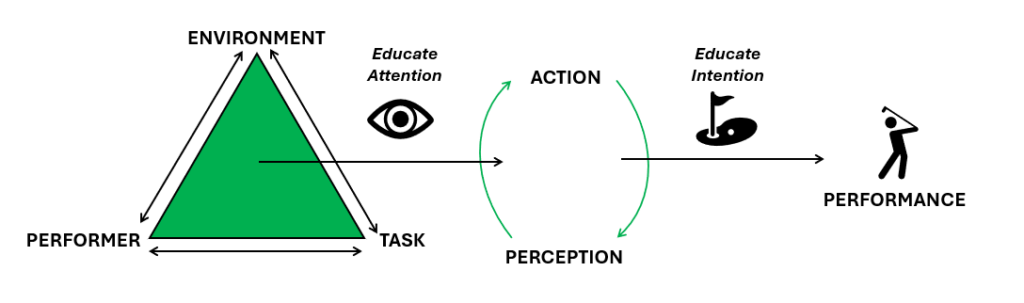
Figure 1. How Constraints Educate Attention, Intention, and Action. The performer, task, and environment shape the information available for action. Coaching adaptability means educating attention toward relevant information, educating intention around the shot problem, and helping the player organize action toward performance.
Figure 1 shows why adaptability is not only a movement issue. When slope, lie, wind, pressure, or consequence changes, the player must perceive different information before choosing and organizing the shot.
Slope Changes Balance And Ball Flight
Slope changes how the player stands, loads, rotates, aims, and controls the low point.
This has been shown in golf-specific biomechanics research. Blenkinsop, Liang, Gallimore, and Hiley’s study on uphill and downhill golf shots examined elite male golfers hitting six-irons from flat, uphill, and downhill 5° slopes. The golfers shifted center of pressure toward the lower foot, adopted a wider stance in sloped conditions, and moved the ball toward the higher foot at address. Ball speed was not significantly affected, but launch angle, spin, and shot direction changed.
That matters for coaching because slope changes the performer-environment relationship before the swing begins. An uphill lie often changes launch, speed delivery, pressure organization, and balance. A downhill lie often challenges contact, low point, and commitment. A sidehill lie changes posture, start-line bias, face-to-path control, and the player’s ability to remain balanced through impact.
Slope also changes how players use the ground. The applied biomechanics article from Titleist Performance Institute on ground reaction forces in the full swing and short game makes a useful coaching point: ground reaction force patterns organize around task intent. A driver swing, a distance wedge, and a chip do not ask the player to use the ground in the same way.
As shown in Figure 1, slope changes the environment-task relationship. The player must first perceive how the ground changes balance, pressure, and ball flight before forming an intention that fits the shot.
On the putting green, slope changes the relationship between read, start line, pace, entry point, and capture width. The same stroke intention on a flat putt becomes a different task when gravity and break shape the ball’s path.
Zen’s article on why flat putting practice often fails to transfer explains this issue in putting terms. Flat practice helps isolate start line and face control. Sloped practice asks the player to connect read, pace, and stroke behavior in realistic context.
Lie Changes The Movement Solution
Lie quality changes the shot before the swing begins.
- A ball sitting down in rough constrains club delivery and spin.
- A ball above the feet changes posture and start direction bias.
- A ball below the feet changes reach, balance, strike, and curvature tendencies.
- A tight lie changes the player’s tolerance for low-point error.
In an ecological dynamics view, education of attention describes how a performer learns to detect the information that matters for action. A player who understands lie quality notices ball position in the grass, ground firmness, slope under the feet, likely strike pattern, club-turf interaction, and the ball-flight consequence attached to each option.
The Skilled Intentionality Framework helps explain why this matters. Skilled intentionality describes how performers coordinate with multiple affordances simultaneously in a concrete situation. The player is not responding to the lie alone. They are responding to the lie, slope, wind, target, club, score, and acceptable target zone as one connected performance problem.
That attention then constrains intention. A ball sitting down in rough does not invite the same intention as a clean fairway lie. The lie might shift the intention from spin control to contact quality, from attacking the flag to finding the center of the green, or from a high stopping shot to a lower release pattern.
When players train only from perfect lies, they often learn one clean solution. On the course, they must solve a wider set of interactions. The issue is not only that movement changes. The player must first learn what information to attend to, then allow that information to shape the shot intention.
A coach should assess whether the player can identify the lie, predict its effect, choose a shot, and accept the likely dispersion. The movement pattern should serve that decision.
Attention-Intention Coupling: Coaching Sequence
This gives coaches a practical sequence:
- Help the player perceive the lie – educate their attention
- Ask the player to predict the likely constraint – educate their intention
- Shape the shot intention around that information
- Let the movement solution organize around the intention
- Review whether the miss came from perception, decision, execution, or calibration
Zen Swing Stage gives coaches a controlled way to build this relationship between attention and intention. By changing slope conditions, the coach can help the player learn which information matters before asking for technical change. The player is learning how the environment informs the shot.
Wind As Ball-Flight Information
Wind changes the task through ball flight, not only aim.
In Figure 1 terms, wind changes the environment before the player moves. The player has to educate attention toward wind direction, trajectory window, spin tolerance, landing area, and acceptable target zone before choosing the shot intention.
This is where skilled intentionality also applies to wind. The player must coordinate with several affordances at once: the wind direction, trajectory window, spin tolerance, landing area, target risk, and acceptable target zone. The intention becomes stronger when attention is educated toward those relationships before the shot begins.
- A player facing headwind needs to manage launch, spin, speed, and trajectory.
- A crosswind asks the player to decide whether to hold the ball against the wind, ride the wind, or shift the target.
- A downwind shot changes landing angle, stopping power, and distance control.
Adaptability improves when players practice predicting the flight window before the shot, then compare the outcome with the intention. A vague intention often leads to late compensation, extra tension, or a swing chosen from fear.
Pressure As An Attentional Constraint
Pressure alters how the player organizes attention and movement.
Figure 1 also applies to pressure. The task may look the same from the outside, but consequence changes the performer-task relationship. Attention may narrow, intention may become defensive, and action may become over-controlled.
A player might look at the danger for longer, rush the routine, tighten grip pressure, shorten the finish, or over-control a stroke. The physical shot might look the same from the outside, but the player’s perception-action system has changed.
This is why pressure belongs inside practice design. A coach can add consequence through scoring, one-ball tasks, match-play constraints, target penalties, or decision review.
The goal is to help the player preserve useful attention and commitment while the shot matters.
Consequence As Committed Action Under Uncertainty
Consequence is the bridge between practice and play.
In Figure 1, consequence changes the task. The player is no longer solving a neutral shot. They are solving a shot where score, risk, target selection, and acceptable target zone shape the intention before movement begins.
A block-practiced 7-iron to a center target from a flat lie carries low strategic consequence. A 7-iron from a downhill lie, wind off the left, water short-right, and a tucked pin asks a different question.
The player needs to define the playable miss, select the right club, choose the start line, and commit to the intention. A good outcome might be 25 feet past the hole. A poor decision might be a technically strong swing aimed at the wrong target.
Accepting the consequence means the player commits to the chosen shot while accepting the uncertainty attached to the outcome. This does not mean the player stops caring. It means they do not reorganize the movement around avoidance, fear, or last-second doubt once the shot has been selected.
Gardner and Moore’s Mindfulness-Acceptance-Commitment approach gives this step a useful sport psychology reference. The player learns to notice pressure, doubt, or discomfort without needing to remove those experiences before acting. They stay connected to the task and commit to the chosen action.
This also connects with Oudejans and Pijpers’ research on training with anxiety. Consequence should appear inside practice because players need to learn how intention and action behave when the shot matters. A one-ball task, match-play constraint, target penalty, or score-based challenge helps the player practice commitment under realistic pressure.
Coaches should evaluate decision quality alongside strike quality.
A Practical Coaching Model For Adaptability
A practical coaching sequence is:
- Read the environment – Education attention
- Choose the shot – Educate intention
- Organize the movement – Exploit the redundant degrees of freedom
- Accept the consequence – Commit by accepting uncertainty
- Learn from the outcome – Reflect as embodied cognition / reflection in and on action
This sequence helps coaches avoid reducing every miss to a technical fault.
A player might miss because they misread the slope, chose the wrong club, misunderstood the wind, selected a poor target, lost attention under pressure, or failed to calibrate pace. Technique matters, but it sits inside a wider performance system.
The performer searches the movement space, identifies a solution that works, and then stabilizes that solution under more demanding conditions.
Practical Example: Breaking Putt Under Score Pressure
Set a 10-foot right-to-left putt on a 3% slope, approximately 1.7°. Give the player one ball and a scoring consequence.
Ask the player to define:
- Read
- Start line
- Pace
- Entry speed
- Apex point
- Acceptable leave
- Routine commitment
After the putt, ask whether the miss came from read, pace, start line, stroke delivery, or pressure response.
This task develops putting skill as a relationship between perception and action. It also connects with Zen’s article on constraining to afford in putting coaching, which explains how constraints help coaches reveal behavior before prescribing a technical correction.
How Zen Golf Supports Representative Adaptability Training
Zen products should be understood as practice-design tools. They help coaches create richer problems, clearer feedback, and more representative testing environments.
Zen Green Stage is a moving floor that replicates on-course gradients for putting, green reading, ball-roll work, and slope-aware practice. It gives coaches a controlled way to test read, pace, start line, and stroke adaptation across real gradients.
Zen Swing Stage allows coaches to create uphill, downhill, sidehill, and compound lies for full-swing training. That lets coaches observe how balance, setup, strike, shot shape, and ground interaction change when the player no longer stands on flat ground.
Zen Golf Stage supports integrated putting and hitting environments. For facilities and academies, that ensures adaptability is not confined to one part of the game. Players need to solve the course from tee to green.
The Trackman × Zen Golf Integration Explained article shows how performance data becomes more meaningful when launch, club, ball-flight, and ground-interaction information are interpreted inside real environmental constraints. Zen’s integration page explains that movement patterns can be evaluated under balance and ground-interaction demands rather than only flat-bay conditions.
These environments do not replace coaching judgment. They give the coach stronger tasks, clearer observation, and a more direct way to test whether skill transfers.
Why This Matters For The Golf Industry
The golf industry is growing across both on-course and off-course participation. The National Golf Foundation’s 2025 golf industry data reports that 48.1 million Americans age 6+ played golf on-course or off-course in 2025, including 29.1 million on-course players and 19 million off-course-only participants. It also reports 3.3 million beginners and notes that retention and conversion remain an industry focus.
That creates a coaching challenge. More people are entering golf through indoor, off-course, and technology-enabled settings. Those environments need to build confidence, but they also need to prepare players for the variability of the course.
A realistic indoor environment should help players understand slope, lie, decision-making, and consequence before those factors appear in play. That is where practice design, motor learning, and golf technology need to work together.
How Coaches Can Start Training Adaptability
Start With One Constraint
Begin with one variable the player can perceive.
For example, move from flat to 3% uphill, approximately 1.7°. Ask the player to predict how launch, contact, balance, or pace will change. The first goal is awareness.
Add A Clear Intention
The player should know the task before swinging or putting.
A full-swing intention might include carry distance, trajectory window, start line, curve, and acceptable target zone. A putting intention might include read, start line, pace, entry point, and leave zone.
Create A Feedback Loop
Ask the player to compare prediction, feel, ball outcome, and data.
This turns variability into learning. Without a feedback loop, practice becomes random exposure.
Couple Constraints Progressively
Add a second and third constraint only when the player can use the information.
A coach might progress from slope, to slope plus target, to slope plus wind, to slope plus consequence. The task should remain difficult enough to reveal adaptation, but clear enough for the player to learn.
Zen’s article on what skill load means in indoor golf practice gives coaches a useful language for regulating task difficulty through slope, target size, feedback timing, pressure, and variability.
Test Transfer With One-Ball Tasks
Golf gives players one attempt. Practice should include one-attempt tasks.
Use scoring systems where the player must choose, commit, execute, and review. The coach should score the decision and the response, not only the strike.
Key Takeaways
- Golf adaptability training develops the player’s ability to solve changing shot problems across slope, lie, wind, pressure, and consequence.
- A constraints-led approach helps coaches understand how individual, task, and environmental constraints shape movement behavior.
- Representative practice should preserve the information players use on the course, including slope, target, wind, turf, score, and consequence.
- Useful variability helps the player detect information, choose an intention, organize movement, and calibrate the outcome.
- Zen Green Stage, Zen Swing Stage, and Zen Golf Stage support representative practice by bringing real gradients and ground interaction into controlled coaching environments.
Continue The Series
Read the next blog in the series: Using Constraints To Reveal Perception, Decision-Making, And Movement Tendencies.
The next article explains how coaches can use constraints to reveal what a player currently perceives, how they make decisions, and which movement tendencies emerge under changing task demands. It will show why constraints are not only useful for making practice harder. They are also a diagnostic tool for understanding how players organize behavior around the shot problem.
Series roadmap:
- Viewing Golf Skill Through Attractors And Invariants
- Identifying Functional And Rate-Limiting Movement Patterns
- Designing Practice To Stabilize Performance Principles Rather Than Fixed Techniques
- Improving Adaptability To Slope, Lie, Wind, Pressure, And Consequence
- Using Constraints To Reveal Perception, Decision-Making, And Movement Tendencies
- Designing Practice Tasks That Amplify Affordances And Improve Transfer
- Creating Better Players By Moving From Repetition-Based Practice To Problem-Solving Practice
Join The Webinar With Rob Gray And Will Stubbs
For coaches who want to explore these ideas in a live learning environment, Will Stubbs and Rob Gray are hosting Ecological Dynamics Approach To Golf Coaching on Wednesday, September 2, 2026.
The session is designed for coaches who want to understand how ecological dynamics, constraints-led practice, perception-action coupling, and representative learning design apply to golf coaching.
Join the webinar to explore how adaptability can be trained through better task design, clearer coaching observation, and more realistic performance environments.
