
Advanced Golf Coaching Practice
Overview
Research-informed ideas for coaches who want to understand how golfers adapt, design more representative practice and develop skills that transfer to the course.
Golf is not played from one lie, toward one target, with one intention or under one level of pressure. Advanced coaching practice begins when we design learning around that reality.
Book the webinar to get a first-hand deep dive into the subject.
Wednesday, September 2, 2026 | 6:00 PM BST | Online
Explore the blog series below to understand the key concepts we’ll be exploring.
Written and curated by Will Stubbs, Head of Education, Zen Golf
Developed alongside the webinar with Dr. Rob Gray
Last Updated: 27/07/2026
Moving From Technical Description To Skill Development
Golf coaching has access to more information than ever. We can measure movement, club delivery, ball flight, ground interaction and performance with extraordinary precision.
But more information does not automatically create better learning.
The coach still has to decide what the data means, whether a movement pattern is functional, what is limiting performance and how practice should be designed to support change that survives beyond the lesson.
Advanced Coaching Practice is a growing Zen Golf education hub exploring those questions through ecological dynamics, skill acquisition, representative learning design and the constraints-led approach.
The series examines golf skill as an interaction between:
- The individual golfer
- Their intention
- The task they are attempting to solve
- The information available within the environment
- The movement solution that emerges
- The consequence of the shot
The aim is not to dismiss technique, data or instruction. It is to place them within a more complete model of the golfer, the task and the environment.
What Is Advanced Coaching Practice?
Advanced coaching practice series explores our ability to observe, understand and influence the relationship between the golfer, the task and the environment.
It requires more than identifying whether a movement matches a technical model. It asks whether the movement is functional for the shot, adaptable across changing conditions and capable of transferring to the course.
For the coach, this creates four important questions:
What Remains Stable?
Identify the attractors, invariants and performance principles that organize the player’s behavior.
What Needs To Adapt?
Understand which movement components can change as the lie, slope, target, club, intention and consequence change.
What Is Limiting Performance?
Distinguish between an unconventional movement and a genuinely rate-limiting pattern.
What Should Practice Reveal?
Design tasks that expose tendencies, educate attention and help the player discover more functional solutions.
Explore The Advanced Coaching Practice Series
The articles are designed to be read as a sequence, moving from understanding skill and diagnosing performance toward practice design, adaptability and transfer.
Part One: Viewing Golf Skill Through Attractors And Invariants
Why do certain movement patterns repeatedly emerge, even when the coach asks the player to change them?
This article introduces attractors as the stable tendencies a golfer returns to and invariants as the information or performance relationships that remain important across changing solutions.
Part Two: Identifying Functional And Rate-Limiting Movement Patterns
Not every unusual movement needs to be corrected.
Part Two explores how coaches can distinguish between individual movement variability that supports performance and patterns that genuinely restrict the player’s ability to solve the task.
Part Three: Stabilizing Performance Principles Rather Than Fixed Techniques
Consistency does not require the golfer to reproduce an identical movement.
This article examines how coaches can stabilize important performance principles—such as low-point control, strike, ball flight or pace—while allowing the player flexibility in how those outcomes are achieved.
Part Four: Developing Adaptability Across Changing Conditions
Slope, lie, wind, pressure and consequence do more than make a shot harder. They change the problem the golfer must solve.
Part Four explains why adaptability must be developed through exposure to the information, decisions and movement demands found on the course.
Part Five: Using Constraints To Reveal Player Tendencies
A constraint can be an intervention, but it can also be a diagnostic tool.
This article explores how changes to the task or environment can reveal what a golfer attends to, how they make decisions and which movement solutions remain stable or begin to break down.
Part Six: Designing Affordance-Driven Practice Tasks
An affordance is an opportunity for action that exists in relation to the player’s capabilities and intentions.
Part Six shows how coaches can amplify useful information within practice so players become better at perceiving the shot, selecting an intention and organizing an appropriate movement solution.
Part Seven: Moving From Repetition To Problem-Solving Practice
Repetition can stabilize performance, but repetition without a changing problem can also create fragile skill.
Part seven shows how to design practice in which players must read the environment, choose a shot, organize movement, experience the consequence and learn from the outcome.
Part Eight: Applying Uncontrolled Manifold Theory To Swing Changes
Successful swing changes preserve flexibility across the movement system while stabilizing performance variables such as strike, club delivery and ball flight.
Part Eight introduces Uncontrolled Manifold Theory to explain how golfers coordinate multiple movement solutions around a stable outcome. The article shows how coaches distinguish functional variability within the solution space from variability associated with performance breakdown, then design swing-change practice with sufficient adaptability for changing slopes, lies and shot demands.
The Advanced Coaching Series




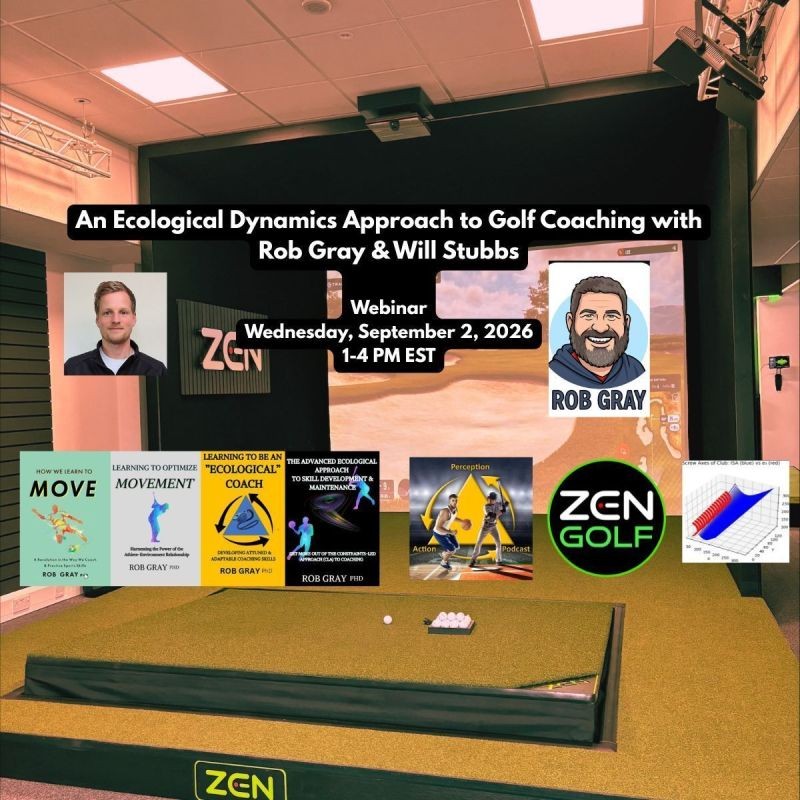
Join Rob Gray And Will Stubbs Live
An Ecological Dynamics Approach To Golf Coaching
On Wednesday, September 2, 2026, Dr. Rob Gray and Will Stubbs will bring the Advanced Coaching Practice series into a live learning environment.
The webinar will connect ecological dynamics and the constraints-led approach to the decisions coaches make during assessments, lessons and practice sessions.
Rather than treating these ideas as theory alone, Rob and Will will use golf-specific examples, practical demonstrations and coaching case studies to explore:
- How attractors and invariants help coaches understand player tendencies
- How to separate functional individuality from rate-limiting movement patterns
- How constraints can be used for assessment and intervention
- How attention and intention shape the movement solution
- How to design representative practice without creating uncontrolled difficulty
- How variability can develop adaptability while stabilizing important outcomes
- How technology and performance data can support learning without replacing perception
- How to move from repetition-based practice toward guided problem-solving
This webinar is for coaches who want to move beyond describing what the golfer did and become more effective at designing the conditions through which better skill can emerge.
Wednesday, September 2, 2026 | 6:00 PM BST | Online
Who Is Advanced Coaching Practice For?
This education series has been created for:
- PGA professionals and golf coaches
- Skill acquisition and motor-learning practitioners
- Academy and player-development leaders
- University golf and sport-science programs
- Coaches using launch monitors, force plates or motion analysis
- Coaches designing putting, full-swing and on-course practice
- Practitioners who want to connect research with the reality of coaching
You do not need access to Zen Golf technology to apply the principles. The ideas can be used on the practice ground, putting green, golf course or within an indoor coaching environment.
Zen Active Terrain Technology allows these environmental constraints to be controlled and repeated with greater precision, but the coaching questions remain relevant in every setting.
