
Change the Slope, Change the Stroke: Using the Zen Green Stage to Develop the Three Principles of Putting
Overview
Putting practice on slopes helps golfers learn how read, pace, and start direction change when gravity becomes part of the task. For coaches, academies, and indoor golf centers, slope-based practice creates a more representative environment where players learn to adapt their decisions and stroke behavior to the putt in front of them.
The Constraints-Led Approach gives coaches a practical model for designing putting environments where players learn from the interaction between the player, the task, and the surface. On the Zen Green Stage, a moving floor that replicates on-course gradients, coaches can change slope direction and severity to help players connect green reading, pace control, and launch control in one applied practice environment.
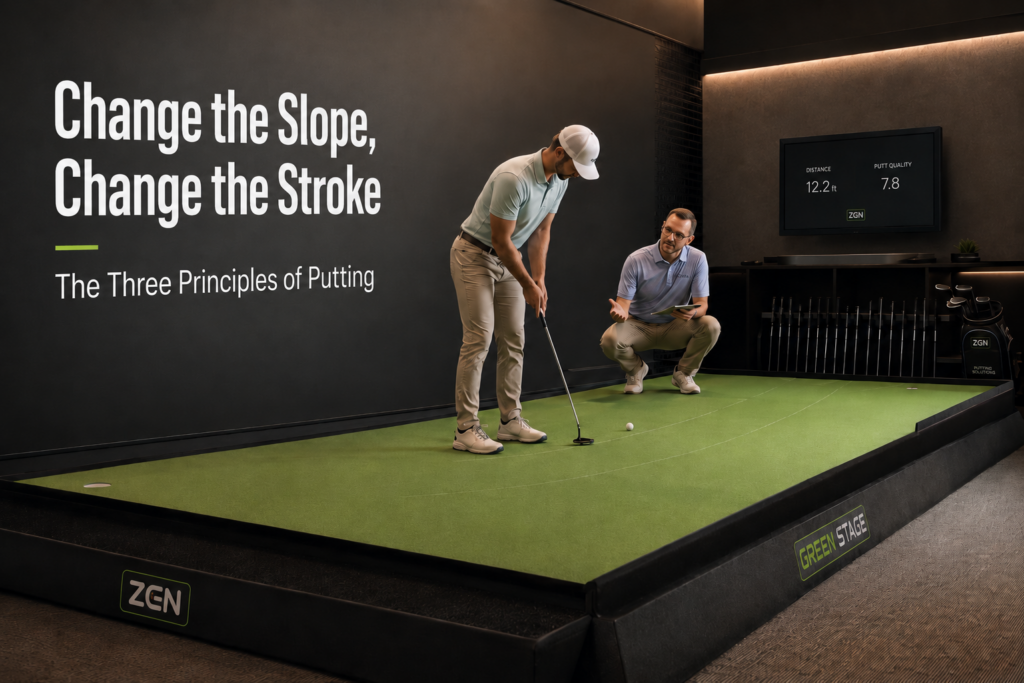
This article introduces the core philosophy behind the putting principles series: Change the Slope, and you Change the Stroke. The idea comes directly from the Zen education presentation for 5 Iron Golf, which frames putting movement as something shaped by the interaction between the player, the task, and the environment.
Written by: Will Stubbs, Head of Education, Zen Golf
Last Updated: 01/06/2026
The Three Putting Principles
Putting is often treated as a stroke problem. A player misses, and the first response is to adjust face, path, rhythm, grip, or setup.
Those details matter, especially when launch, start direction, and strike patterns become unstable. Yet putting performance on the course also depends on how well the player perceives slope, predicts speed, chooses intention, and adapts the stroke to the environment. This issue arises when these become the sole focus, and not exploring putting as a complex task, where read, pace, launch, and outcome influence one another.
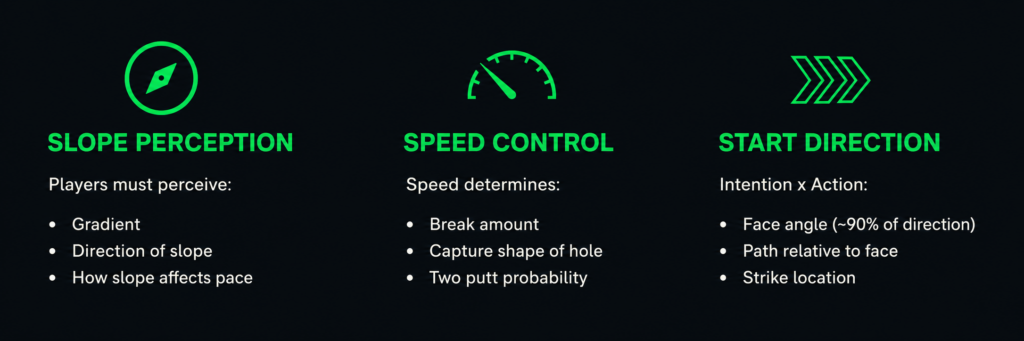
This means we need to understand a logical process to put the key principles together:
- Slope Perception – Green reading
- Speed Control – Perception-Action coupling
- Start Direction – Calibrating stroke to slope
The Constraints-Led Approach, often shortened to CLA, helps coaches design practice around those interactions. Instead of asking only how the stroke should change, the coach asks which constraint should be tuned. That might be slope, distance, target size, read information, time pressure, scoring, or feedback.
The Zen Green Stage gives coaches a controllable way to manipulate the most important putting constraint: gravity. Zen describes the product as a moving putting surface that integrates with technologies such as Science & Motion and Quintic to provide slope-specific feedback.
Why Putting Practice Starts In The Wrong Place
Many golfers practice putting on flat surfaces because flat practice feels simple, measurable, and repeatable.
A flat putt removes break, reduces uncertainty, and means the player ends up solely focusing on stroke mechanics. That has value when the coach needs to isolate a technical factor. The limitation appears when flat practice becomes the main learning environment.
On the course, the ball rarely travels across a flat or solely planar surface. A real putt asks the golfer to solve a relationship between slope, speed, start line, entry point, and consequence.
Zen’s article on indoor golf practice makes this point directly: the closer practice resembles the course, the more transferable learning becomes. Indoor Golf Practice: Why Slopes Change Learning and Performance explains how indoor practice loses value when the ground itself disappears from the learning environment.
A player who practices mainly on flat surfaces might build confidence in a narrow task. The issue appears when the course asks a different question for every shot. Now the player must read gradient, predict break, manage pace, and deliver the ball on a line that only makes sense because of gravity and grain.
Therefore, the stroke must belong to the putt.
The Constraints-Led Approach in Putting
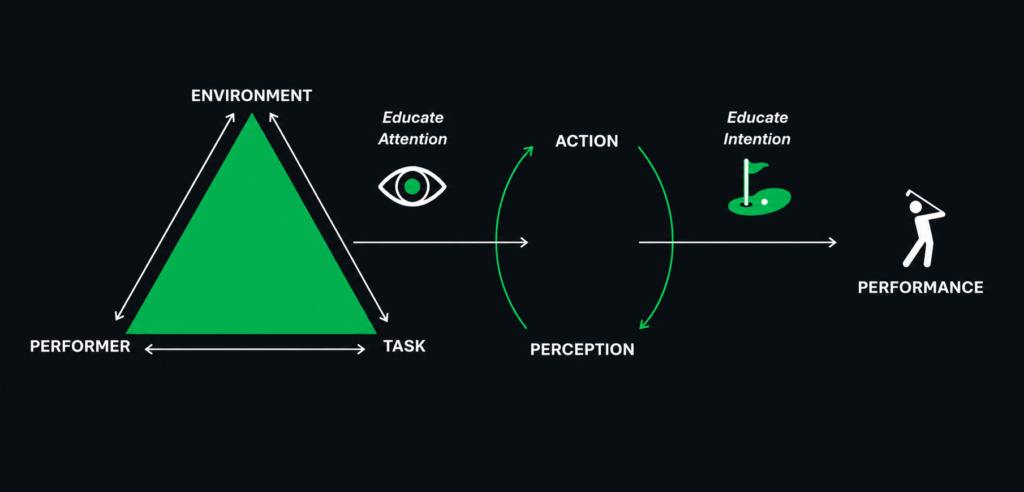
Note: image an adaption of CLA model created by Karl Newell.
The Constraints-Led Approach (CLA) created by Karl Newell, explains how movement emerges from the interaction of three constraint categories:
Individual constraints: The player’s body, perception, experience, confidence, fatigue, emotional state, and skill level.
Task constraints: The goal, distance, target size, scoring rules, time limits, success criteria, and feedback.
Environmental constraints: Slope, green speed, grain, weather, surface quality, visual context, pressure, and social setting.
Applying this model to putting, we view it as a skill that movement emerges from player, task, and environment rather than from technique alone.
Putting is not a single movement repeated in different places, but a family of movement solutions shaped by the problem in front of the player.
A 6-foot uphill putt, a 6-foot downhill putt, and a 6-foot sidehill putt share a distance. They do not share the same intention, do not ask for the same pace, do not create the same start line. Therefore, they do not invite the same stroke behavior.
The CLA model does not mean that we ignore technique. With the framework, a coach changes the conditions first so the player receives better information, makes clearer decisions, and reveals the movement solution the task is inviting.
This develops ownership and awareness through self-organization. Rather than instructed by the coach, they learn through the environment, which ties them directly to the experience and decision making required on the course.
Why Slope Is The Dominant Environmental Constraint In Putting
In full swing, the ground influences balance, force, strike, direction, and shot shape. In putting, slope has a more direct relationship with the ball’s route to the hole.
Slope changes the start line. It changes the pace requirement. It changes the effective size and shape of the hole. It changes the player’s emotional response to the putt. It changes the consequence of over-speed and under-speed.
With Zen Golf Stages, we can now use slope as dominant environmental constraint in putting to allow coaches to effectively manipulate gravity.
This is where the Zen Green Stage becomes more than a training surface. It becomes a constraint design tool. Coaches create uphill, downhill, sidehill, and compound putts, then observe how the player adapts.
Zen’s article on tilting putting greens explains that slope-based practice matters when it recreates realistic gradients and challenges decision-making and speed control. The same article states that putting is governed by gravity, with speed and start line working together.
A coach might keep the putt at 8 feet and change only the slope. The golfer then experiences how one task becomes several tasks:
- A 1 percent right-to-left slope asks for subtle start-line adjustment.
- A 3 percent right-to-left slope asks for a different read, pace, and commitment.
- A downhill right-to-left slider asks the player to manage fear of over-speed.
The distance stayed the same, but the stroke changed because the environment changed.
Representative Learning Means The Practice Environment Carries The Right Information
Representative learning design means practice should preserve the key information players use in performance. Pinder and colleagues proposed representative learning design to help sport scientists and coaches connect practice tasks more closely to performance environments.
In putting, the key information includes slope direction, slope severity, green speed, target size, entry speed, break, and consequence. When those elements disappear, the player practices a reduced version of the game.
Ecological dynamics also frames learning and performance as connected rather than separate processes. Renshaw and colleagues describe how ecological dynamics reframes learning and performing as a coupled relationship in high-performance sport.
This view fits putting well because the golfer learns while solving the task. The player does not apply a stored stroke to every putt. The player perceives the situation, forms an intention, and organizes movement around that intention.
A representative putting environment should therefore help players answer four practical questions:
- What does the slope invite?
- What pace fits the chosen line?
- What start direction matches the intended entry point?
- What launch and roll pattern support that decision?
Flat practice only answers part of the putting question. Slope-based practice answers more of the question the course asks.
Constrain To Afford
The phrase “constrain to afford” gives coaches a useful way to think about practice design. A constraint changes what the player perceives. That change invites a behavior.
- A coach might narrow the target gate to improve start direction. The gate constrains the task and invites more face awareness.
- A coach might add a downhill slope and a small safe zone beyond the hole. The slope and target zone constrain the task and invite softer pace.
- A coach might hide the hole and ask the player to finish the ball in a speed zone. The task constrains outcome obsession and invites pace calibration.
The constraint does not force one technique. It changes the problem so the player searches for a functional solution.
Instead of asking, “How should I change the stroke,” the coach asks, “Which constraint should I tune?”
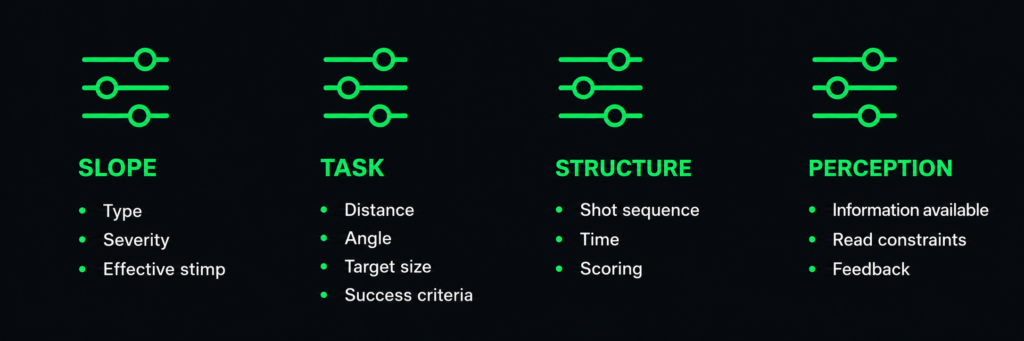
With the Zen Green Stage the coach, and player, can use slope types, severity and task constraints to manipulate the challenge point of the practice session. This reframes putting and coaching around session design for skill adaptability, rather than technique change. Technique training is now replaced with skilled ability to match the three principles of putting against the task.
The Skilled Intentionality Framework defines skilled intentionality as selective engagement with multiple affordances simultaneously in a concrete situation. It also emphasizes that affordance perception and coordination happen in real situations, within a rich landscape of affordances, not in abstract isolation.
This is the true measure of skill.
Educating Attention: Green Reading Starts with Noticing Better Information
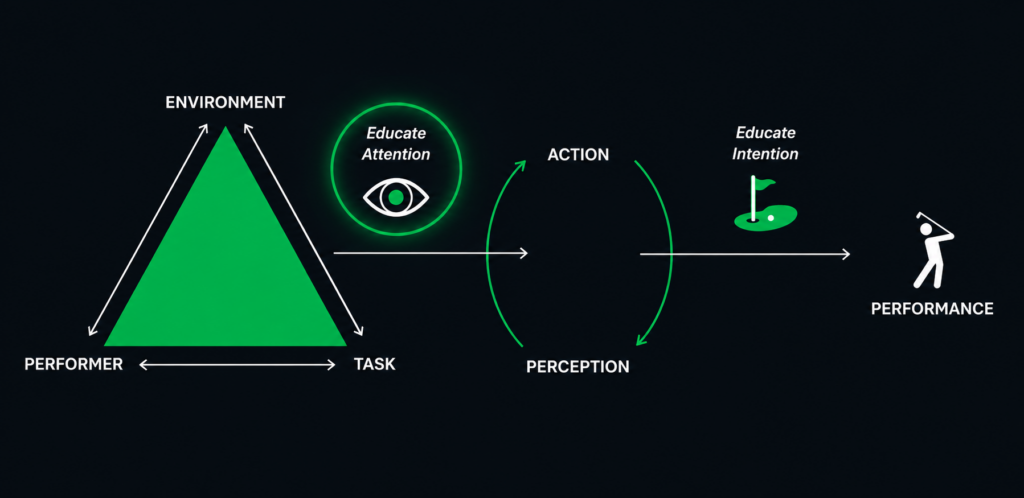
Green reading is often described as choosing a line, but that is too narrow interpretation for becoming a great putter.
A player must notice the information that matters before choosing a start line. That includes gradient, direction of fall, speed, surface, entry point, and the relationship between pace and break.
Educating attention means helping the player become more sensitive to useful information. The coach designs tasks that direct attention toward the slope and its effect on the ball.
For example, a coach using the Zen Green Stage might build a six-position read:
- Behind the ball.
- Behind the hole.
- Low side.
- High side.
- Halfway along the putt.
- At the intended entry point.
The player predicts start line, break, and entry speed before putting. After the putt, the coach asks the player to compare prediction with outcome. This gives the delta between perception, intention and action.
Using this process means attention becomes trainable through the task. The player learns which information helped and which information misled.
Quiet eye research supports the broader idea that visual attention influences putting performance. Vine, Moore, and Wilson studied elite golfers and found that quiet eye training improved competitive putting performance under pressure.
The coaching lesson is practical. A player who looks more carefully does not automatically read better, but one who learns where to look, what to compare, and how the ball responds starts building perceptual skill.
Educating Intention: The Stroke Follows The Putt The Player Chooses
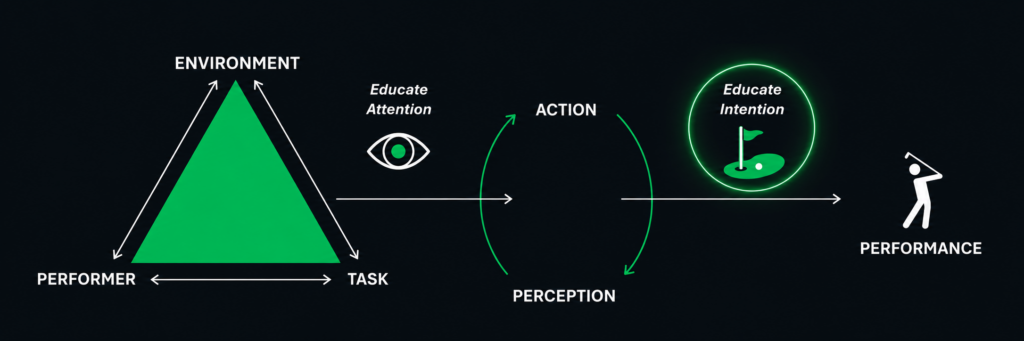
Intention gives perception a purpose.
A golfer might see the slope but still fail to commit to the speed. Another player might choose the start line but deliver a pace that belongs to a different read. In both cases, the player has an intention problem as much as a technique problem.
Educating intention means helping the player connect read, pace, and launch to one chosen solution.
This is central to putting. Line and speed do not operate separately. A firmer pace reduces break and changes entry conditions. A softer pace increases break and increases the influence of slope. A downhill putt reduces margin for speed error. An uphill putt changes the player’s acceptable entry speed.
Zen’s article on Indoor Putting Practice: Build Confidence Inside 10 Feet states that each putt is shaped by slope, speed, and gravity, and describes how Zen Green Stage recreates planar uphill and downhill slopes, compound breaks, and downhill sidehill putts.
The practical coaching implication is direct. Ask the player to declare a full intention before the stroke:
- Start line
- Entry point
- Entry speed
- Finish zone if the ball misses
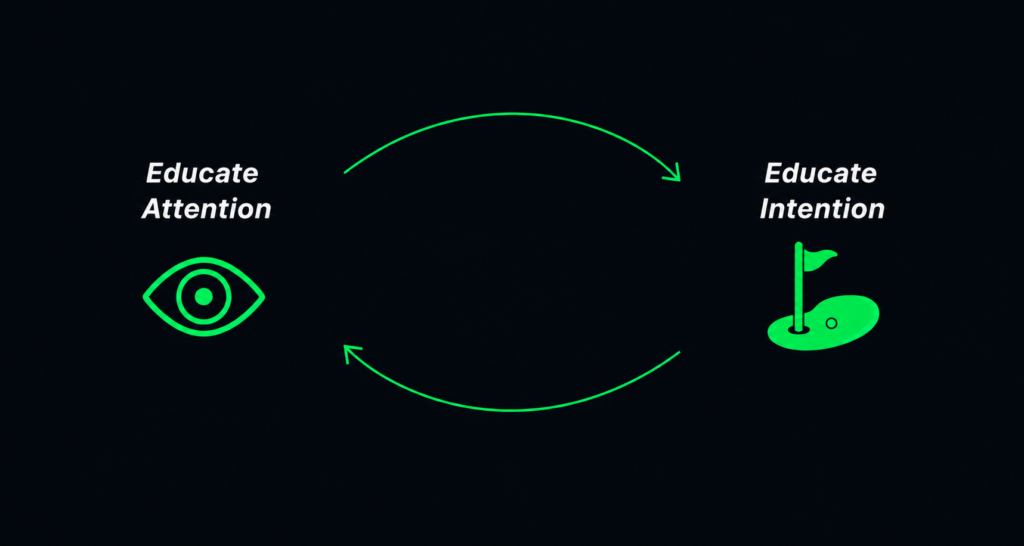
The stroke then becomes the movement expression of that intention. This couples attention with intention.
Where Launch Control Fits
Green reading and pace control shape the player’s decision. Launch control reveals whether the stroke delivered the chosen solution.
The presentation identifies start direction as a core putting principle, with face angle strongly influencing ball direction, while path and strike location also matter.
This gives coaches an important decision point. If the player reads well and chooses a functional pace but the ball starts off line, launch control needs attention. If the ball starts on line but repeatedly misses low, the read or pace might be the bigger issue. If the ball skids, hops, or loses roll quality, setup, loft, strike, and rise angle might need investigation.
The Zen Masters pages show how different applied coaching environments combine Zen Green Stage with putting technologies such as Quintic Overhead Putt Tracker and SAM PuttStudio. Preston Combs uses the Zen Green Stage and Quintic, while Daniel Gray, Dylan Ross, and Darren Webster-Clarke use Zen Green Stage and SAM PuttStudio.
Combining the Zen Green Stage with integrated ball tracking technology brings the putt to life, with slope and ball data allowing us to answer different questions. The slope shows the task, while the ball data shows how the player delivered the intention.
Self-Determination and Player Ownership
A CLA-informed putting environment also supports player ownership. The coach creates conditions where the player reads, predicts, tests, reflects, and adapts.
This connects with self-determination theory, which identifies autonomy, competence, and relatedness as basic psychological needs associated with optimal functioning and well-being.
In coaching terms, autonomy grows when players make meaningful choices. Competence grows when feedback helps them understand progress. Relatedness grows when coach and player work together to solve the task rather than treating learning as one-way instruction.
A coach might offer three slope challenges and ask the player to choose the one they believe best matches their current tournament need. The player then owns the intention, performs the task, and reflects on the result.
This does not remove structure but makes it more meaningful within the coaching session.
Practical Coaching Interventions
Intervention 1: Same Putt, New Slope
Set an 8-foot putt on the Zen Green Stage.
Start flat. Then move to 1 percent, 2 percent, and 3 percent side slopes.
The player must predict:
- Start line
- Break amount
- Entry speed
- Finish zone if the putt misses
The coach watches for how the player changes setup, aim, tempo, length of stroke, and commitment. The learning goal is adaptation across slope, not one perfect stroke.
Using the SAM PuttStudio, the coach can track stroke dynamics and launch characteristics per slope. Now you have an in-depth insight into how they solve the puzzle of each putt, and whether they have an inherent bias on different putt types, or whether their stroke breaks down over certain severity gradients.
Intervention 2: Pace Window Ladder
Create a zone 10% of total putt distance beyond the hole.
The player scores points only when the ball finishes in the zone or enters the hole at a predetermined speed window.
Run the task uphill, downhill, and sidehill.
This shifts the player’s attention from making or missing, toward pace intention. It also helps the coach see whether the player understands how slope changes the speed requirement.
Combining Quintic Overhead Putt Tracker with this allows the coach and player to visualize the different phases of the ball roll: skid, true roll, and decay. This visualization helps educate attention to how the slope type and gradient alters the roll characteristic, which in turn implicates the intentionality of the putt. Now the coach can see whether the player’s strategy matches their skilled intentionality – what Rietveld and colleagues term optimal grip.
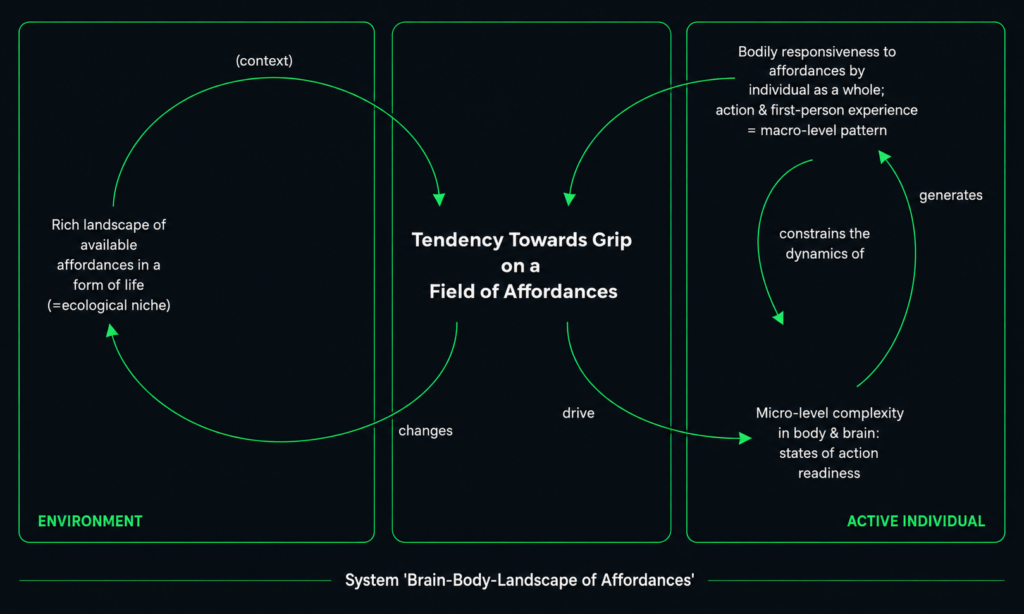
Note: Sketch of the Skilled Intentionality Framework. Adapted from (Bruineberg and Rietveld 2014).
Intervention 3: Read, Commit, Remove
Allow the player to read the putt with full visual information.
- The coach then asks the player to place a marker on their aim point.
- Then add a visual aid, such as a start line gate between the hole and the aim point.
- The player readdresses the putt and states whether there’s a visual change between aim point and the read they have already formed.
This intervention helps bridge perception and action. It allows the coach to test whether the player has an aim or stroke bias based on their tendencies across different slopes.
When conducted with a SAM PuttStudio the coach can measure whether the bias is perceptual (read and aim) or action (stroke mechanics). The key is not to change the player to neutral, but to understand how that player solves the puzzle of the putt, and with slope-training on the Zen Green Stage, start to test how consistent their delivery is across different environments.
The player learns to trust the relationship between read, start line, and pace rather than becoming dependent on internal stroke cues. This means they can trust their stroke’s signature and focus attention externally, which has shown to improve performance.
Coaching Workflow
- Use slope as the first coaching variable when transfer is the goal.
- Change one constraint at a time when diagnosing behavior.
- Ask the player to predict before performing.
- Separate read errors from pace errors and launch errors.
- Use ball-roll data when the outcome does not explain the cause.
- Let the player choose some challenges to support autonomy and ownership.
- Use blocked practice for awareness, then move toward random practice for adaptability.
- Connect every technical intervention to the putt being solved.
Player Workflow
- Before putting, state the start line, pace, and entry point.
- Read from more than one position when slope is unclear.
- Practice the same distance across different slopes.
- Track your miss as high or low, short or long, and fast or soft.
- Treat a missed putt as information about the read, pace, launch, or commitment.
- Build confidence through adaptability across slopes, not repetition on one slope condition.
How Zen Green Stage Makes the Science Actionable
CLA and ecological dynamics offer fundamental theory that guides how we shape our philosophy on learning and coaching. The Zen Green Stage gives the coach a practical environment where those ideas become coachable.
The Zen Green Stage allows the coach to change the surface, repeat slopes, create compound breaks, and pair the putting task with feedback tools. The Zen Green Stage integrates with Science & Motion and Quintic for data-rich, slope-specific feedback.
When the coach uses slope as part of the toolkit they develop a richer control panel:
- Environment: slope type, slope severity, effective green speed.
- Task: distance, angle, target size, start-line gate, entry-speed window.
- Structure: blocked, serial, random, pressure, time limit.
- Perception: available information, read constraints, feedback timing.
- Performer: confidence, strategy, attention, movement response.
The Zen Green Stage ecosystem does not replace coaching judgment, but gives the coach more relevant variables to tune.
This aligns with Zen’s wider education content whereby our article Trackman × Zen Integration: Training the Mental Game with Slopes explains that slope-based putting training exposes how pace control changes on gradients.
Key Takeaways
Putting is an adaptive skill shaped by the player, the task, and the environment.
Slope is the dominant environmental constraint because it changes start line, pace, break, entry speed, and stroke behavior.
Green reading is best understood as educating attention.
Pace control is best understood as educating intention.
Launch control shows whether the chosen intention was delivered.
The Zen Green Stage gives coaches a controllable way to manipulate slope and gravity indoors.
The best coaching question is often, “Which constraint should I tune?”
Explore how the Zen Green Stage supports slope-aware putting practice, or review the applied coaching examples from Zen Masters to see how elite coaches integrate slope, data, and representative learning into player development.
What’s the Next Steps?
For coaches, the next step is to treat slope as a controllable learning variable rather than an occasional putting challenge. Start with one putt distance, change one slope condition at a time, and ask the player to predict start line, entry speed, and finish zone before each attempt.
For players, the next step is to track each miss through the three putting principles. A long or short miss points toward pace intention. A putt that starts away from the intended line points toward launch control, strike, face, or commitment. When you can separate intention from action, and review against the three principles you start to understand what you practice must focus on.
For academies and indoor golf centers, the next step is to build slope-based putting tasks into coaching programs, member practice sessions, and player assessments. The Zen Green Stage gives facilities a moving floor that replicates on-course gradients, helping coaches connect green reading, pace control, and launch control in a repeatable indoor environment.
To continue the learning journey, explore how Zen Green Stage supports putting practice on slopes, review applied examples from Zen’s Master coaches, or connect this article to the wider education series on indoor practice, SAM PuttStudio integration, Quintic integration, and Trackman × Zen integration.
