
Trackman × Zen Integration: Real-World Club Fitting on Slopes
Overview
The Trackman x Zen integration introduces real-world slope testing into indoor custom club fitting environments. By combining Trackman’s ball flight and club data with Zen’s moving floors that replicate on-course gradients, fitters can validate equipment performance under uphill, downhill, and sidehill conditions.
Insights within this blog have been brought to life through an interview with elite club fitter Ian Fraser.
Instead of optimizing clubs only on flat ground, club fitters can now:
- Test carry distance and launch under slope
- Assess dynamic lie and face-to-path changes
- Evaluate dispersion when balance is challenged
- Confirm that gapping remains functional beyond neutral conditions
This approach brings indoor club fitting closer to how equipment is tested on tour, where performance is validated on the course, not just measured on a range.
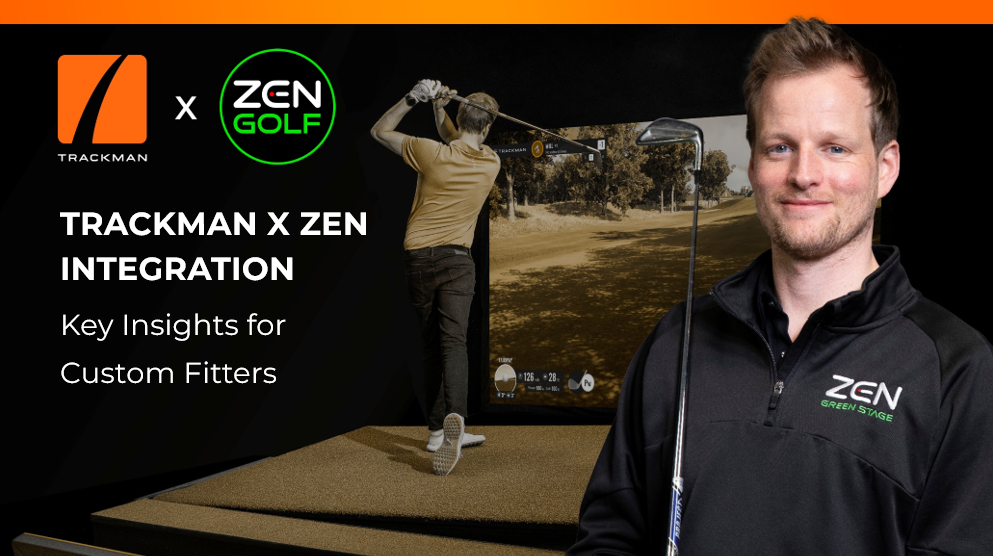
What Is the Zen Golf × Trackman Integration for Custom Club Fitting?
The Zen Golf × Trackman integration connects Trackman’s launch monitor and simulator data with Zen Golf’s moving floor technology, allowing the physical ground beneath the player to match real-world slope conditions during a club fitting session.
Instead of testing clubs only from flat indoor mats, fitters can now evaluate equipment performance from uphill, downhill, compound and sidehill lies, while Trackman captures full club and ball performance data.
This enables custom fitting decisions to be validated under the same real-world slopes players experience on the course.
How the Integration Works in a Club Fitting Environment
- Trackman identifies lie and slope conditions using simulator course data or fitter-selected terrain scenarios.
- That terrain data is transmitted to the Zen Golf Stage.
- The Zen platform adjusts to replicate the selected gradient under the player’s feet.
- The player hits the shot while Trackman records club delivery and ball flight metrics.
- The physical slope, visual simulation, and performance data are aligned to the same shot.
- Fitters can optimize on flat ground and then immediately validate performance on slope — within the same session.
Why This Matters for Custom Club Fitters
Traditional indoor club fitting measures performance in neutral conditions.
Golf is played on uneven terrain.
The integration allows fitting data to be interpreted within real environmental constraints, not just ideal ones.
For custom fitters, this means:
- Performance data reflects functional club behavior under balance constraint
- Dynamic loft, lie angle, and face-to-path interactions can be observed on slope
- Gapping decisions can be validated beyond flat-ground assumptions
- Players gain confidence that equipment performs when terrain changes
The result is not simply optimized numbers.
It is validated performance.
Trackman x Zen Integration: What Tour-Level Club Fitting Really Looks Like
Custom club fitters carry a heavy responsibility.
You are not just selecting equipment. You are shaping how golfers experience performance, confidence, and trust in their game.
At its best, club fitting delivers clarity:
This club works for you. Here is why.
At its worst, it delivers numbers that look impressive indoors but fail to hold up on the course.
The difference is not the launch monitor.
It is the environment in which fitting decisions are made.
As Ian Fraser put it when testing slopes for the first time:
“It gets a bit easy, doesn’t it? Always hitting off that flat lie.”
The numbers are precise.
The context we play in is not.
This is where the Trackman x Zen integration changes the standard of what “tour-level fitting” means.
The Limitation of Flat-Ground Club Fitting
Trackman has long articulated a principle in elite fitting environments:
- The best fittings replicate performance, not just measure it.
Launch monitors tell us how a club performs in neutral conditions.
Golf, however, is rarely neutral.
- Lies vary
- Slopes change
- Balance shifts
- Decision-making adapts
A club that performs perfectly on flat ground can behave very differently when the golfer is:
- Standing on sidehill lies
- Managing uphill or downhill attack angles
- Adjusting delivery under balance constraint
When fittings ignore these realities, fitters are forced to extrapolate, and players are asked to trust the numbers.
That trust is fragile if performance changes when we’re on the course.
A 250-Yard Decision: When a Five-Wood Becomes a Seven-Wood
Midway through the session, Ian was presented with a 250-yard uphill lie with a gentle right-to-left tilt.
On flat ground, the five-wood was a reliable 240–245 carry club. Launch numbers were strong. Spin was stable. Gapping looked clean.
Then the slope moved.
The first strike was flushed. The flight wasn’t.
The ball launched higher than expected, climbed, and fell short of its normal window.
“That’s the slope,” Ian observed.
“That’s launched it to the moon. Turned the five-wood into a seven-wood.”
The conversation shifted immediately:
- Was this still the right club?
- Was the additional dynamic loft predictable?
- Was the player comfortable taking this shot on the course?
On flat ground, the five-wood was optimal.
On slope, it required management.
The fitting decision wasn’t reversed. It was validated with context.
Because slopes reveal what flat ground hides:
- Effective loft shifts under uphill conditions
- Launch + spin profile changes
- Carry windows distort
- Static gapping is not functional gapping
The numbers explained the club.
The slope explained the game.
Precision Club Fitting Meets Real-World Performance Testing
This is the shift Zen introduces.
Zen Golf Stages, combined with Trackman, allow fitters to test clubs in conditions that resemble how the game is played.
With the Swing Stage and Green Stage, fitters can now:
- Adjust slope and lie angles underfoot
- Replicate uneven stances that change delivery patterns
- Observe how ball flight, and dispersion respond to terrain
Trackman captures the data and provides the immersive on-course experiences within the sim.
Zen provides the context that gives that data meaning.
Fitting moves from theoretical optimization to validated performance.
We’re now able to test effective loft and lie angles with real-world slopes and explore how confidence transfer to on-course experiences within the Trackman software.
The Last 15 Minutes of the Fit
Ian framed it simply:
“In the last 15 minutes of the fitting… let’s take your new driver, your new 3-wood, let’s take them for a run out.”
The model becomes clear:
- Optimize on flat.
- Validate on slope.
- Observe dispersion under constraint.
- Confirm decision under pressure.
This does not replace traditional fitting.
It completes it.
Why This Changes the Psychology of the Fit
For custom fitters, reputation is built on one thing:
- Did the clubs work when the golfer walked onto the course?
Fitting is not only about optimization.
It is about feasibility.
Mid-session, Ian asked:
“Is this even within your wheelhouse off this lie?”
That is a different question from:
“What produces the best launch numbers?”
A club must perform not only when the swing is ideal, but when balance is challenged.
Zen x Trackman strengthens trust by allowing players to feel performance differences, not just see them on a screen.
- Confidence rises when stability holds on slopes
- Decision-making sharpens when dispersion remains predictable
- Belief increases when fittings reflect real-world problems
You are now no longer just optimizing for numbers alone.
You are building on-course confidence.
This elevates the fitter’s role from technician to performance authority.
A Functional Advantage
Zen Stages expose differences that flat fitting bays often conceal.
- Shafts that feel stable on flat ground may lose consistency on sidehill lies
- Clubheads that launch well indoors may struggle when attack angle shifts
- Dynamic lie changes may alter the players perception of aiming on slope
- Face-to-path relationships alter under balance constraint
These are not theoretical changes. With Zen Stages they become measurable.
By combining Zen with Trackman and tools such as Swing Catalyst, fitters gain a complete picture:
- Ball flight
- Club delivery
- Ground interaction
- Balance and force strategies
This leads to more accurate recommendations, fewer post-purchase doubts, and ultimately more customer referrals.
Differentiation That Can’t Be Copied by Software
Many fitting studios now look the same.
- Same monitors
- Same clubs
- Same data
Zen x Trackman creates differentiation that cannot be replicated by a software update.
- Tour-level fittings under real slopes
- Demonstrations of performance on-course scenarios
- Evidence that clubs hold up beyond flat ground
On tour, fitting rarely ends on the range.
As Ian Fraser noted, once dialed, players go and test it. They validate on the course.
For off-course facilities, that step has historically been missing.
This gives fitters a story worth sharing, and a reason golfers choose you.
It places you at the forefront of experience, rather than the mechanic for their golf bag.
Driving Higher Conversion and Club Sales
When golfers understand why a club performs better for them, conversion improves naturally.
Zen-powered fittings support:
- Premium pricing for advanced performance fittings
- Clear identification of full-bag optimization opportunities
- Greater confidence in upsells based on performance gaps
Fitters move from single-club decisions to system-level optimization.
When players feel a club hold its line under different slope conditions, the decision comes with a stronger truth.
It comes with the confidence that what you see and what you feel line up.
That stops second guessing when you must commit to a shot over water or shape it around a hazard.
By utilizing Trackman’s Optimizer and Map Your Bag features, you’re using slopes to provide real-world numbers that will help the players perform on course.
Add coaching partnerships and post-fit performance reviews, and fittings become the start of long-term relationships, and not just one-off transactions.
Future-Proofing the Club Fitting Model
The most successful fitters over the next decade will not compete on data access alone.
They will compete on:
- Experience
- Trust
- Transfer to the course
As Ian Fraser noted:
“We don’t have that in an off-course facility.”
Historically, off-course fitting environments have lacked real-world slopes.
Zen closes that gap.
The Trackman x Zen integration creates a fitting ecosystem where:
- Technology integrates seamlessly
- Fitters focus on interpretation
- Players leave with understanding and confidence
This positions your business ahead of commoditized fitting services.
Why Zen x Trackman for Custom Club Fitters
- Real-world testing environment that puts experience at the forefront
- Tour-level differentiation that increases conversion
- Premium positioning justified by experience
- Scalable ecosystem for coaching, fitting, and retail partnerships
Together, Zen and Trackman allow fitters to deliver what golfers want:
Clubs that perform when it matters.
Looking Ahead
The question for custom fitters is no longer:
“How accurate is your data?”
It becomes:
“Will this club perform on the course?”
If that reframes how you think about fitting environments, the conversation is worth having.
Zen does not replace precision.
It gives it context.
If this reframes how you think about fitting environments, we’d welcome the conversation.
Explore What Real-World Slopes Could Unlock
Book a Call to explore how the Trackman × Zen integration can elevate your fitting experience, and your business.
Explore the Trackman x Zen Integration Overview
Discover how Zen Golf and Trackman work together to bring real-world slopes, contextual data, and representative learning into a single performance framework.
Take a Deep Dive and learn how to apply slope-based constraints, task design, and Trackman metrics across your session plans—Turn technology into experience to make practice more representative of the course.
