
Flat vs Sloped Practice: What Really Transfers
Overview
Golf isn’t played on flat ground, so why do most golfers still train that way?
When you remove gravity and slope, you remove the game’s information. Flat practice grooves control, slope practice builds adaptability. Only one transfers to the course.
Written by: Will Stubbs, Head of Education, Zen Golf
Last Updated: 12/01/2025
Why flat practice feels good but fails under pressure
A flat mat creates comfort: a predictable stance, identical lies, and repeated ball flights. You leave the bay feeling consistent, until the first uneven fairway in April.
The reason is ecological: flat environments strip away the perceptual cues that link movement to outcome. Your swing becomes calibrated to an artificial world. When the ground tilts, those learned solutions collapse under the complexity we face on the course.
Motor-learning studies call this context-specificity: skill doesn’t generalize when practice lacks representativeness.
The Zen Stage solution: reintroducing reality
The PoST Framework structures how golfers transition from flat, stable tasks to slope-integrated, fully representative ones:
- Coordination: Start with mild slopes (1–2%) to restore real golf information without overwhelming perception.
- Adaptability: Introduce variable slopes (2–4%), randomizing direction every few shots so players learn to organize movement around gravity.
- Performance: Combine multiple slope types in random order while benchmarking SG to test true transfer.
PoST ensures representativeness emerges progressively, so skills stabilize before additional variability is introduced.
Using PoST to progress to fully representative practice
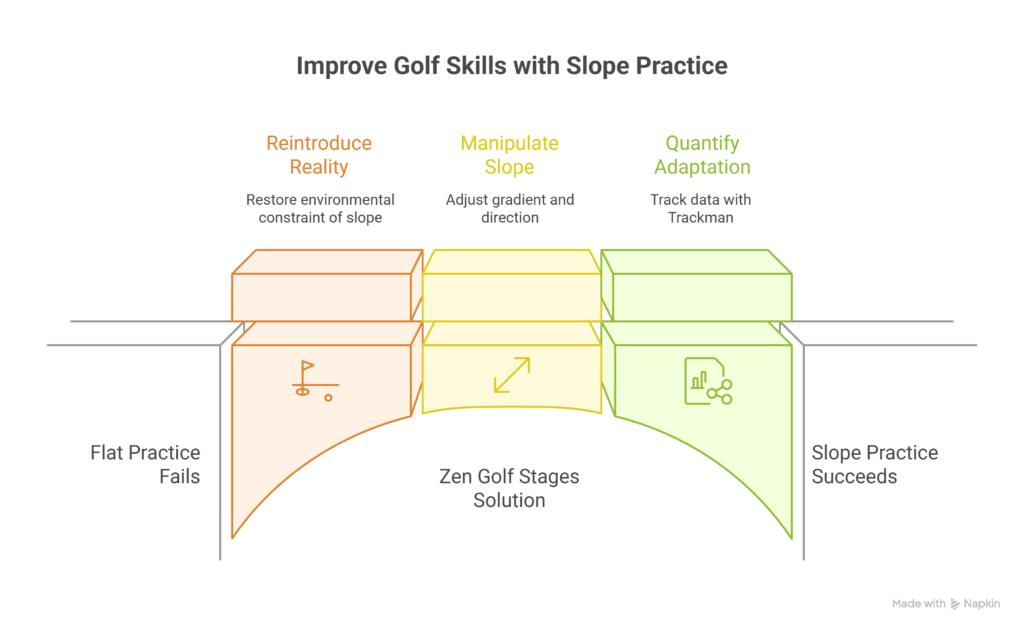
Zen’s Swing Stage and Zen Green Stage restores the environmental constraint that the course provides naturally, slope.
By manipulating slope gradient (e.g. 2–6 %), direction (uphill, downhill, sidehill, diagonal, compound or twists) and coupling it with Trackman’s data, you can quantify adaptation, which is the hallmark of learning.
When you train on slope, gravity becomes the instructor. Balance, timing, and swing path self-organize. Each lie demands a new coordination pattern, and the nervous system expands its library of solutions.
Measuring transfer with Trackman strokes gained
To test whether slope practice truly transfers, we can use Trackman Combine or Performance Center to gather Strokes Gained vs Handicap (SG) data before and after slope blocks.
| Environment | Typical Combine Score | Average SG Change vs Handicap | On-Course Transfer |
| Flat mat practice | 75 points | ≈ +0.20 (per shot) | Minimal; improvement fades outdoors |
| Slope-integrated practice (2–6 %) | 63 points | ≈ -0.15 (per shot) | High; SG carries to course data |
A +0.10 SG improvement sustained on random slopes typically predicts 1–2 stroke reduction over 18 holes once back on grass. The numbers support what experienced coaches report: adaptability outperforms repetition.
Building your own slope transfer test
Step 1 – Baseline (Flat)
Run a standard Trackman Combine (60 shots, flat mat). Record overall score and distance-specific SG vs Handicap.
Step 2 – Adaptive Phase (Weeks 1–3)
Use the Zen Swing Stage:
- Alternate 2 % uphill to 2 % downhill every shot.
- Keep targets identical to baseline Combine.
- Goal = Maintain SG within ±0.10 vs Scratch.
Step 3 – Challenge Phase (Weeks 4–6)
- Add sidehill and diagonal slopes (2-4 %).
- Increase variability: randomize club and target distance.
- Goal = Stabilize performance; avoid SG drop > 0.20.
Step 4 – Re-Test on flat
Run the same Combine again. If slope training worked, your flat-ground SG should improve because coordination patterns are more stable and adaptive.
Understanding the data
A rise in within-session SG variability during slope training isn’t bad, it’s the signature of adaptation. What matters is that the trendline stabilizes closer to zero for your targeted handicap.
We need to start plotting weekly SG standard deviation rather than just averages for the session. A narrowing SD across variable slopes indicates improved movement robustness.
Coach application
- Compare contexts: Always run both flat and sloped tests; discuss SG shifts, not aesthetics.
- Target transfer indicators: Aim for < 0.15 SG loss when moving from flat to 4 % slope. Less loss = better adaptability.
- Design representative blocks: 30 balls, 3 slopes, Trackman SG scoring on; encourage external attentional cues.
Player application
- Track your SG curve: Export your data each week and see dispersion tighten even if average SG wobbles.
- Note slope bias: Different lies may shift patterns; quantify SG impact to increase awareness.
- Celebrate variability: Small SG drops on more challenging slopes indicate exploration, not regression.
Zen practice tip
Run a “Slope Transfer Combine” once a month:
- 60 shots, alternating slope every 10 balls (uphill → downhill → sidehill → flat → random → flat).
- Record SG vs Handicap by segment.
- Build a radar chart to identify which slopes create the largest SG deficit.
This becomes the next training map and raises the floor of performance, not just the ceiling.
Closing thought
If flat practice builds confidence; sloped practice builds competence.
When you train on slopes, you’re rehearsing the course itself.
The next time you face a downhill 7-iron to a tucked flag, you’ll sense the solution because mastered it indoors, guided by gravity, measured by Trackman Strokes Gained, and shaped by the Zen Stage beneath your feet.
Real Slopes. Real Data. Real Golf.
