
Trackman × Zen Integration: From Data to Better Golf Decisions
Overview
This article reflects on why many coaching problems are not skill problems, but environment problems, and how the integration between Trackman and Zen Golf is reshaping how we think about learning, coaching, and the entertainment experience.
It explores the shift from flat, repeatable conditions toward environments that restore gravity, slope, consequence, and decision making. It looks at how data gains meaning when placed back into context, how AI motion capture on slopes changes the conversation around movement, and why coaching works best when we start with the human before the player.
This is about completing the ecosystem with Zen Swing Stage and Zen Golf Stage, so performance, practice, and play begin to align again.
Written by: Will Stubbs, Head of Education, Zen Golf
Last Updated: 30/01/2026
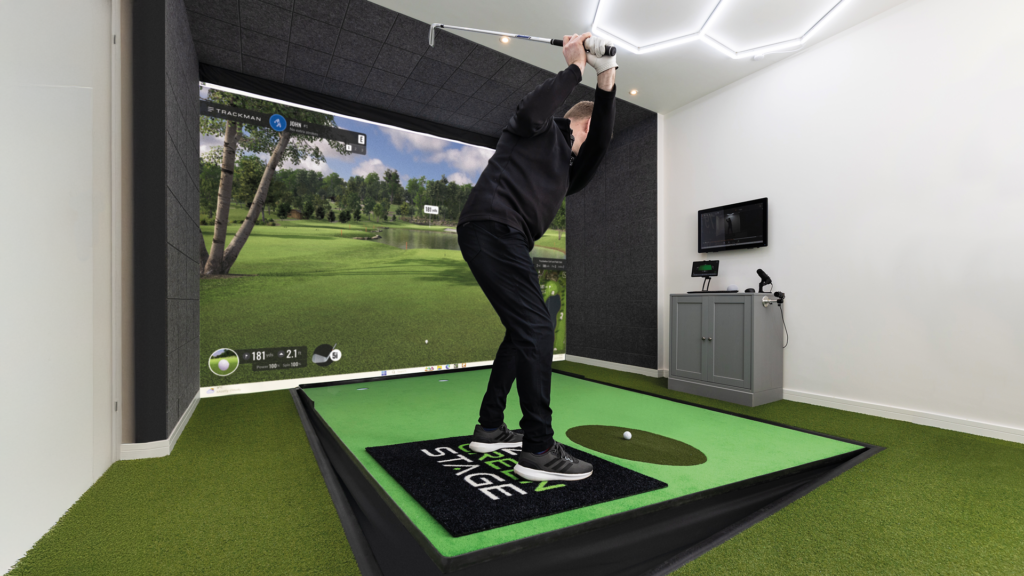
The Trackman & Zen Golf Integrated Experience
Over the course of the PGA Show, a pattern kept surfacing in conversations with clubs, coaches, colleges, and indoor golf centres.
We have never had more technology in golf. More data. More screens. More numbers. Yet many people feel further away from understanding performance than ever.
That tension sat behind almost every discussion I had throughout the week.
Most coaching problems are not skill problems. They are environment problems.
For years, indoor golf has chased graphics and accuracy, but in doing so the environment became increasingly impoverished.
Players were asked to adapt to flat floors and repeatable conditions. Coaches did the best they could within those constraints.
When the environment offers little information, instruction fills the gap. Positions become proxies for performance, and anecdotal narratives replace the player’s lived experience.
The integration between Trackman and Zen Golf shifts that balance.
When the Swing Stage, Green Stage or Golf Stage move the ground , behaviour changes. When slope enters the equation, decisions matter again. Distance control, shot shaping, intention, and emotional response surface naturally. Data no longer floats in isolation, but sits inside a lived experience.
During the Show, I spoke about moving from sterile to enriched environments. That phrase resonated more than I expected.
An enriched environment does not mean complexity for its own sake, but restoring the information golfers rely on outdoors. Gravity. Lie. Consequence. Uncertainty. These elements shape learning whether we acknowledge them or not.
This is where the conversation moves from positions to decisions.
When players experience a real sidehill or a twisted uphill slope, the question shifts. Not how do I hold the face, but what did I perceive, what did I choose, and how did the ball respond. Coaching starts to orbit judgment rather than compliance.
Trackman data becomes more valuable in this context. Ball speed, club path, start direction, and dispersion gain meaning because the environment demands interpretation. Data supports insight rather than driving prescription.
One theme that kept returning was the idea of moving from narration to reality.
Players often arrive saying they have a technical flaw. What they usually carry into the lesson is a moment from the round. A missed putt that carried momentum. A shot that felt uncomfortable. A decision they did not trust.
With the integration, those moments return indoors. The same distance. The same gradient. The same task. The ground, club, and ball recreate the experience. Skills develop through repetition in context, not rehearsal of technique.
Another unexpected point of connection came through play.
Historic putts. Iconic shots. Famous moments. Not as theatre, but as learning tasks. The same slopes, the same decisions, the same pressure, scaled through play and person-to-person interaction.
Hidden inside games and challenges, learning feels lighter. Curiosity replaces tension. Engagement rises without instruction dominating the session. Players compete with the task, not with a checklist.
Another layer of the integration deserves more attention. How movement data changes once slopes are introduced.
Trackman’s new AI motion capture technology offers a clearer picture of how golfers organise movement. Not in isolation, but in response to the task. When slopes enter the environment, swing biomechanics stop being abstract and become situational.
A player does not move the same way on a sidehill lie as they do on flat ground. Pelvis orientation, pressure shifts, sequencing, and timing all adapt. The environment invites different solutions. What the AI reveals is not a fault, but a strategy.
This changes the conversation for both coach and player.
Instead of asking why a swing looks different, we begin to ask why it makes sense. Slopes reveal how players protect joints, manage balance, and generate power in ways that feel safe and familiar. Over time, preferences emerge. A golfer might favour one slope over another. Not because of technique, but because of history.
An old injury. A movement pattern built to avoid pain. A negative experience from the past. With this information, coaching moves upstream. We are no longer correcting movement without context. We are understanding why movement organised itself that way in the first place. The AI does not dictate change. It supports conversation.
The integration speaks clearly about this from a coaching perspective, where movement lives in interaction with the environment. Change happens when players feel safe enough to explore alternatives, not when their instincts are overridden. Slopes give permission to explore, and the motion capture shows how that exploration unfolds.
This creates a different coaching relationship.
We are no longer coaching a swing in isolation. We are coaching a human navigating a task. The person comes first. The player comes second.
When players understand their movement tendencies on different slopes, learning accelerates. Corrections become adjustments rather than rebuilds, and confidence grows because change feels natural, not imposed.
This is where technology earns its place. Not by telling golfers how they should move, but by helping coaches and players understand how and why they already do.
In that sense, the integration brings us full circle. Where data returns to service awareness, and the environment leads behaviour. Coaching becomes a shared process of sense-making rather than pre instruction.
This matters beyond individual sessions.
For college golf programs, it creates a shared language between performance, practice, and transfer. Training environments begin to mirror competitive demands rather than abstract preparation. Student athletes become way-makers in their own development, allowing coaches to maximise their time across the squad and provide more personalised approaches.
For indoor golf centres, the experience shifts. Members return because every session feels different, as the same bay delivers new problems, new stories, and new conversations between people, not just between people and screens. As Head of Product for Trackman’s Indoor Golf, Jakob Munk put it, the integration brings virtual golf from a 2D screen into a 3D environment.
For golfers, the experience reconnects with why they play. Not to chase perfect numbers, but to solve problems, adapt, and improve over time. The ecosystem they practice and play within now blends seamlessly to the course.
I spoke about this on SiriusXM PGA Tour Radio during the Show with Chantel McCabe. At Zen we pride ourselves on bringing this game in its realist form to more people, so they can fall in love with it. The phrase we kept returning to was simple.
More People. Playing Better. For Longer.
Technology does not achieve that on its own, but with immersive environments the ecosystem brings realism to life. Technology earns its place when it helps people see, feel, and understand the game more clearly.
The Trackman x Zen integration is not about adding another layer of data. It is about completing the performance and play ecosystem by restoring context so coaching, learning, and play align again.
That is the conversation I hope continues well beyond the PGA Show as this partnership aims to shape the future of golf.
