

Putting Under Pressure: Build Confidence Inside 10 Feet
Author: Will Stubbs – Head of Education, Zen Golf
Key insight
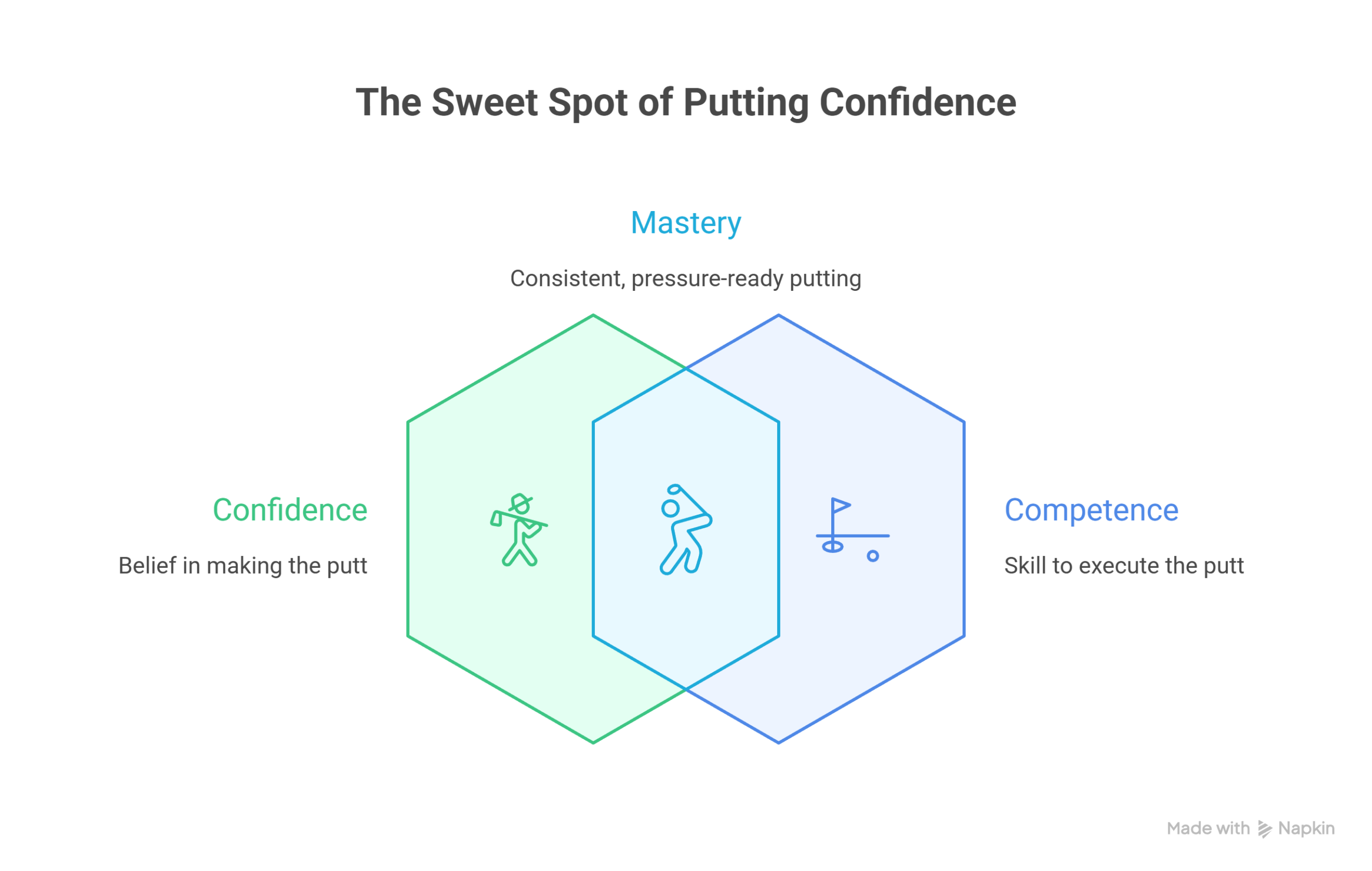
Inside ten feet, there’s a mismatch between confidence and competence. We see the opportunity and believe we should make everything, but that never becomes a reality.
Each putt is shaped by slope, speed, and gravity: a physics problem disguised as a simple stroke. With the Zen Green Stage and Trackman Putting analytics, you can replace guesswork with measurable, slope-informed performance.
Why flat putting practice fails
Flat indoor mats emphasize rhythm and mechanics but lack the environmental information that makes putting realistic. On static surfaces, the brain receives no cues about slope or break, so perceptual calibration drifts. The focus turns inward, toward mechanics rather than intention and pace.
On the course, every putt is unique. As the ground tilts, gravity reshapes roll, influences capture speed, and alters visual perception. Without representative slopes, players struggle with pace control, misreads, uncertainty, and doubt.
As Zen Master Ambassador Marcus Bell says, “Confidence comes from solving the same problems the course gives you, not avoiding them.”
The Zen Green Stage: Re-introducing gravity
Zen’s adjustable Green Stage allows you to recreate every type of real-world putt:
- Planar uphill and downhill slopes (1–4 %) for pace control.
- Compound breaks (1–3 %) for read and roll calibration.
- Downhill and sidehill ‘sliders’ to test commitment under pressure.
Each slope becomes a constraint that shapes movement, revealing how line, speed, and perception interact. Practice shifts from “repeating the stroke” to solving the putt.
Using trackman putting to quantify challenge
Trackman’s putting module measures start line, pace, and predicted outcome, producing Strokes Gained (SG) vs Handicap for each attempt. This data lets you design progressive challenge blocks that track both skill and confidence.
| Challenge Level | Slope Severity | Target Make % | SG vs Handicap | Learning Focus |
| Foundation | 1 % uphill vs downhill | 70 % | ±0.10 | Pace calibration |
| Development | 2–3 % sidehill | 60–70 % | –0.10 to 0.00 | Green-reading accuracy |
| Pressure | 3 % compound | 50–60 % | –0.15 to –0.05 | Decision-making & flow |
When SG improves toward 0.00 while slope difficulty increases, you know perception and control are adapting, not just your mechanics.
The 10-Foot Conversion Challenge
Design a six-week indoor progression aligned with PoST’s Coordination, Adaptability, and Performance structure.
Weeks 1–2 – Baseline Awareness
- Slopes: 1–4 percent, variable uphill/downhill
- Goal: SG within ±0.10
- Focus: start-line precision (face angle ≤ 1°)
Weeks 3–4 – Realistic Variability
- Slopes: 1–3 % clockface challenges.
- Record make-percentage radar chart and SG trendlines.
- Reflect: “Where was the zero break line?” “Did perception match reality?”
Weeks 5–6 – Pressure Simulation
- Slopes: Randomized compound breaks
- Break 30 challenge: 18 putts and the aim to finish with less than 30.
- Scoring: +1 pt for every putt holed = SG ≥ +0.10, –1 pt for a miss = SG ≤ –0.20.
- Create the tournament feel — verbalize your read, commit, review data.
This plan reflects the PoST periodization framework:
Coordination Phase (Weeks 1–2): simplified slopes (1–4%) build perceptual-motor coupling between line and pace.
Adaptability Phase (Weeks 3–4): variable clockface slopes (1–3%) introduce perceptual uncertainty to refine green reading.
Performance Phase (Weeks 5–6): randomized compound breaks simulate competition realism and test self-organization under pressure.
Confidence grows when you can predict and confirm success under changing slopes.
Coach Applications
- Integrate SG into lesson flow: Start with easy slopes (SG ≈ 0) and intentionally add difficulty until performance stabilizes at more than –0.10.
- Link physics and perception: Discuss how slope angle alters capture speed and hole size; validate with Trackman roll data.
- Use Desirable Difficulty: Maintain 70 % make or success rate to let challenge, not over explanation, drive learning.
Player Applications
- Track SG trendlines: A slight SG dip (–0.05 to –0.10) on harder slopes = ideal learning zone.
- Compare feel vs data: Note whether the putt rolled faster or slower than expected, this builds perceptual calibration.
- Gamify Pressure: Create a 10-ball ladder, advancing after +7 points or stepping back if scoring below 6.
Zen practice tip
Pair Zen Green Stage with Trackman’s Custom Practice:
- Program three slope presets (1%, 2%, 3%).
- Hit ten putts per preset, alternating slopes.
- Export SG vs Handicap data.
- Plot SG vs Slope graph to create your personal “Putting Challenge Curve.”
The flattest curve wins, as it means your skill transfers across conditions.
From data to confidence
Confidence isn’t built by making every putt, but by understanding every miss. When you see your SG data converge around zero across multiple slopes, you’ve proven to yourself that your read, pace, and line hold up under pressure.
Using Mark Broadie’s strokes-gained baselines for Tour players and recent Shot Scope–powered putting charts for amateurs by handicap, we can give players realistic benchmarks. Save the table below into your phone and use it to structure and support your practice.
Make-rate benchmarks:
| Distance | Tour Pro | Scratch (0) | 5 HCP | 10 HCP | 15 HCP | 20 HCP |
| 3 ft | 96–99% | ~98% (0–3 ft bucket) | ~96% | ~96% | ~93% | ~90% |
| 5 ft | 75–80% | ~76% (3–6 ft) | ~67% | ~65% | ~59% | ~55% |
| 8 ft | ~50% | ~49% (6–9 ft) | ~44% | ~39% | ~36% | ~33% |
| 10 ft | 38–40% | ~34% (9–12 ft) | ~34% | ~26% | ~22% | ~18% |
| 15 ft | ~25–30% | ~19% (12–18 ft) | ~19% | ~18% | ~16% | ~14% |
Important: The amateur numbers above are approximations derived from Shot Scope buckets (0–3 ft, 3–6 ft, 6–9 ft, 9–12 ft, 12–18 ft).
Closing thought
Putting mastery is not about perfection; it is about adaptability. With the Zen Green Stage recreating authentic gravitational challenge and Trackman Putting metrics quantifying each attempt, you practice exactly what the course requires.
Ten feet. Real slopes. A structured plan. The quiet confidence that comes from knowing (not hoping) that the putt will hold its line.
Real Slopes. Real Data. Real Golf.
–
CONTACT
- Andy Hiseman, VP Global Sales & Marketing, Zen Golf
- +44 (0)1226 781000 | [email protected] | WhatsApp / Cell +44 (0)7795 360112
- Book a meeting: https://calendly.com/zen-andy-hiseman
INTERNATIONAL OFFICES
- International: +44 1226 781000
- USA: +1 727 855 2034
- South Korea: +82 010 8788 7646
- Asia Pacific: +65 8183 7806
- South Africa: +27 698 639 059
- Australia: +61 413 132 989
- Southern Europe: +34 689 647 555
NOTES FOR EDITORS
ABOUT ZEN GOLF
www.zen.golf | @zengreenstage | #onlyzen | #golfsmovingfloor | #1ingradient
Zen Green Stage and Zen Swing Stage are golf’s most accurate and reliable moving platforms with the best playing surfaces and the widest range of movement – ideal for capturing new performance data suitable for elite training, or for recreating the golf course indoors for a more enjoyable golf sim experience. Golf’s leading launch monitors and simulators, putting technologies and force / balance plate systems are brought to life on Zen’s precisely-adjustable gradients. The Zen Famous Putts experience is becoming increasingly popular as a brand activation at golf tournaments. Our customers across the world include the PGAs of America, GB & Ireland, Australia and Germany; tours and event sponsors such as DP World Tour, Legends Tour and LIV; many leading major venues and universities; PGA Tour and DP World Tour players and their coaches; national governing bodies; serious golfers with home studios; and a wide range of different golf clubs, golf equipment companies including PING, golf academies, golf coaching facilities and commercial entertainment venues. The company is based in Sheffield, UK, with a network of Zen Certified Installers and sales offices established worldwide.