

Gamify Your Golf Practice: Turning TPS Data Into Learning Fuel
Author: Will Stubbs – Head of Education, Zen Golf
Key insight
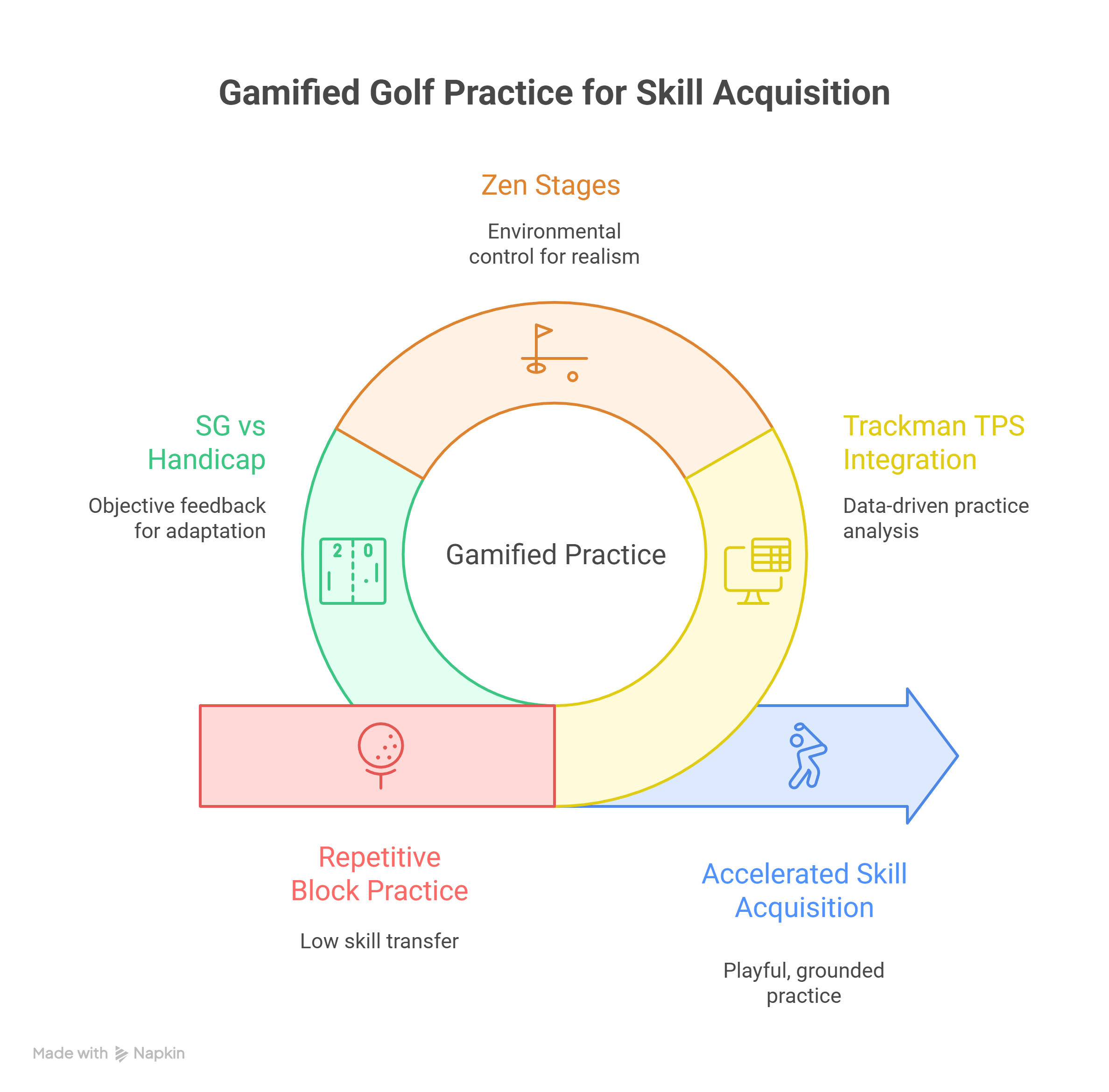
Golfers and coaches increasingly rely on data, yet the real opportunity lies in transforming that data into learning fuel. By combining Trackman TPS with the environmental control of a Zen Stages, practice becomes a structured game that accelerates skill acquisition.
The goal is measurable progress through representative challenge, not repetitive block practice.
Why gamification works in golf learning
Learning science shows that engagement, variability, and feedback accelerate skill retention. Gamification unites all three by turning practice into purposeful play.
However, true gamification is more than entertainment. It requires constraints and metrics that shape behaviour and support adaptation. In golf, this means blending realistic slopes with objective feedback such as Strokes Gained (SG) vs Handicap.
The result is practice that feels playful yet remains grounded in performance science. It’s like Inception for your golf game. That’s how fun becomes functional.
Trackman TPS: The game engine for learning
Trackman’s TPS software offers multiple practice modes with each ideal for designing learning challenges. When paired with a Zen Swing Stage, Zen Golf Stage or Zen Green Stage, every slope and target change can be quantified in Strokes Gained (SG).
| TPS Mode | Purpose | How to Gamify | SG Integration |
| Performance Center | Adaptive distance & dispersion training | Build “Skill Ladders” (increase difficulty as success exceeds 70%) | Use SG ±0.10 as the optimal challenge window |
| Combine Test | Benchmark under pressure | Run “Slope Combine” with 10 shots per slope type | Compare SG per slope type to track adaptability |
| Virtual Golf | Transfer to course conditions | Play full holes with changing slopes | Use SG by shot category to measure transfer |
Each session produces measurable outcomes such as dispersion, carry accuracy, and SG per shot. Your task is to convert those numbers into appropriate challenge levels.
Building your SG challenge ladder
A Slope Challenge Ladder transforms learning into a progression system. Each level represents one training condition. You advance only when SG stabilises within ±0.10 (≈70% success).
| Set | Slope Condition | Target Zone | Goal (SG vs Handicap) |
| 1 | Flat (0%) | 10% dispersion | ±0.10 |
| 2 | 2% Uphill | 8% dispersion | ±0.10 |
| 3 | 4% Sidehill (ball above feet) | 7% dispersion | ±0.10 |
| 4 | 6% Downhill | 6% dispersion | ±0.10 |
| 5 | Compound Slope (random) | 5% dispersion | ±0.10 |
You can use Trackman’s Test Center to custom build this ladder or adapt Performance Center mode to your approach play goals.
Every slope you conquer within your SG window earns a “Level Up.” If SG drops below –0.20, you “Level Down” and reattempt with softer slope or wider target zone.
This learning system transforms your simulator into a learning arcade, powered by physics, defined by data.
PoST: The engine behind structured game progression
Gamification becomes transformative when difficulty scales with learning. The PoST Framework maps perfectly onto game-based practice:
- Coordination Games: Level 1–2 challenges (predictable slopes, simple targets) where players stabilize core skills.
- Adaptability Games: Level 3–4 challenges where slopes, targets, and feedback vary, forcing creative solutions.
- Performance Games: Level 5-6 pressure tests — full combines, randomized slopes, or competitive ladders.
You “level up” when SG data demonstrates stability at each stage.
Feedback loops that matter
Every game needs a scoreboard. In practice, the scoreboard is your SG trendline.
Export your SG data from Trackman after each session and chart three key metrics:
- Average SG vs Handicap (learning efficiency)
- SG Variability (SD) (movement stability)
- SG Progress per Slope Type (adaptability)
Improvement doesn’t mean higher averages, but reduced variability across slopes. This is the hallmark of adaptability and that’s the key skill that transfers to the course.
Coach applications
- Gamify constraints, not just mechanics: Use slope, distance, and dispersion to change difficulty, not just swing cues.
- Create tiered leaderboards: Compare SG per slope among students. Highlight consistency within ±0.10 SG band.
- Reward adaptation: “Player of the Week” = smallest SG gap between flat and 4% slope.
Player applications
- Play against yourself: Track SG challenge ladders week to week; celebrate when performance stabilizes, not just improves.
- Add stakes: 10 balls per slope—lose a point for SG below –0.20; gain a point above 0.00.
- Reflect after each round: Which slope type felt hardest? Where did SG drop most? That’s your next challenge.
Zen practice tip
Set up a “Trackman x Zen Tournament” with your training group:
- Three slope conditions (2 percent, 4 percent, 6 percent)
- Ten shots each using Trackman SG scoring
- Rank by SG consistency per slope, not total score
This rewards adaptability rather than purely striking quality.
Why it works
Gamified SG tracking merges the three pillars of modern golf learning:
- Ecological realism – Zen Stages replicate the slopes and gravity of real play.
- Constraint manipulation – Using slope, distance, and feedback delay to tune difficulty.
- Objective feedback – Trackman data quantifies success precisely.
This triad turns every practice into a loop of play → feedback → adaptation. Practice becomes purposeful, engaging, and measurable.
Closing thoughts
Golf learning doesn’t need more drills; it needs better games.
By blending the Zen Swing Stage, Zen Golf Stage or Zen Green Stage’s environmental challenge with By integrating Zen Stage challenge with Trackman TPS analytics, each session becomes enjoyable and effective. When practice feels like play with purpose, improvement becomes an inevitable by-product.
Real Slopes. Real Data. Real Golf.
–
CONTACT
- Andy Hiseman, VP Global Sales & Marketing, Zen Golf
- +44 (0)1226 781000 | [email protected] | WhatsApp / Cell +44 (0)7795 360112
- Book a meeting: https://calendly.com/zen-andy-hiseman
INTERNATIONAL OFFICES
- International: +44 1226 781000
- USA: +1 727 855 2034
- South Korea: +82 010 8788 7646
- Asia Pacific: +65 8183 7806
- South Africa: +27 698 639 059
- Australia: +61 413 132 989
- Southern Europe: +34 689 647 555
NOTES FOR EDITORS
ABOUT ZEN GOLF
www.zen.golf | @zengreenstage | #onlyzen | #golfsmovingfloor | #1ingradient
Zen Green Stage and Zen Swing Stage are golf’s most accurate and reliable moving platforms with the best playing surfaces and the widest range of movement – ideal for capturing new performance data suitable for elite training, or for recreating the golf course indoors for a more enjoyable golf sim experience. Golf’s leading launch monitors and simulators, putting technologies and force / balance plate systems are brought to life on Zen’s precisely-adjustable gradients. The Zen Famous Putts experience is becoming increasingly popular as a brand activation at golf tournaments. Our customers across the world include the PGAs of America, GB & Ireland, Australia and Germany; tours and event sponsors such as DP World Tour, Legends Tour and LIV; many leading major venues and universities; PGA Tour and DP World Tour players and their coaches; national governing bodies; serious golfers with home studios; and a wide range of different golf clubs, golf equipment companies including PING, golf academies, golf coaching facilities and commercial entertainment venues. The company is based in Sheffield, UK, with a network of Zen Certified Installers and sales offices established worldwide.