

Winter Indoor Golf: A Deep Dive into Practicing Smarter with Zen Stages & Trackman
Author: Will Stubbs – Head of Education, Zen Golf
Deep Dive
Most golfers lose winter to flat mats, mechanical drills, and false confidence. This blog argues the opposite: with Zen Swing Stage, Zen Green Stage, Zen Golf Stage and Trackman TPS, winter can be the most transferable practice period of your year.
Key ideas in a nutshell:
- Train like you play, not like the range. Real golf lives on slopes, lies, and uneven ground. Flat practice strips away the very constraints your brain and body need to learn.
- Use science to design practice, not vibes.
- Non-linear pedagogy & ecological dynamics: skill emerges from the interaction of player–task–environment, not from chasing a “perfect swing”.
- Challenge Point Theory: aim for ~70% success. Too easy, no learning; too hard, no control.
- PoST 6-week winter framework:
- Coordination (Weeks 1–2) – simple, stable slopes to organize new patterns.
- Adaptability (Weeks 3–4) – random slopes, tasks, and tempos to force adjustment.
- Performance (Weeks 5–6) – realistic, pressured tests with Trackman Combines and games.
- Slopes = your second coach. Changing slope changes ground reaction forces, balance, and strike. You use uphill, downhill, and sidehill lies to feel GRF, timing and shot windows instead of memorizing positions.
- Full swing & putting are both slope sports.
- Full swing: slopes teach impact control, GRF use, trajectory management, and problem solving.
- Putting: Zen Green Stage and strokes gained can re-frame expectations, calibrate pace, start line and read on planar and compound breaks, using realistic make-rate benchmarks.
- Everything is measured and gamified. Trackman TPS + Zen Stages let you turn practice into experiments: SG vs handicap, success %, dispersion, slope bias, confidence ratings.
- SMART winter targets: 6-week blocks tied to clear gains (e.g., +4–6 mph club speed, +5–10% make rate at ≤10 ft) so spring feels like a continuation, not a reset.
The bottom line is if you move the ground and restore gravity, you can turn winter practice from repetition on flats into representative training that shows up on the course.
Introduction
We all know that feeling the last round of the year brings – a point of reflection of what could have been, a look ahead to the promise of something better next year, but not really any idea of how to do it. Winter does not have to mean lost momentum. With modern technology, the off-season can become your most productive period of the year—if you practice with realism, challenge, and intent.
This series explores how we can use technology Zen Swing Stage, Zen Green Stage, and Trackman Performance Studio (TPS) environment to design scientifically optimized practice that transfers directly to on-course performance.
By applying the constraints-led approach, non-linear pedagogy, and challenge-point theory, we can build adaptable skills, not fragile habits. Using slopes to manipulate difficulty, you can keep every session within the sweet spot—around 70% success rate—where learning is deepest and most durable. When the Masters comes around, you will not be dusting off the golf bag in hope of a new-year-new-me, but the promise of better golf will be a certainty.
The winter opportunity
As temperatures drop and fairways freeze, we face a choice: maintain, evolve, or hibernate.
Traditional winter practice often means several buckets of balls hit on the range while your other half does the Christmas shopping or an escape from yet another Harry potter film. Usually, this practice is from flat mats, is a focused on mechanical drills, ends up being a race to hit the driver as quick as possible and we leave with a false sense of progress. This is the pursuit of practicing perfect swing, but when spring returns, those perfect swings vanish the moment gravity and course terrain reappear.
The problem is not the player, but the environment. Flat indoor surfaces strip away the essential constraints that shape real golf: slopes, lies, and variability. Without them, our brain and body adapt to an artificial world.
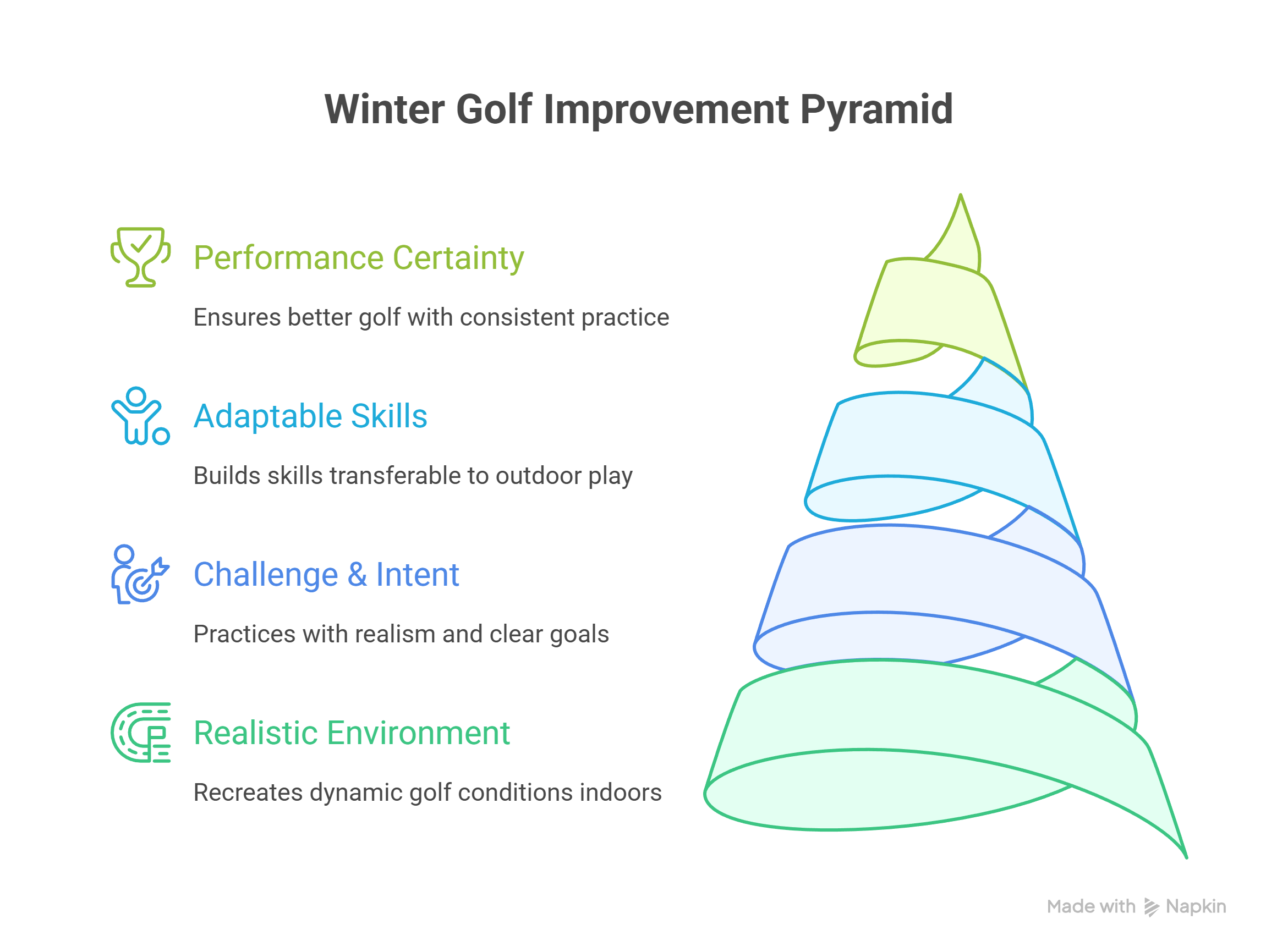
Our philosophy at Zen Golf’s turns this challenge into an opportunity. Using our adjustable stages and Trackman’s accurate data feedback, you can recreate the dynamic, unpredictable conditions of real play indoors—training the same perception-action coupling that drives performance outdoors.
Winter practice becomes our ideal laboratory for adaptation.
The science of learning
What is non-linear pedagogy (NLP) in golf?
Most traditional practice assumes learning is linear: more reps = more consistency = better performance. Non-linear pedagogy flips that assumption. It starts from the idea that humans are complex systems. Learning is messy, adaptive, and highly individual.
Underpinned by ecological dynamics, NLP views skill as something that emerges from the ongoing interaction between:
- The Player (their body, intentions, our history)
- The Task (shot type, target, scoring rules)
- The Environment (slope, lie, wind, pressure)
Instead of chasing a single “ideal swing,” we must now see every shot in context. No longer is a 150yrd shot a stock 7 iron, but now embodied within the interaction between the task, environment, and yourself. For example, a 150yrd shot on a ball below lie to a raised green now changes everything. The slope affects our balance and confidence to commit to aim and swing speed, the raised green changes the trajectory we need, the decisions go on. When we embrace this, our mindset changes, it is not about grooving swings but about understanding how we interact with the challenges this shot throws at us and how we respond.
When we design our practice, we need environments that invite our curiosity and cognition in action, we need to explore and stabilise movement solutions that work for us.
Core practice principles
You can frame the winter indoor work around these six design principles:
- Representative learning design
Practice must preserve the key informational cues and action demands from real play. A golfer learns best when what they see, feel, and do in practice mirrors what they will face on the course. For us that means:- Slopes and gravity (stance and ball lie).
- Real targets and distances (not just “net shots”).
- Full routines and real consequences (scores, penalties, ladders).
- Manipulation of constraints
Learning is driven by changing task, environment, and performer constraints to moderate difficulty and enjoyment. In winter practice this might be:- Task: vary distance, club, or shot shape.
- Environment: change slope % and direction on Zen Swing / Green Stage.
- Performer: fatigue level, time pressure, attentional focus.
- Encouraging functional variability
Rather than “eliminating” variability, NLP treats useful variability as the engine of learning. We want to find many ways to solve similar problems. Randomised slopes, clubs, and targets deliberately inject variability that the nervous system must organise into stable performance. - Task simplification, not decomposition
Beginners do not need a different game, they need a scaled version of the same game. Instead of removing slopes or decision-making, you can:- Use gentler slopes (1–2%) instead of flat lies.
- Use larger targets or wider dispersion zones.
- Shorten distance while keeping slope, routine, and scoring.
- Attentional focus & autonomy
NLP favours external focus, so thinking about the ball flight, slope, target. We want to develop your awareness of the task goals and in so develop ownership over your learning. When we are practicing, instead of thinking about what angle the club is, consider:
-
- Asking questions (“What did you feel under your lead foot?”)
- Owning the choice over constraints (slope, club, targets).
- Using data and environment as feedback, not constant verbal correction – We have had enough of our mate telling us about something they saw in a ‘golf mag.’
- Challenge Point Theory (CPT)
The Challenge Point is where difficulty and skill intersect to maximize learning. Research shows that ~70% success is ideal. Too easy (>85%) and there is no learning signal; too hard (<60%) and the system overloads. By adjusting slope severity, target size, or distance, we can regulate this success window precisely—creating “desirable difficulty” that accelerates retention.
When we look ahead to developing our own practice plan, we need to appreciate one key thing: Learning is not linear. We wake up every day feeling, thinking, moving different, so we need to switch our focus from perfecting to adapting. Session-to-session progress is not a straight line, and that is exactly what you want. Our job is to find what works for us in every session, just like we must on the course. By knowing you and your swing, you will become the Master of Motion.
Periodizing adaptation with the PoST Framework
Modern skill acquisition isn’t just about what we train, but when and how we sequence challenge. The PoST Framework provides a clear architecture for winter development:
- Coordination Phase (Weeks 1–2): Simplify information. Stable slopes (1–2%) and predictable tasks help establish new patterns in GRF, sequencing, and pace control.
- Adaptability Phase (Weeks 3–4): Increase variability. Random slopes, tempo changes, and distance unpredictability force players to adjust perception and movement.
- Performance Phase (Weeks 5–6): Restore realism. Randomized slopes, Trackman Combines, and pressure ladders test whether skills hold under true constraints.
This mirrors how elite coaches structure off-season work: stabilize → diversify → test.
The environment as our coach
Building movement intelligence
Golf is not played from flat ground, yet every swing we train is. On slopes, gravity demands constant adaptation:
- Uphill lies require pressure management and a higher dynamic loft.
- Downhill lies teach tempo and timing to maintain contact.
- Sidehill (ball above or below feet) reconfigures swing plane and path.
By training across these variables, you build movement intelligence, the capacity to sense and solve movement problems in real time.
“Whoever does the work, does the learning,” says Zen Master Ambassador Liam Mucklow.
In traditional settings, the drill does the work; and we comply. Club here, stand here, grip here.
In ecological learning, we are leveraging the environment to do the teaching.
On a slope, your body instinctively rebalances. Your swing adjusts to the terrain, not through conscious command but through embodied intelligence. Each lie whispers that perceptive feedback that no mirror or launch monitor can replicate.
Zen’s Swing Stage and Zen Green Stage are environmental constraint moderators—tools that let us dial challenge up or down by adjusting slope gradient, compound tilt, and slope directions.
Want to increase difficulty? Move from a 2% sidehill to a 4% diagonal downslope.
Need to stabilize a new pattern? Return to planar 2% until the player regains 70% success.
The slope becomes the syllabus.
Core principles for full-swing performance
- Impact fundamentals – control the collision
Everything in the full swing reduces to the moment of truth: Clubface, club path, strike location, and speed determine ball flight. A good full-swing player understands and can manipulate these variables intentionally.
- Face angle largely controls start direction.
- Face–path relationship determines curvature.
- Strike quality (vertical/horizontal) affects launch, spin, and energy transfer.
- Aim, setup, and structure – organize the body for the task
Small setup changes produce systematic ball-flight tendencies. Strong players create a repeatable starting position that supports consistent movement:
- Grip that matches desired face control.
- Posture and alignment that orient the swing’s geometry correctly.
- Ball position and stance width that support predictable low-point and path behavior.
- Ground interaction & force production – use the body’s engine
Elite players don’t “manufacture positions”, they organize forces.
- Using the ground to start, stabilize, and accelerate the club.
- Sequencing vertical, horizontal, and torsional forces to generate speed.
- Adapting GRF patterns to the lie, slope, and shot demands.
- Swing dynamics – coordination, tempo, and rhythm
Dynamic control beats mechanical perfection. Good full-swing movers organize motion with:
- Functional rhythm and tempo that match their natural movement signature.
- Efficient sequencing (lower → upper → club).
- Stable but adaptable balance throughout the swing.
- Shot planning & trajectory management – create a launch window
Trajectory control is course management in disguise. Good full-swing players know how to send the ball into the correct corridor:
- Adjusting face, path, low point, and speed to shape shots intentionally.
- Understanding trajectory: height, spin, curve, and land angle.
- Playing with windows and patterns, not guessing.
- Perception, adaptation & problem solving – play the lie
Golf is not played on flat mats. This is the biggest difference between range-based technicians and real golfers.
- Aim, setup, and swing organization based on lie, slope, wind, and moisture.
- Contact and trajectory expectations based on environmental constraints.
- Self-awareness & feedback – know your patterns
Great players understand their tendencies and use technology—Trackman, Zen Stages, Zen Eye, force plates—to reveal patterns, not chase perfect numbers.
- Miss-patterns for strike, face, path, and speed.
- GRF signatures under pressure.
- Ball-flight fingerprints (start line, curve amount, height).
- Mental framework & shot commitment – one decision, one swing
Uncertainty kills coordination; clarity simplifies movement. Elite players:
- Choose a clear intention.
- Build a single task focus.
- Commit fully to the start line, shot shape, and finish.
- Physical capabilities – a body that supports the task
The swing is a physical skill as much as a technical one.
- Sufficient mobility, stability, and strength to access intended positions.
- Rotational speed and sequencing ability.
- Pressure tolerance to maintain dynamic balance.
- Practice structure & transfer – train skills, not positions
Strong players train in a way that builds robust, adaptable movement. If it won’t transfer under pressure, it has no value:
- Use variability (slopes, changing targets, angle of attack windows, etc.).
- Work at appropriate challenge levels (70% success).
- Blend blocked → serial → variable → random structures.
- Prioritize representativeness over repetition.
How slopes shape swing forces
Coaches like Marcus Bell (GRF Golf) and researchers like Dr Scott Lynn (Swing Catalyst) have highlighted that great ball-strikers do not just make pretty swings, they create timely, directional ground reaction forces (GRFs).
In simple terms:
- GRFs are the forces your feet apply into the ground.
- The ground “responds” (Newton’s 3rd Law), and that reaction is what accelerates the club.
The figure-of-eight pressure trace
On force plates, many efficient swings show a figure-of-eight center-of-pressure (CoP) trace:
- Pressure shifts into the trail side in the backswing,
- then diagonally towards the lead side in transition and through impact,
- forming a looping pattern rather than a straight line.
Marcus Bell’s GRFi “infinity” concept codifies this: a figure-of-eight pressure trace that reflects a coordinated use of vertical, lateral, and rotational forces.
Why slopes help:
- On a downslope, gravity encourages earlier lead-side pressure. We now feel how “falling” into the lead leg too soon can cause early extension or low-point issues — or, if timed well, deliver powerful, on-plane strikes.
- On an upslope, you must push longer and more vertically, exaggerating the feeling of “posting up” through the lead side and using vertical GRFs late in the downswing to add speed.
- On sidehill lies, the figure-of-eight trace becomes more diagonal, teaching players to manage medial–lateral force as well as simple front–back shifts.
With a Zen Swing Stage, you can turn slope into a GRF teacher:
- Want to feel more vertical force? Use an uphill lie.
- Want to train earlier lead-side loading? Use a gentle downhill with clear intent to “push off” the ground.
- Want to understand our natural patterns? Rotate through uphill, downhill, ball-above, ball-below and see how our pressure traces, ball speed and ball flights change.
Timing peaks: what Scott Lynn’s work adds
Dr Scott Lynn and colleagues (working closely with Swing Catalyst) have shown that larger vertical GRFs in the late downswing are strongly associated with higher club-head speed, especially with the driver.
- It is not just “how much” force you create, but when you create it.
- Elite players often show peak vertical force before or around shaft-parallel in the downswing, so that by impact the body is already unwinding and transferring energy.
- Swing Catalyst data summarized by Lynn shows that many good drivers of the ball have similar lead/trail pressure ratios at impact with both irons and driver. Matching those pressure signatures appears to correlate with more consistent strike and direction.
On slopes, you can test this idea:
- Capture pressure / GRF data for your favorite iron and driver on a flat lie.
- Then run the same shots on 2–4% slopes and see how well you preserve the lead/trail pressure pattern at impact.
- Do this using Map My Bag mode on Trackman and see how slopes affect your distance. You will soon realize why those flushed 7 irons keep coming up short.
- Use slopes as a bias: e.g., a downhill if you are a player who chronically hangs back, so that gravity and task demand encourage timely lead-side loading.
We are not chasing a model swing; we are using slopes to nudge ourselves towards awareness of our functional GRF pattern that produces their best ball-flight and consistent strike that delivers the ball pin high.
Core putting principles
When it comes to putting, few coaches have influenced elite performance more than Phil Kenyon. His system breaks the task down into clear, trainable components, each designed to help us understand why a putt misses and how to make meaningful change.
Kenyon’s framework highlights seven interconnected skills that underpin consistent putting performance:
- Start line
- The ability to launch the ball precisely along the intended line, typically within one degree of error. Face angle at impact is the foundation of all accurate putting and equates to 90% of ball launch direction.
- Aim and setup
- Ensuring the putter face, eyes, and body are aligned to your target. Even small setup biases can cause repeated directional errors.
- Green reading
- Interpreting slope, grain, and speed to choose a realistic line that gives every putt a chance. Good reads depend on perception, and we can develop a process, not rely on plum-bob guesswork.
- Speed and distance control
- Matching energy to intention. A perfect read is wasted if pace is poor; speed defines the effective hole size.
- Stroke dynamics
- Maintaining rhythm, tempo, and balance to deliver the face squarely and consistently through impact.
- Perception and feedback
- Developing awareness of individual tendencies and using challenges and technology to expose start-line or speed biases.
- Practice structure and transfer
- Integrating these elements into realistic, variable practice so skills transfer seamlessly to the course.
For winter training, this framework provides a roadmap for structured improvement indoors. The goal is not repetition; it’s integration. Every session should combine perception, execution, and feedback to create adaptable, competition-ready skill.
Training perception & pace
Putting is perception in motion. Yet most of the time we train on flat carpets or move from one hole to the next in a circle, repeating the same putts in the same place every time. No wonder we find this part of the game boring!
The issue with this is not just boredom, but miscalibration when faced with real greens. By hitting the same putts every time our intention turns from solving the puzzle the putt presents to over-focusing on mechanics. As such our mind turns inwards and the stroke become the goal, rather than the hole. It’s like a strange game of darts, when the ball becomes the dartboard, rather than the hole. Our objectives are switched the wrong way around. Hence, why real-world slopes become an integral part of our practice.
The Zen Green Stage enables you to practice both planar and compound breaks—those real-world double-break putts that twist both uphill and sideways. You will never really face a planar break outside of 4ft, so being able to practice on compound slopes is key to mastering the short stroke.
Feedback & flow
Slopes naturally create external focus. When your feet are uneven, your attention shifts from mechanics to task: line, pace, and feel. This enhances automaticity and can induce flow state—the psychological sweet spot where skill and challenge meet.
As Zen Master Marcus Bell notes, “Flow emerges when awareness widens. On a slope, the game demands it; you cannot think your way through, you must feel your way through.”
When practicing on varied slopes, each one influences our perception – remember our three constraints (Task, Player, Environment) – As we change the slope it affects the difficulty of the task, now the straight 5ft putts becomes a downhill left to right slippery slider. This impacts how we feel (confident? and competent?), how we see the pace of the putt and even the size of the hole. As slope changes it adjusts the ball’s capture speed and alters the effective hole size, meaning every putt has its own level of difficulty. We call this the Putting Index, where we consider the delta between the distance and how slope affects the challenge it presents.
Putting reality in check: make rates from 3ft to 15ft.
Most golfers feel like they should hole everything inside 10ft. The data says otherwise.
Using Mark Broadie’s strokes-gained baselines for Tour players and recent Shot Scope–powered putting charts for amateurs by handicap, we can give players realistic benchmarks.
Approximate make percentages by distance
Tour Pro:
- 3 ft: ~96–99%
- 5 ft: ~75–80%
- 8 ft: ~50%
- 10 ft: ~38–40%
- 15 ft: ~25–30%
So even at the highest level, a 10 ft putt is less than a coin-flip. How many of us can say we do not walk away disappointed with a miss from 10ft? But should that really be the case?
Putting performance benchmarks:
| Distance | Tour Pro | Scratch (0) | 5 HCP | 10 HCP | 15 HCP | 20 HCP |
| 3 ft | 96–99% | ~98% (0–3 ft bucket) | ~96% | ~96% | ~93% | ~90% |
| 5 ft | 75–80% | ~76% (3–6 ft) | ~67% | ~65% | ~59% | ~55% |
| 8 ft | ~50% | ~49% (6–9 ft) | ~44% | ~39% | ~36% | ~33% |
| 10 ft | 38–40% | ~34% (9–12 ft) | ~34% | ~26% | ~22% | ~18% |
| 15 ft | ~25–30% | ~19% (12–18 ft) | ~19% | ~18% | ~16% | ~14% |
Important: The amateur numbers above are approximations derived from Shot Scope buckets (0–3 ft, 3–6 ft, 6–9 ft, 9–12 ft, 12–18 ft).
If you are a 10-handicapper making around 25–30% of your 10-footers, you are exactly where the data says you should be. Our goal over six weeks is not to turn you into a Tour Pro, but to nudge you toward the scratch benchmark — say, from ~26% to ~32–35% — by improving your read, pace, and slope management on the Green Stage.
When it comes to putting performance, realistic expectations are essential. A scratch golfer holing one in three putts from ten feet is performing at an excellent level, while a ten-handicapper averaging one in four is right on par. For a twenty-handicapper, making one in five from that distance represents solid progress. Missing from eight to ten feet is therefore normal, not a disaster, but part of the game. These benchmarks provide useful context for goal setting, helping players create SMART targets such as improving their make rate from 22% to 28% over six weeks (e.g., “move from 22% to 28% at 8–10 ft over six weeks”).
Applying this to our putting plan
In the 6-week putting program you can:
- Log make % from 3–5, 6–9, 10–14 ft, then compare against the appropriate row for our handicap.
- Set a goal to move them one column towards the left (e.g., a 15 HCP putting like a 10 HCP from inside 10 ft).
- Combine this with SG Putting vs target handicap for your handicap. What is the difference between now and where you want to be?
The 6-Week Program
Using the structure from our Winter Blueprint, every “skill day” operates like a workout:
- Warm-Up: Activation and coordination (balance and rhythm drills).
- Main Sets: Slope-based tasks (e.g., 2%, 4%, 6% gradient progressions).
- Adaption Work: Randomized club and target challenges for variability.
- Reflection: Track success, note where adaptation occurred.
For example, the Approach Play Plan follows a clear structure:
- Coordination Phase (Weeks 1–2) focuses on new patterns: Introducing new ground-reaction-force (GRF) patterns and calibrating distance control with slopes.
- Adaptability Phase (Weeks 3–4) increases variability: Tempo ladders, random slopes, and precision under load.
- Performance Phase (Weeks 5–6) consolidates adaptability: Trajectory control, random targets, and competition-style Trackman Combines on slopes.
Every task follows the 70% rule. If success exceeds 85%, increase difficulty (slope, tighter dispersion). If it drops below 60%, reduce constraint or simplify the task. This balance keeps learning in the sweet spot.
SMART Targets: turning winter practice into a clear plan
To make the winter work tangible, we need to anchor each practice plan in SMART targets:
- Specific:
- “Increase driver club-head speed by 6 mph,” not “swing it faster.”
- “Improve 10 ft make rate by 10%,” not “putt better.”
- Measurable:
- Use Trackman: Club head speed, ball speed, dispersion, Strokes Gained vs handicap.
- Use Green Stage + Trackman Putting: make %, SG Putting at 3–5, 6–9, 10–14 ft.
- Achievable:
- Typical off-season club head speed gains of 4–8 mph with structured speed and GRF work are realistic for many amateurs.
- A 5–15% relative gain in putting make % at key distances is realistic depending on starting level.
- Relevant:
- Every target connects back to scoring: longer carries, tighter dispersion, fewer 3-putts, better conversion inside 10 ft.
- Time-bound:
- 6-week macrocycle, broken into 3 × 2-week phases (Coordination → Adaptability → Performance).
- Session reviews against task goals, Strokes Gained and speed metrics to help you adjust constraints.
Gamification, Feedback & Flow
All golfers are wired for feedback. We are our own biggest critics. The challenge is to make it meaningful. Trackman’s Practice Modes allow you to gamify variability through Score Zones, Performance Targets, and Skills Tests. It’s TPS environment provides the perfect feedback loop:
- Performance Center Mode: for variable distance targeting based on Strokes Gained.
- Combine Tests: for controlled competition and progress tracking.
- Virtual Golf Rounds: for transfer training under simulated pressure.
Integrating slopes transforms these from flat-screen entertainment into realistic training ecosystems. Moving from a 2D to 3D experience. Here you will see the good variability emerge, that’s where adaptation happens.
Here is how to build feedback that fuels flow:
- Use slope severity to scale difficulty dynamically.
- Add consequences: More points for behaviors you want to promote, and less for those you don’t, e.g. leaving putts short.
- Introduce variability: Rotate slopes between uphill, downhill, and sidehill each set.
- Track data: Success rates, dispersion, carry distance, and SG metrics.
- Reflect: Note what constraint influenced success most.
This turns every practice into a live experiment. The player becomes scientist and subject and an active learner, rather than a passive repeater. Flow arises when the challenge slightly exceeds comfort. Each slope change provides just enough novelty to maintain full engagement.
Our levers to tune difficulty
| Variable | Adjustment Lever | How It Scales Difficulty |
| Slope Gradient | % gradients and slope direction on Swing Stage / Green Stage | Alters GRF coordination complexity |
| Target Size | Tighten or widen Trackman dispersion or Strokes Gained targets | Changes precision requirement |
| Feedback Frequency | Delay or reduce data access (guess first, check data second to develop self-awareness) | Increases intrinsic self-organization |
| Task Variability | Randomize distances, clubs, reps, or trajectories | Raises perceptual load |
| Pressure Load | Add shot-selection games, scoring or competitive objective (Catch the leader) | Builds decision resilience |
This dynamic approach ensures challenge progression across the 6-week cycle.
Example weekly progression
| Week | Focus | Constraint Level | Goal |
| 1 | Establish baseline | Easy, predictable slopes | Build confidence |
| 2 | Stabilize new pattern | 2% random slopes | Maintain 70% success |
| 3 | Drive adaptation | 4% random slopes | Increase variability |
| 4 | Consolidate | Same slopes, tighten task goals | Integrate feedback |
| 5 | Pressure test | High variability | Refine under load |
| 6 | Transfer | Realistic play | Prepare for season start |
By week six, our aim is that you are not just striking it better, you are thinking, sensing, and adapting like a player mid-season. This ensures you step on to that first tee Masters-week highly tuned and ready to deliver the result you wished you did last season.
The takeaway
Every great golfer learns through their environment.
When you move the ground, you move the learning forward.
The Zen Swing Stage and Zen Green Stage put the course under your feet, letting you dial realism, variability, and challenge through gravity itself.
For Coaches:
- Use slope as a dial: treat slope as a controllable difficulty variable.
- Integrate the 70% rule: monitor session success rates, adjusting task challenge accordingly.
- Encourage reflection: ask open questions (“what did that shot teach you?”).
- Gamify learning: track sg data across slopes, reward adaptive improvement.
- Shift role: from instructor to environment designer.
For Players:
- Chase adaptation, not perfection: variability equals growth.
- Record & reflect: note success percentages and what each slope felt like.
- Simulate play: run mini “9-hole” sessions on virtual golf, changing slope every shot.
- Be present: let the slope demand your attention; external focus frees motion.
- Trust the struggle: the messiness is proof of learning.
This winter, train where your game lives—not in repetition, but in representation.
When Spring comes, your first round will not feel like a restart, it will feel like a continuation. When you move the ground beneath your feet, you will move your game beyond where you thought possible.
Downloadable blueprint: your winter performance program
Available as a free PDF in the Resource Hub, our three 6-Week Practice Blueprints includes:
- Full Swing Speed Plan: 3-phase GRF progression with Trackman metrics.
- Approach Precision Plan: random slope–target matrices and performance scoring.
- Putting Conversion Plan: 10ft-and-in slope progression for read and pace calibration.
- Session Reflection Templates: 70% rule trackers, strike × confidence rating (0–5).
Real Slopes. Real Data. Real Golf.
–
Discover more at www.zen.golf.
CONTACT
- Andy Hiseman, VP Global Sales & Marketing, Zen Golf
- +44 (0)1226 781000 | [email protected] | WhatsApp / Cell +44 (0)7795 360112
- Book a meeting: https://calendly.com/zen-andy-hiseman
INTERNATIONAL OFFICES
- International: +44 1226 781000
- USA: +1 727 855 2034
- South Korea: +82 010 8788 7646
- Asia Pacific: +65 8183 7806
- South Africa: +27 698 639 059
- Australia: +61 413 132 989
- Southern Europe: +34 689 647 555
NOTES FOR EDITORS
ABOUT ZEN GOLF
www.zen.golf | @zengreenstage | #onlyzen | #golfsmovingfloor | #1ingradient
Zen Green Stage and Zen Swing Stage are golf’s most accurate and reliable moving platforms with the best playing surfaces and the widest range of movement – ideal for capturing new performance data suitable for elite training, or for recreating the golf course indoors for a more enjoyable golf sim experience. Golf’s leading launch monitors and simulators, putting technologies and force / balance plate systems are brought to life on Zen’s precisely-adjustable gradients. The Zen Famous Putts experience is becoming increasingly popular as a brand activation at golf tournaments. Our customers across the world include the PGAs of America, GB & Ireland, Australia and Germany; tours and event sponsors such as DP World Tour, Legends Tour and LIV; many leading major venues and universities; PGA Tour and DP World Tour players and their coaches; national governing bodies; serious golfers with home studios; and a wide range of different golf clubs, golf equipment companies including PING, golf academies, golf coaching facilities and commercial entertainment venues. The company is based in Sheffield, UK, with a network of Zen Certified Installers and sales offices established worldwide.